
Writings
What Makes You Age. What Makes You Younger. The Science Is In, and Most of You Are on the Wrong Side.
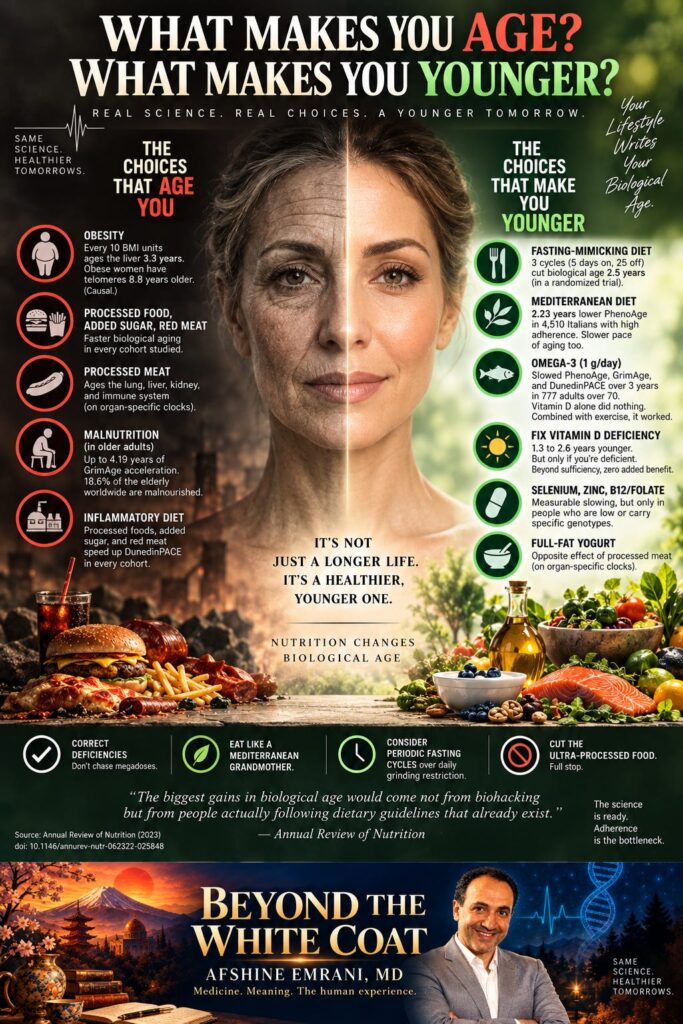
Originally published on Substack.
I’m a cardiologist. For most of my career, the only age that mattered on a chart was the one next to the date of birth.
That is no longer true.
Over the last decade, researchers have built molecular “clocks” that read the chemical marks on your DNA and estimate how old your body actually is, as opposed to how many birthdays you’ve had. Two people born the same year can be a decade apart on these clocks. And unlike your birth certificate, this number moves.
A new review in the Annual Review of Nutrition (Albright, Poganik, and Gladyshev, 2026) just gathered every major study that used these clocks to measure what food does to the aging process. I read the whole thing so you don’t have to. Here’s what holds up, what doesn’t, and what I’d actually do about it.
First, a two-minute primer on the clocks
You’ll see these names in every study below, so it helps to know what each one measures:
-
Horvath / Hannum clocks. The originals. They estimate your chronological age from DNA methylation patterns. Good at telling you how old you are, less good at telling you how fast you’re aging.
-
PhenoAge and GrimAge. Second generation. Trained on health outcomes and mortality rather than just age, so they predict how long you’ll live and how sick you’ll get.
-
DunedinPACE. Different animal entirely. It measures your rate of aging, like a speedometer rather than an odometer. A value of 1.0 means one biological year per calendar year. Below 1.0, you’re aging slower than the calendar.
Why this matters: the same intervention often moves one clock and not another. That isn’t the intervention failing. It’s the clocks measuring different things. Keep that in mind, because it explains a lot of the “mixed results” you’ll see below.
What lowered biological age
1. The fasting-mimicking diet
This was the single most impressive result in the review.
A randomized trial of 100 healthy adults, ages 18 to 70, tested a 5-day plant-based, low-calorie, low-protein diet done once a month, so five days on, roughly 25 off. After three cycles, participants’ biological age (measured with Levine’s algorithm, the precursor to PhenoAge) dropped by a median of 2.5 years.
Three cycles. Fifteen days of restriction total. Two and a half years off the clock.
The authors describe it as a practical compromise: you get the metabolic reset of a fast without the grinding, unsustainable daily restriction that fails in almost every long-term study.
2. The Mediterranean diet
The largest observational dataset came from the Moli-Sani study in Italy: 4,510 adults. Those with high adherence to a Mediterranean pattern had a PhenoAge 2.23 years younger than low adherers and a measurably slower DunedinPACE.
The pattern replicated in American women (the Sister Study), middle-aged women, and postmenopausal women in the Women’s Health Initiative.
An interventional trial called NU-AGE gave Italian and Polish adults aged 65 to 79 a one-year Mediterranean diet. Here’s the interesting part: the Polish participants got significantly younger on the clocks. The Italians did not. The likely reason is that the Italians were already eating this way. You can’t improve what’s already optimized.
Translation: the further you are from this pattern, the more you have to gain.
3. Omega-3 fatty acids
The DO-HEALTH trial in Switzerland randomized 777 adults over 70 to vitamin D, omega-3 (1 gram daily), a home exercise program, or combinations, for three years.
Omega-3 alone slowed PhenoAge by 2.9 months, GrimAge by 3.8 months, and reduced DunedinPACE by about 1%. Small numbers, but this was a placebo-controlled trial in people over 70, and the effect was consistent across three different clocks.
Vitamin D alone did nothing. Exercise alone did nothing. But the combination of all three worked best, especially in people who started with low levels.
4. Correcting vitamin D deficiency
The Berlin Aging Study tracked over a thousand adults for seven years. People who were vitamin D deficient and started supplementing came out 1.3 to 2.6 years younger on the clocks (depending on the clock) than deficient people who didn’t.
But there was a ceiling. Once you reached sufficiency, more vitamin D did nothing. This is a threshold effect, not a dose-response curve. The VITAL trial (over 1,000 participants, 2,000 IU daily for five years) confirmed a related finding: vitamin D reduced telomere shortening by 140 base pairs, roughly the equivalent of several years of attrition.
5. Selenium, zinc, and B vitamins
Same story, narrower audience.
-
Selenium: in 1,568 older adults, those with serum levels below 90 μg/L aged faster on DunedinPACE. Selenium dominated the beneficial effect of every trace element mixture studied.
-
Zinc: higher serum levels correlated with slower aging in elderly Chinese adults, and the Strong Heart Study found selenium, zinc, and molybdenum together were linked to lower age acceleration.
-
B12 and folate: two years of supplementation changed methylation at 162 CpG sites versus 14 in controls. But the reduction in Horvath age showed up only in women with a specific MTHFR genotype.
A multicomponent supplement (B3, C, D, omega-3, resveratrol, olive phenols, astaxanthin) reduced inflammatory aging only in people who started out at least 2 years biologically older than their calendar age. In people who were already aging normally, it did nothing measurable.
The lesson across all of these: supplementation corrects deficiency. It doesn’t optimize beyond normal.
What accelerated biological age
1. Obesity
This is the most consistent accelerant in the entire literature, and the evidence is causal, not just correlational (Mendelian randomization studies have established this).
-
Liver epigenetic age increases 3.3 years for every 10 BMI units above normal.
-
Obese women have leukocyte telomeres about 240 base pairs shorter than lean women, equivalent to 8.8 years of additional biological age.
-
Young, obese Chilean adults showed 15 to 16% positive age deviation across multiple clocks.
-
Children aged 8 to 14 with obesity already show accelerated clocks.
The authors note that this acceleration may be difficult to fully reverse even after successful weight loss, which is one more reason prevention matters more than rescue.
2. Inflammatory dietary patterns
Processed food, refined sugar, trans fats, red meat, low fiber, low omega-3. Researchers score this with something called the Dietary Inflammatory Index.
-
In 421 adults followed for five years, higher inflammatory scores meant faster DunedinPACE.
-
In 1,041 adults followed for 11 years, better diet quality tracked with younger GrimAge, PhenoAge, and slower DunedinPACE, both at baseline and over time.
-
48 women on a nutrient-dense, plant-rich diet for at least five years had significantly slower DunedinPACE than 49 women on a standard American diet.
3. Malnutrition
We think of this as a problem of the developing world. It isn’t. A meta-analysis of 98 studies found 18.6% of elderly people globally are malnourished. Among 2,532 US adults over 50, moderate-to-severe malnutrition was associated with up to 4.19 years of GrimAge acceleration, with a clear dose-response relationship.
In older patients, the enemy is often not too much food. It’s too little protein, too little variety, and quietly declining intake that nobody notices until the muscle is gone.
4. Specific foods, specific organs
This is the frontier. Newer proteomic clocks can estimate the age of individual organs from a single blood sample, and UK Biobank analyses show different foods hit different organs.
Processed meat aged the lung, liver, kidney, and immune system. Full-fat yogurt, of all things, was associated with younger brain, lung, kidney, intestine, artery, and immune system. Raw salads and vegetables lowered age across multiple organs. Sweetened beverages raised it.
We’re not yet at the point of prescribing food by organ. But we’re closer than most people think.
The humbling result: caloric restriction
If you’ve read anything about longevity, you know that caloric restriction is the most reproducible life-extending intervention in biology. Cut calories 20 to 40% in mice and they live 20 to 40% longer. It works in yeast, worms, flies, rats.
Then came CALERIE, the two-year human trial: 220 healthy, non-obese adults, targeting 25% restriction.
Participants averaged 11.9% restriction. Not because they were weak. Because sustained restriction in a world full of food, social meals, and stress is nearly impossible for humans. Most of the epigenetic clocks didn’t move. Only DunedinPACE showed a modest slowing.
Even primates disagree. Two rhesus monkey studies with similar designs produced contradictory results.
The honest conclusion: what works in a cage doesn’t automatically work in a kitchen. This is exactly why the fasting-mimicking diet is so interesting. It captures the biology of restriction in a form people can actually do.
What I would actually do
Here’s how I’d translate this into a Tuesday.
1. Get your vitamin D, B12, and ferritin checked. Ask about selenium and zinc if you’re over 65. Correct what’s low. Stop megadosing what’s normal. The data say the benefit ends at sufficiency.
2. Take omega-3. One gram daily is the dose that moved three clocks in people over 70. It’s cheap and low-risk.
3. Eat like a Mediterranean grandmother. Vegetables, fruit, legumes, whole grains, nuts, fish, olive oil. Less red meat. If your current diet is far from this, you have the most to gain.
4. Consider a fasting-mimicking cycle instead of daily restriction. Five days a month, a few months a year, produced more measurable change than two years of trying to cut calories every day. Talk to your doctor first, especially if you’re on glucose- or blood-pressure-lowering medication.
5. Cut ultra-processed food and sweetened drinks. Every inflammatory-diet study pointed the same direction.
6. Protect your weight, and protect your muscle. Obesity is the strongest accelerant in the data. In older adults, the mirror-image risk is under-eating protein. Both age you.
7. Eat at consistent times. The animal data increasingly suggest that circadian regularity, not just the fasting window, drives part of the benefit. A predictable eating schedule may matter more than a heroic one.
The part nobody wants to hear
The authors close with a sentence I’d frame on my office wall: the tools for slowing biological aging are already available, and the primary barrier is implementation rather than knowledge.
Adherence to existing dietary guidelines, the boring ones you’ve heard your whole life, is associated with slower clocks, less dementia, and lower mortality. Most people don’t follow them. The biohacking industry sells refinements on top of a foundation that most of us haven’t built.
So before the peptides, before the NAD infusions, before the $500 methylation test, ask one question: am I doing the things we already know work?
If the answer is no, that’s where the years are.
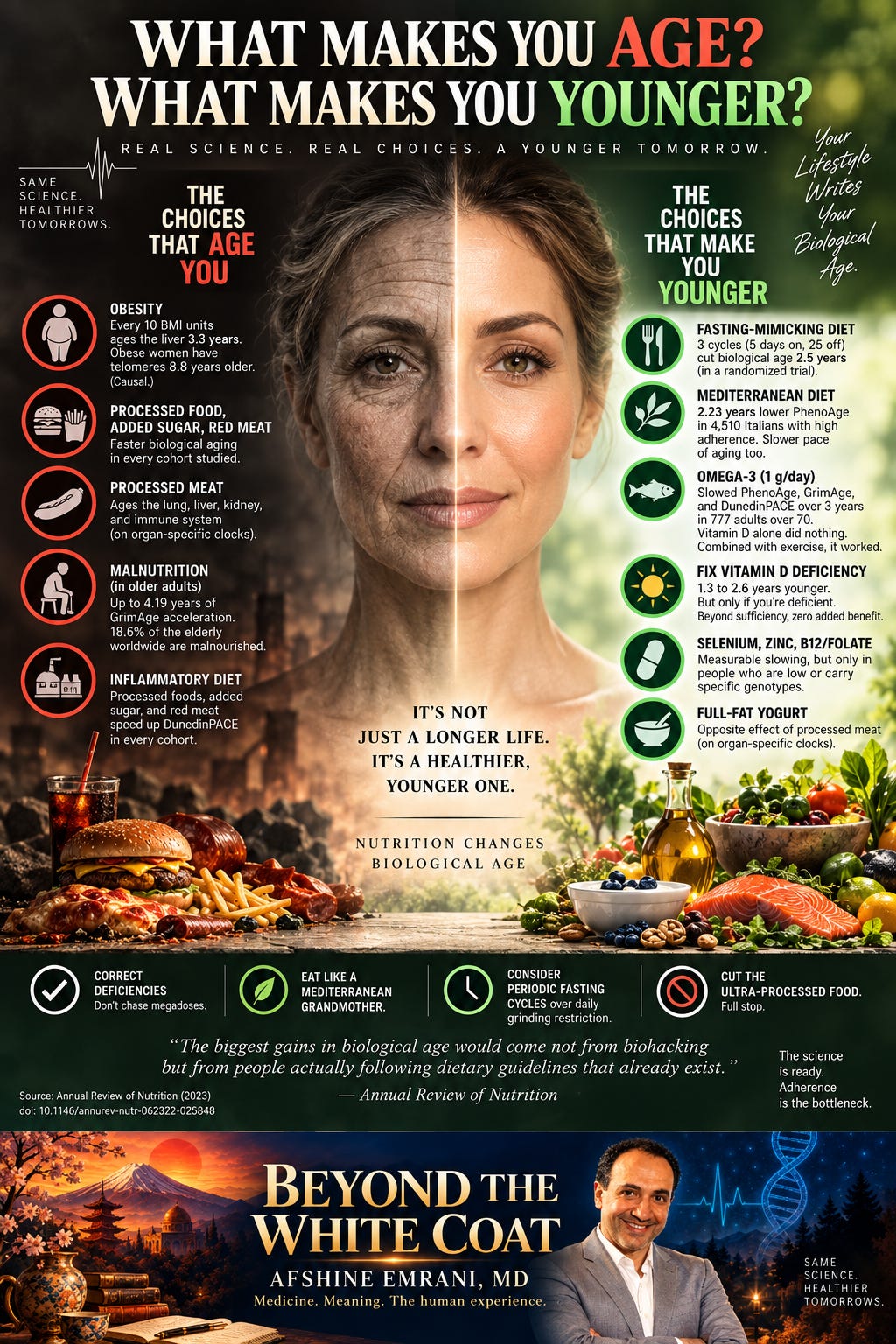
Important caveats, because you deserve them: Most of this evidence comes from observational cohorts, not randomized trials. Different clocks disagree with each other. Effect sizes in the trials are modest, often months rather than years. The causal link between clock changes and actual lifespan is still being worked out. And nothing here replaces the conversation with your own physician.
Source: Albright SM, Poganik JR, Gladyshev VN. Nutritional Strategies for Targeting Biological Age. Annual Review of Nutrition, Vol. 46 (2026). https://www.annualreviews.org/content/journals/10.1146/annurev-nutr-062322-025848
If this was useful, forward it to one person who is still eating like the clocks don’t exist.
Blessings.
Afshine Ash Emrani, M.D., F.A.C.C.
Assistant Clinical Professor, UCLA
David Geffen School of Medicine
Join Our new website
Castle-Connolly Nationwide Top Doctor (Since 2008)
Los Angeles Magazine Super Doctor (Since 2010)
LA Style Magazine Top 100 Doctors in America (2024)
Subscribe to mynewsletter: substack.com/@afshineemrani
Explore my books: Amazon Author Profile