Writings
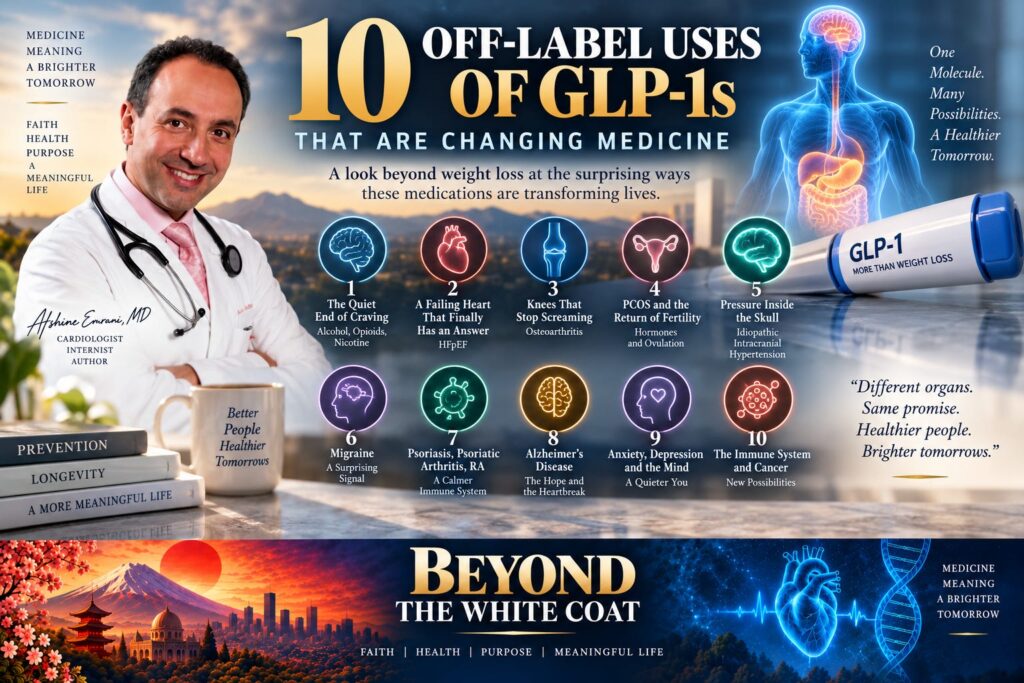
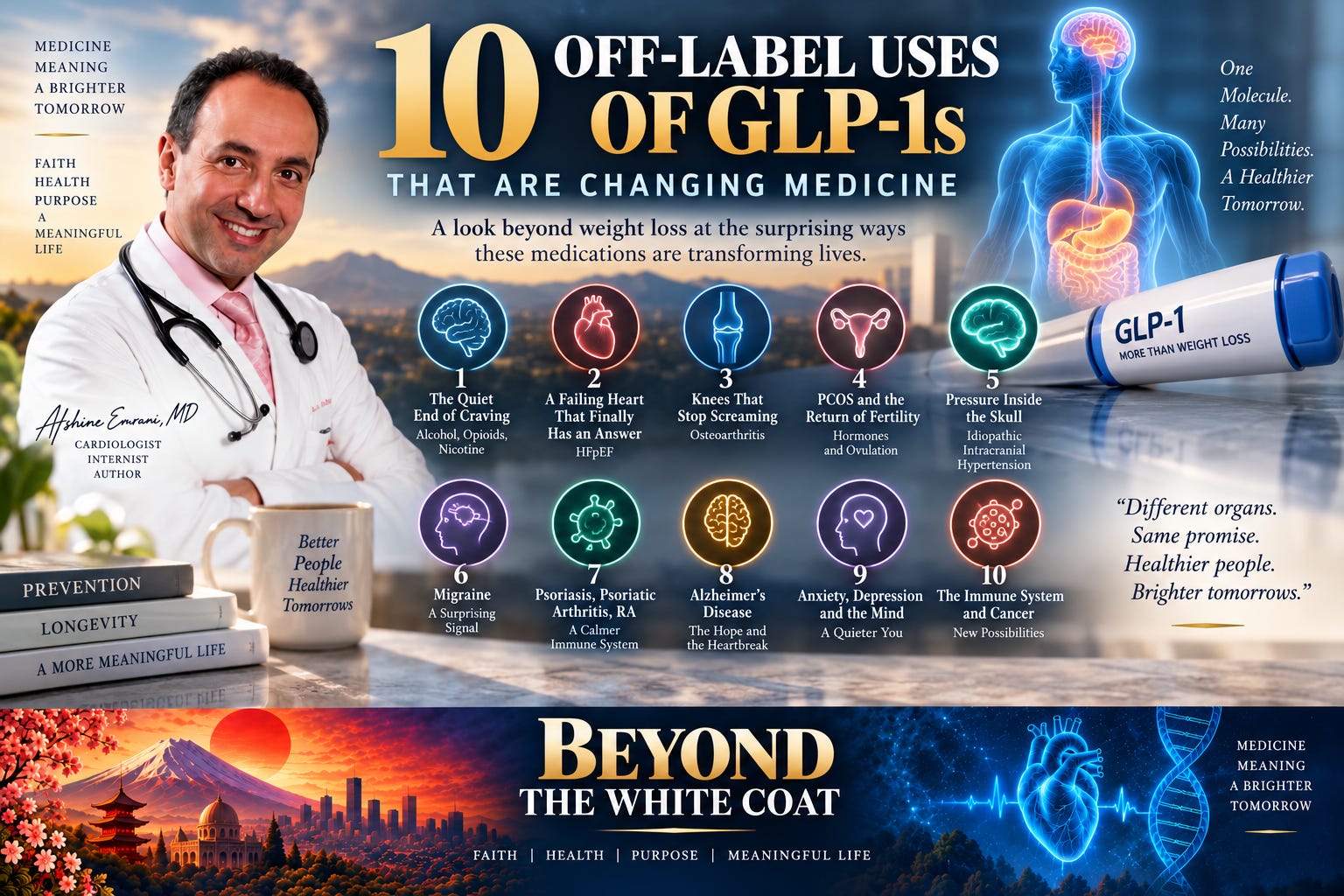
10 OFF-LABEL USES OF GLP-1s THAT ARE CHANGING MEDICINE
Originally published on Substack.
A patient sat across from me last spring and said something I have not been able to forget.
“Doctor, I came in for my weight. But I stopped wanting wine. My knees stopped screaming. My headaches are gone. And for the first time in twenty years, I’m not thinking about the next thing to fill the hole.”
She was on a GLP-1 drug. She had expected to lose weight. She had not expected the drug to reach into her joints, her brain, and her longing.
After twenty-five years in cardiology, I have learned to be suspicious of miracles. But I have also learned to pay attention when patients keep telling me the same unexpected story. And right now, across clinics and research centers around the world, patients are telling a story medicine did not plan for.
We thought we were treating blood sugar. We may have been treating something much deeper.
From Lizard Venom to a Medical Platform
The story begins with a hormone your gut releases after you eat: glucagon-like peptide-1. It tells the pancreas to release insulin, slows the stomach, and signals the brain that you have had enough.
The first drug built on it came from the saliva of the Gila monster, a desert lizard. For years these medicines were modest diabetes tools. Then came semaglutide and tirzepatide. Weight loss of 15 to 20 percent became possible without a scalpel.
That alone would have been a revolution. But scientists then found GLP-1 receptors almost everywhere they looked: the brain, the heart, the kidneys, the liver, blood vessels, and immune cells.
A drug that touches that many systems is not a single-purpose tool. It is a platform.
Some of its uses have already earned FDA approval: reducing heart attack and stroke risk in people with obesity and heart disease, protecting the kidneys in diabetes, treating obstructive sleep apnea, and treating fatty liver disease with fibrosis. Each was once considered “off-label.”
The next wave is already here. Here are ten frontiers, ranked by the strength of the evidence and how much they surprise me.
1. The Quiet End of Craving: Alcohol, Opioids, Nicotine
This is the one that keeps me up at night, in a good way.
GLP-1 receptors sit inside the brain’s reward circuitry, the same dopamine pathways hijacked by alcohol, opioids, and nicotine. When those receptors are activated, the wanting seems to soften.
In a small randomized trial of people with alcohol use disorder, low-dose semaglutide reduced craving, reduced how much people drank on drinking days, and reduced how much alcohol they consumed in a laboratory setting compared with placebo. Large Veterans Affairs data covering hundreds of thousands of patients linked GLP-1 use to lower rates of alcohol, opioid, cannabis, and stimulant use disorders.
Think about what that means. For centuries, we treated addiction as a failure of character. Now a molecule is suggesting that part of the struggle lives in receptors.
That is not an excuse. It is a doorway to compassion.
Larger trials are underway. If they confirm these signals, this could become one of the most important developments in psychiatry in a generation.
2. A Failing Heart That Finally Has an Answer
As a cardiologist, I want to tell you about heart failure with preserved ejection fraction, or HFpEF.
For years, HFpEF was a therapeutic desert. Patients were breathless, swollen, and exhausted, and we had very little to offer them. These were often women, often carrying excess weight, often told that their symptoms were “just deconditioning.”
Then the STEP-HFpEF trials arrived. In patients with obesity and HFpEF, weekly semaglutide meaningfully improved symptoms, physical limitations, walking distance, and inflammatory markers compared with placebo.
These are not cosmetic gains. These are people climbing stairs again, carrying grandchildren again, and living again.
The evidence is strongest in the obesity form of the disease, not every HFpEF patient. But for a condition that had resisted almost everything, it is a seismic shift.
3. Knees That Stop Screaming
In 2024, the New England Journal of Medicine published STEP 9. It enrolled patients with obesity and painful knee osteoarthritis.
Semaglutide reduced pain scores by roughly 42 points, compared with about 28 for placebo, and improved physical function. That benefit is larger than many nonsurgical options we routinely offer.
Weight loss explains part of it, since every pound lost takes several pounds of force off the knee. But laboratory work suggests these drugs also calm inflammation inside the joint itself.
No, they do not regrow cartilage. But a person who can walk without pain can exercise, and a person who can exercise can change their whole trajectory.
4. PCOS and the Return of Fertility
Polycystic ovary syndrome affects millions of women. It sits where insulin resistance, excess androgens, and inflammation meet. GLP-1 drugs address all three.
Studies show more regular cycles, lower testosterone, improved ovulation, and, in some studies, higher pregnancy rates after preconception treatment. In the culture, people talk about “Ozempic babies.” The biology behind that phrase is real.
But I want to be very clear: these drugs are not for use during pregnancy. Longer-acting versions should be stopped well before trying to conceive, under a physician’s guidance. Used carefully, though, they are changing fertility conversations for women who had been told to “just lose the weight.”
5. Pressure Inside the Skull
Idiopathic intracranial hypertension is a condition in which pressure builds around the brain, most often in young women. It can cause crushing headaches, vision loss, and sometimes the need for surgical shunts.
In a small randomized trial, exenatide lowered intracranial pressure within hours. That effect happened long before any weight could be lost. The choroid plexus, which produces the fluid around the brain, carries GLP-1 receptors.
The drug was not working through the scale. It was working through the plumbing.
6. Migraine: A Surprising Signal
In a small open-label pilot of people with obesity and frequent migraine, liraglutide cut monthly headache days nearly in half, from about 20 to about 11, over twelve weeks. Weight barely changed.
This is early evidence: pilots and case series, not definitive trials. But when a benefit appears without weight loss, it tells us the drug is doing something more direct, possibly by calming inflammation in the nervous system.
7. Psoriasis, Psoriatic Arthritis, Rheumatoid Arthritis
These drugs lower CRP, IL-6, and TNF-alpha, the inflammatory signals that drive many autoimmune diseases.
In psoriasis, small studies show skin improving, sometimes before significant weight loss. In rheumatoid arthritis, retrospective data link starting these drugs to fewer swollen and tender joints.
The controlled trials are still limited. But the anti-inflammatory signal keeps appearing across one immune-mediated disease after another, and in medicine, a pattern that keeps repeating usually means something.
8. Alzheimer’s Disease: The Hope and the Heartbreak
This is where I owe you honesty.
Large observational studies found that people with diabetes taking semaglutide had lower rates of new dementia diagnoses than those on other diabetes drugs. The excitement was enormous.
Then came the real test. Novo Nordisk’s large phase 3 trials of oral semaglutide in early Alzheimer’s disease did not slow cognitive decline, despite shifts in some biomarkers. Parkinson’s results have been mixed as well, including a negative large exenatide trial.
This is why we run trials. Observational signals are hypotheses, not answers. The brain story is still open, but it is not the triumph that headlines promised.
9. Anxiety, Depression, and the Mind
Large health-record analyses have found lower rates of new anxiety and depression diagnoses in people taking GLP-1 drugs. Early concerns about suicidal thoughts have not been confirmed in large datasets, and some analyses suggest the opposite.
Causation is hard to prove. People who start these drugs may differ in many ways. But inflammation, metabolism, and mood are deeply connected. When the body stops burning, the mind may also quiet.
10. The Immune System and Cancer
A small study found that semaglutide restored the function of natural killer cells, the immune system’s frontline cancer hunters, in people with obesity. The effect appeared independent of weight loss.
This is the most speculative entry on the list. Weight loss itself lowers the risk of many cancers, which makes the data difficult to untangle. But it opens a door that researchers will be walking through for years.
Why One Drug Reaches So Far
This is the most important idea in the article.
For a century, medicine has worked in silos. Cardiologists treat hearts. Psychiatrists treat minds. Rheumatologists treat joints. Each specialty has its own drugs.
GLP-1 drugs do not respect those boundaries. They reduce inflammation throughout the body, improve blood vessel function, act directly on brain circuits, and change metabolism in every organ.
Their success hints at an uncomfortable truth: many of the diseases we have treated as separate may share a common root. That root is chronic inflammation and metabolic dysfunction, the slow smolder underneath modern life.
We gave these diseases different names because we saw them in different organs. The body may have been telling us one story all along.
-
The gray market. Compounded and online “research” versions vary in purity and dose. I have seen the consequences. Know what is going into your body and who prescribed it.
-
Off-label is not a shortcut. It is legal, and sometimes it is wise. But it means the evidence is incomplete and the decision belongs in a careful conversation with a physician who knows you.
A Final Thought
There is an old teaching that the remedy is created before the wound. I have thought about that often in recent years.
A hormone from our own gut, first found in a desert lizard’s saliva, now appears to calm the heart, the joints, the brain’s hunger, and possibly the mind’s restlessness. That is not magic. It is biology we are only beginning to understand.
But a molecule cannot do everything. It can quiet a craving. It cannot tell you what you were craving for. It can lower inflammation. It cannot heal the stress, loneliness, and exhaustion that feed it.
The drug can open a door. Walking through that door, by moving, eating well, sleeping, loving, and finding meaning, is still our work.
Use the science. Respect its limits. And never confuse a powerful tool with a whole life.
Blessings.
Afshine Ash Emrani, M.D., F.A.C.C.
Assistant Clinical Professor, UCLA
David Geffen School of Medicine
Join Our new website
Castle-Connolly Nationwide Top Doctor (Since 2008)
Los Angeles Magazine Super Doctors (every year since 2013)
LA Style Magazine Top 100 Doctors in America (2024)
Subscribe to mynewsletter: substack.com/@afshineemrani
Explore my books: Amazon Author Profile