Writings
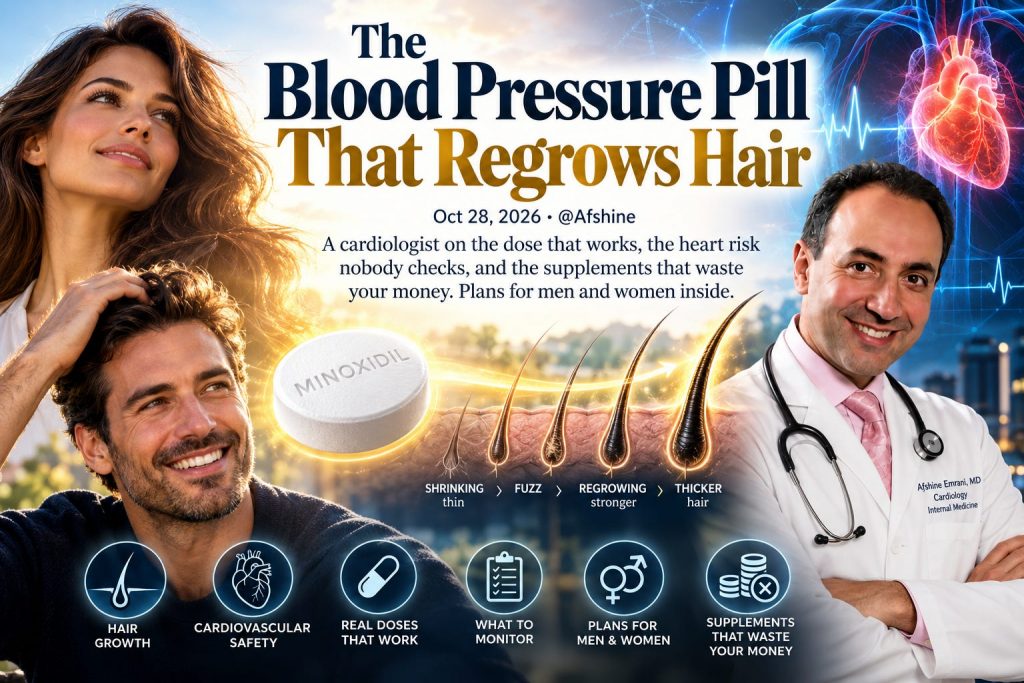
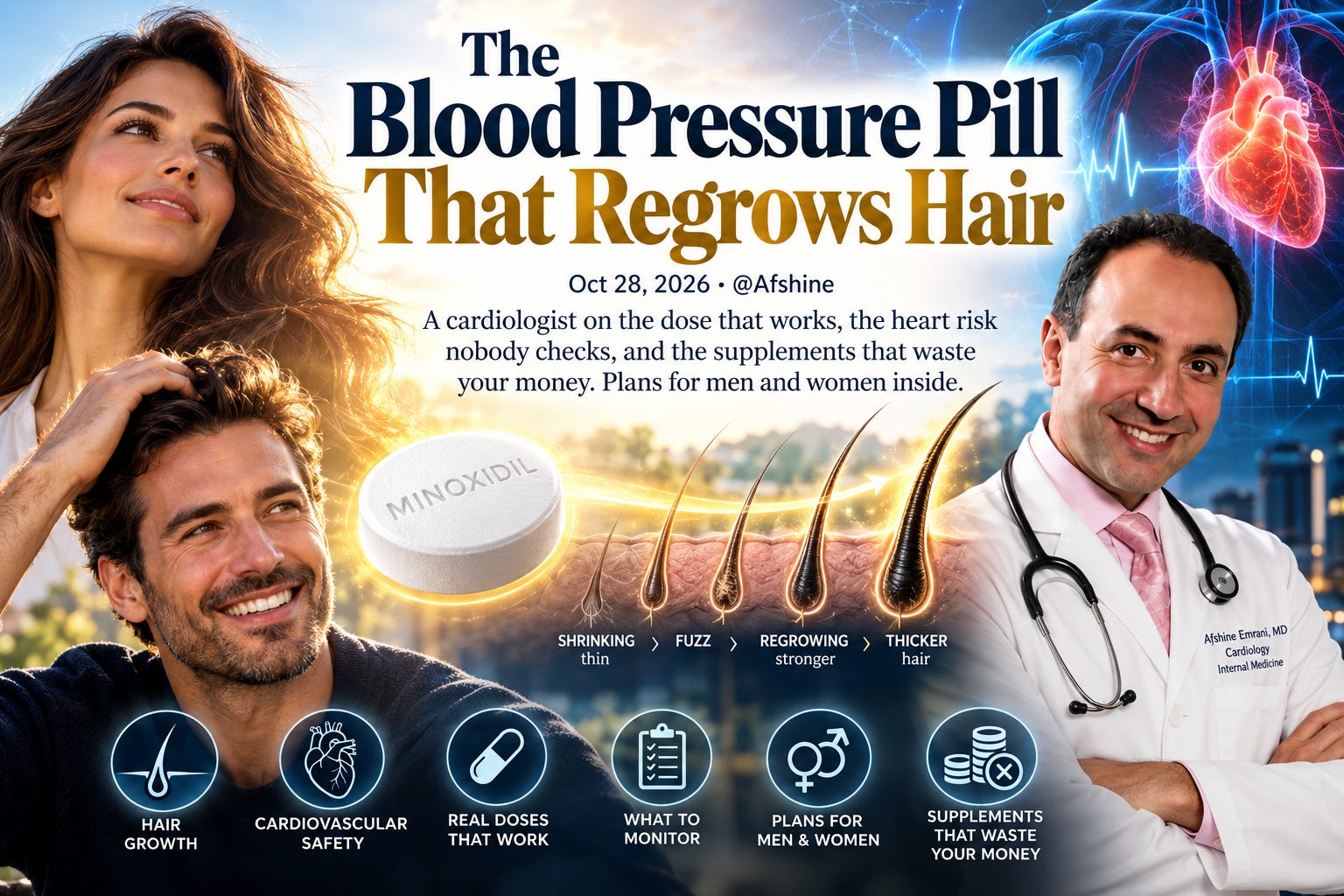
The Blood Pressure Pill That Regrows Hair
Originally published on Substack.
Your hair follicles aren’t dying. They’re shrinking.
Genes and DHT slowly turn a thick hair into a thin one, then into fuzz, then into nothing. That process takes years. Everything below works during those years. Almost nothing works after.
Why is a cardiologist writing about hair? Because the best hair drug of this decade is one of mine. Minoxidil was approved in 1979 as a pill for severe high blood pressure. At those doses it carries a black-box warning for fluid around the heart. At a fraction of one tablet, it has become the workhorse of hair medicine. I’ve prescribed it for nearly thirty years. I know where it bites.
2026 has been the biggest year in hair science in three decades. Here’s what’s real.
Step one: know which hair loss you have
Treating the wrong type is the most expensive mistake I see.
-
Pattern loss. Men: temples and crown. Women: a widening part. Read on.
-
Shedding (telogen effluvium). Sudden diffuse loss 2–4 months after illness, surgery, childbirth, crash dieting or low iron. Fix the trigger; it usually regrows.
-
Alopecia areata. Smooth, round bald patches. See a dermatologist.
-
Scarring alopecia. Shiny skin, burning, redness around follicles. Urgent dermatology; lost hair won’t return.
The Ozempic shed is real, and usually temporary. People on semaglutide and tirzepatide are diagnosed with hair loss 43–68% more often than matched patients on metformin. The pattern points to rapid weight loss, not follicle damage. Eat your protein, don’t crash, and expect it back.
Get these labs first: ferritin, TSH, CBC and vitamin D. Women with irregular periods, acne or chin hair should add testosterone and DHEA-S. Men over 40 starting finasteride or dutasteride need a baseline PSA, because these drugs cut it roughly in half.
Then take photos: same room, same light, same angle. You won’t believe your progress without them.
Oral minoxidil: the tiny dose that’s beating Rogaine
Low-dose oral minoxidil is the biggest change in hair medicine since finasteride. It’s generic, off-label and costs a few dollars a month. No sticky foam, no daily scalp ritual.
The evidence:
-
A study of 1,404 patients found no life-threatening side effects. Unwanted body and facial hair was the most common complaint.
-
In a double-blind trial in men, 2.5 mg worked about as well as 5 mg. More is not better.
-
In 2025, 43 hair specialists from 12 countries published a consensus on how to prescribe it.
-
In a head-to-head analysis, oral minoxidil outranked both standard finasteride and topical minoxidil in men.
Typical doses (your doctor decides):
-
Women: start at 0.625–1.25 mg; usual range up to 2.5 mg; most experts’ ceiling 2.5–5 mg.
-
Men: start at 1.25–2.5 mg; usual range 2.5–5 mg; most experts’ ceiling 5 mg.
Expect some shedding in weeks 2–8. That’s old hair making room. Visible change takes 4–6 months; judge it at 12.
What only a cardiologist will tell you
At blood-pressure doses, minoxidil can cause dangerous fluid around the heart. At hair doses, the news is good. One ultrasound study found small effusions in 5.8% of users and 6% of non-users: the same rate, none with symptoms.
Rare isn’t zero, though. Case reports exist, even at tiny doses. In a lupus study, effusions showed up at 5 mg in patients who already had heart failure, kidney disease or a prior effusion. My read: mostly safe, dose-dependent, and riskiest in people whose heart or kidneys already hold fluid.
See a cardiologist first if you have:
-
A prior pericardial effusion or pericarditis
-
Heart failure, cardiomyopathy or serious valve disease
-
Angina, coronary disease or a recent heart attack
-
A significant arrhythmia
-
Moderate or advanced kidney disease
-
Lupus or similar autoimmune disease
-
Low-normal blood pressure on BP medicines
-
Pheochromocytoma (an absolute no)
-
Pregnancy, breastfeeding or plans to conceive
My monitoring protocol:
-
Record your blood pressure, resting pulse and weight before you start.
-
Weigh yourself daily for two weeks, and again after each dose increase. Gaining 3 lb in a few days or 5 lb in a week means fluid.
-
Recheck blood pressure and pulse at 4–6 weeks.
-
Call your doctor the same day for breathlessness lying flat, chest pain, new swelling, a resting pulse over 100, or fainting.
Unwanted facial hair and swelling usually fade with a lower dose. Many women add low-dose spironolactone, which offsets fluid retention.
The rest of the arsenal
Minoxidil grows hair. DHT blockers stop what’s killing it. The best results combine both.
Finasteride. FDA-approved for hair since 1997; cuts DHT about 70%. Sexual side effects are real but uncommon; most men never notice anything. Pregnant women shouldn’t handle broken tablets.
Dutasteride. Cuts DHT about 90% and grows more hair than finasteride, with similar side-effect rates. The catch: it lingers in the body for months after you stop. Off-label in the US.
Topical finasteride. Not the free lunch telehealth sells. In 2025 the FDA warned these compounded products aren’t approved and have caused side effects like the pill’s. It can also rub off on partners and children.
Laser caps. Beat sham devices in double-blind trials, for men and women. About three sessions a week is enough.
PRP injections. Add hair on average, but results vary wildly between clinics. An add-on, not a foundation.
Transplants. Move hair; they don’t stop loss. You still need medication.
Alopecia areata. Three JAK-inhibitor pills are now FDA-approved: baricitinib, ritlecitinib and deuruxolitinib. They work, but hair often falls out when you stop, and their labels warn about heart events and clots. Know your heart risk first.
Coming in 2027
-
VDPHL01, an extended-release minoxidil pill: two positive Phase 3 trials in men, no cardiac safety signals, women’s results due 2027.
-
Clascoterone 5%, a topical androgen blocker: two Phase 3 trials in 1,465 men, safe at 12 months, FDA filing planned early 2027.
These are company-reported results, not yet peer-reviewed. Promising, not proven.
Supplements: what works, and what’s expensive urine
A few supplements have real trials. None beats a prescription. Many of those trials were funded by the companies selling them.
-
Pumpkin seed oil: beat placebo in men. Cheap and reasonable if you avoid finasteride.
-
Saw palmetto: a weaker finasteride, not a substitute.
-
Nutrafol, Viviscal: modest benefit. A fine add-on, never the foundation.
-
Rosemary oil: tied the weak 2% minoxidil in one small trial. Low risk, low proof; dilute it.
-
Iron, vitamin D, zinc: help only if you’re low. Test, don’t guess.
-
Biotin: useless unless deficient, which is rare. Skip it.
The biotin trap
Hair gummies pack 5,000–10,000 mcg of biotin. At those doses, biotin can make troponin, the ER blood test for heart attacks, read falsely low. It can also fake an overactive thyroid. If you take it, tell every doctor and stop at least 72 hours before blood work. Better yet, stop.
For men
The winning formula: one DHT blocker plus one minoxidil, started early, judged at 12 months.
-
Start here: finasteride 1 mg plus oral minoxidil 1.25–2.5 mg (or topical 5%).
-
Not enough at 12 months: switch to dutasteride 0.5 mg; raise minoxidil toward 5 mg; add a laser cap.
-
Want density: transplant on top of medication.
-
No DHT blocker: oral minoxidil, laser cap, pumpkin seed oil. It slows loss; it rarely reverses it.
-
On testosterone? More testosterone means more DHT, and faster hair loss.
-
Over 40? Get a PSA before starting a DHT blocker, and remind your doctor to double later readings.
-
Trying to conceive? Talk to your doctor first.
-
Heart history? Start with topical minoxidil until your cardiologist clears the pill.
Hair you save is cheaper than hair you rebuild.
For women
Women’s hair loss is more common, more dismissed and more fixable than most women are told. Up to half of women over 50 have it. It usually shows as a widening part, not a receding hairline, so it gets missed.
The core regimen:
-
Oral minoxidil, low and slow. Start at 0.625–1.25 mg; most women never need more than 2.5 mg. Topical 5% foam is the alternative.
-
Spironolactone. It blocks androgens and helps roughly 4 in 10 women alone, closer to 2 in 3 when combined. Typical hair doses are 100–200 mg a day, built up slowly. Give it 6–12 months.
-
After menopause, finasteride or dutasteride are options off-label. Never if pregnancy is possible.
A cardiologist’s note on spironolactone: I’ve used it for heart failure for decades. It raises potassium, so get potassium and kidney labs, especially if you take an ACE inhibitor or ARB. Skip salt substitutes. It also offsets minoxidil’s fluid retention. Never take it while pregnant.
Your life stage changes the answer:
-
After childbirth: usually shedding that recovers; check ferritin and thyroid.
-
PCOS: excess androgens; spironolactone, and ask about birth-control options.
-
Menopause: pattern loss as estrogen falls; minoxidil, often with spironolactone.
-
On Ozempic or Zepbound: rapid weight loss; protein at every meal, and it usually returns.
-
Planning pregnancy: stop minoxidil, spironolactone and DHT blockers before trying.
Always rule out low ferritin, thyroid disease, crash dieting and tight hairstyles first.
The bottom line
-
Diagnose before you treat.
-
Oral minoxidil at hair doses is mostly safe, effective and cheap. A few people should see a cardiologist first.
-
Minoxidil grows; a DHT blocker or spironolactone protects. Use both.
-
Supplements are seasoning, not the meal. Skip biotin.
-
Photograph, commit, wait 12 months.
After nearly thirty years in medicine, I’ve noticed patients rarely come in about the hair. They come in about the stranger in the mirror. Wanting to recognize yourself isn’t vanity. It’s taking your own life seriously.
Live longer. Live wiser.
— Dr. Afshine Emrani, MD, FACC
For education only, not personal medical advice. Most uses described here are off-label. Talk to your physician before starting or changing any medication, especially with heart, kidney or autoimmune disease, or if pregnant or planning to be.