Writings
The Future of MEDICINE is NOW!
Originally published on Substack.
A watch on your wrist can now catch a stroke before you feel it, a printed patch of living tissue can heal a wound your body gave up on, and a microscopic courier can carry chemo to a tumor and nowhere else — this is medicine that finally aims.
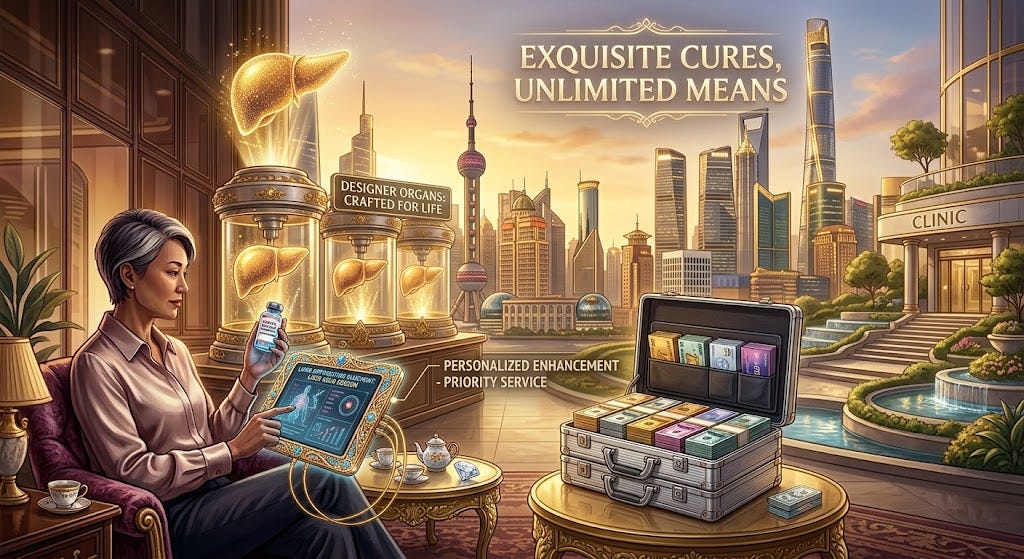
Doctors are editing the human manuscript to erase diseases at their source, growing replacement organs from a patient’s own cells, and building a living digital twin of you so a treatment can be tested before it ever touches your body.
The sentence every doctor dreads — “there’s nothing more we can do” — is quietly dying, and inside this piece are the twenty reasons why, most of them already here and coming for a hospital, a wrist, or a loved one near you.
I want to be careful here, because medicine has been oversold before. But something real is happening, and I don’t think most people have felt the size of it yet. The future of medicine is not a prophecy anymore. It is a shipment already in transit — and some of it has already been signed for.
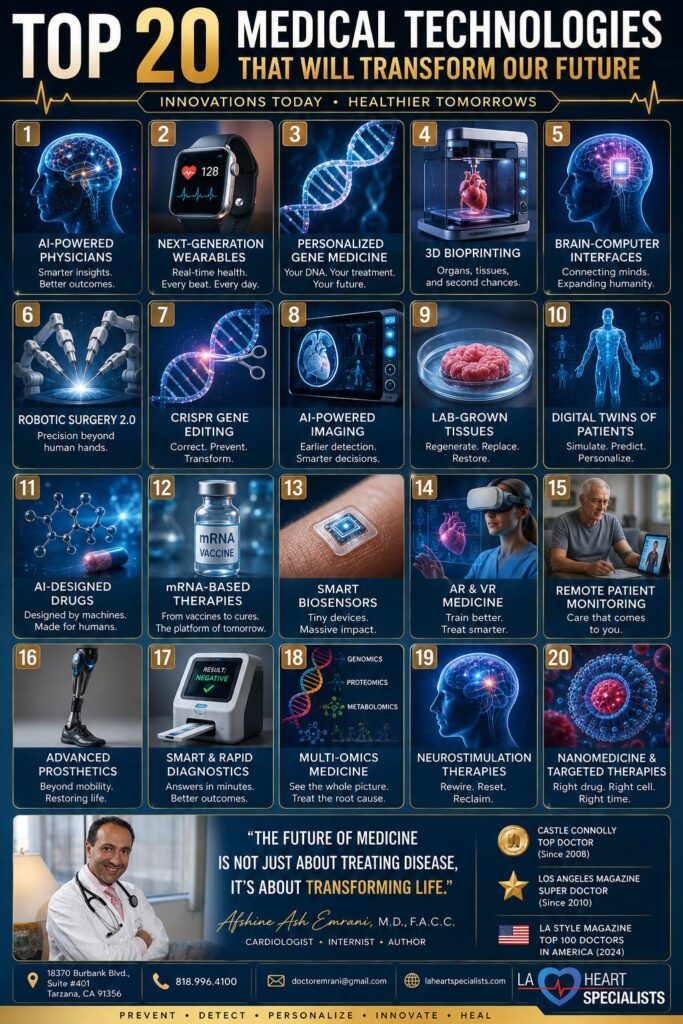
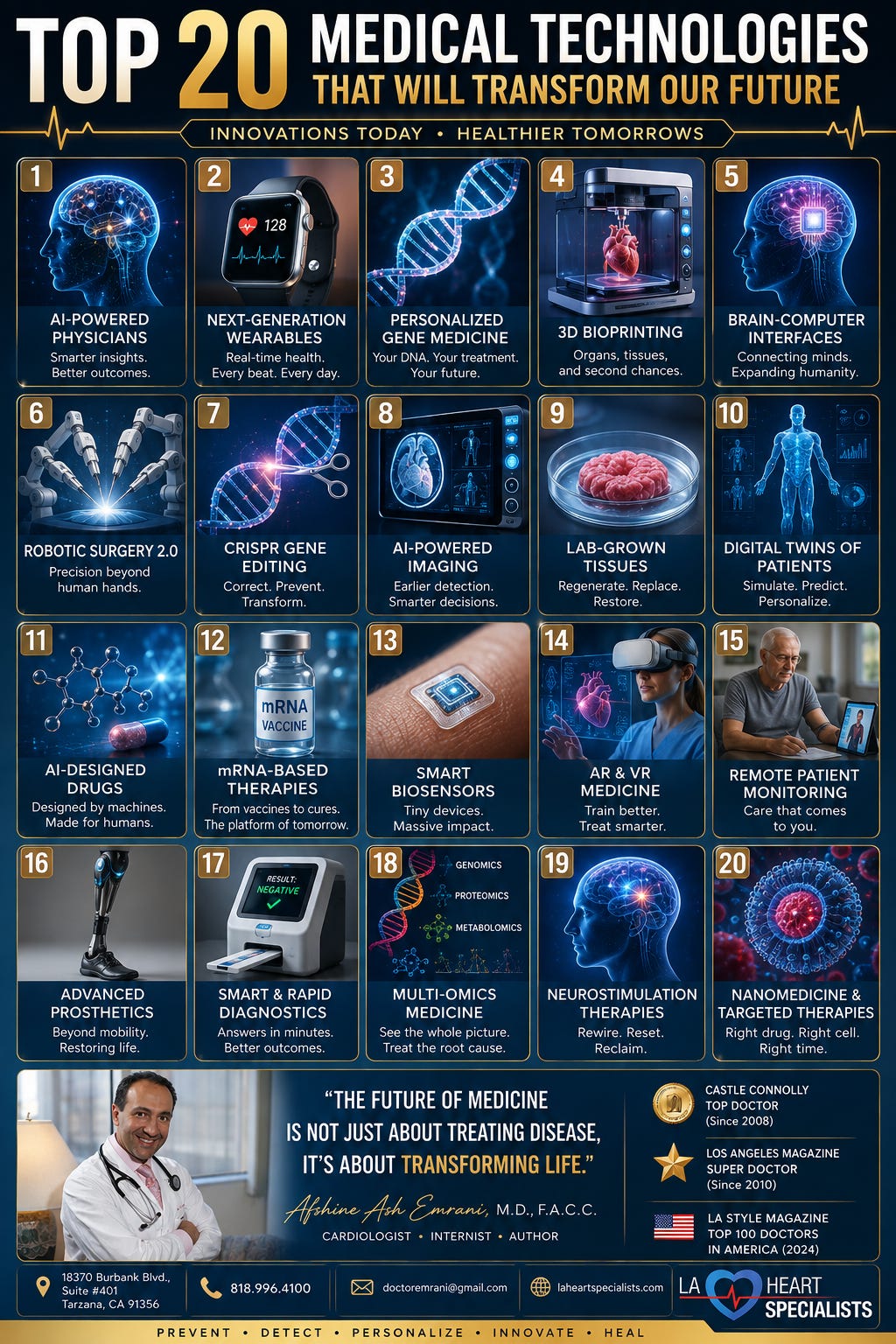
Let me show you what I mean. Twenty technologies. Not twenty daydreams. Twenty forces that are going to touch you, or someone you love, sooner than you think.
Movement One: The doctor in your pocket, the doctor in your skin
For all of human history, health care happened when you finally went in. You waited until something hurt, made an appointment, and hoped it wasn’t too late. That entire model is being turned inside out.
1 · AI Medical Assistants. Imagine a tireless clinical mind that has read every study, forgotten nothing, and is available at 3 a.m. when your fear is loudest. Not to replace your doctor — to make your doctor superhuman, catching the drug interaction, the subtle pattern, the question you were too embarrassed to ask.
2 · Advanced Wearable Health Monitors. The watch on your wrist already reads your heart rhythm and can flag atrial fibrillation before you feel a single flutter. As a cardiologist, let me tell you plainly: that stroke it quietly prevents is a stroke you will never know you avoided. The next generation will track blood pressure, oxygen, glucose, and sleep as a continuous story instead of a once-a-year snapshot.
13 · Smart Biosensors. Sensors thin as a tattoo, worn on the skin or dissolving inside the body, whispering a live feed of your chemistry. The body has always been talking. We are finally learning to listen in real time.
15 · Remote Patient Monitoring. The hospital is leaving the building. Heart-failure patients monitored from their own kitchens. Rural grandmothers seen by specialists a thousand miles away. Care that follows the patient home instead of trapping the patient in a waiting room.
17 · Smart & Rapid Diagnostics. The days of “we’ll call you with the results next week” are ending. Answers in minutes, at the bedside, in the pharmacy, eventually on your bathroom counter. In medicine, time is tissue. Time is brain. Time is life.
8 · AI-Powered Medical Imaging. Algorithms now spot tumors, bleeds, and fractures that a tired human eye can miss at the end of a long shift — and they never have a long shift. This is not the machine replacing the radiologist. It is the machine handing the radiologist a second, sleepless set of eyes.
Movement Two: Rewriting the code of life
Here is where prophecy becomes documented fact. Sit with these.
3 · Personalized Genetic Medicine. For a century we practiced medicine for the average patient — a person who does not exist. Now we can read your individual code and choose the drug, and the dose, meant for you. The same pill that heals one person harms another. Finally, we can tell the difference before we prescribe.
7 · CRISPR Gene Editing. In December 2023, the FDA approved the world’s first CRISPR therapy for sickle cell disease and beta thalassemia — a genetic disease, corrected at its source. In the pivotal trial, nearly every patient walked away free of the crushing pain crises that had defined their entire lives.
Then it got holy. In 2025, an infant known only as KJ was born at Children’s Hospital of Philadelphia with a rare metabolic disorder his body could not survive. Instead of spending a decade developing a treatment, a team designed a gene therapy for his single, specific mutation — a medicine that had never existed and will never be needed by anyone else on earth. A cure built for one child. As of 2026, more than 250 gene-editing trials are underway. We have learned to edit the manuscript of a human being.
We used to inherit our fate in our DNA. For the first time in the history of our species, we can respectfully argue with it.
18 · Multi-Omics Medicine. Your genes are only the first page. Now we can read the whole library at once — genome, proteins, metabolites, the microbes in your gut — and see you as the vast, interconnected system you actually are, instead of a single lab value on a single afternoon.
12 · mRNA-Based Therapies. The technology the world met during the pandemic was only the opening act. In August 2026, a personalized mRNA cancer vaccine — a shot custom-printed against the unique fingerprint of a patient’s own tumor — succeeded in a large Phase 3 melanoma trial. Earlier data had shown it cut the risk of the cancer returning or killing by nearly half when added to immunotherapy. Lung, kidney, bladder, pancreatic trials are following. We are teaching the immune system to hunt cancer by name.
11 · AI-Designed Medicines. Discovering a drug once took a decade, a billion dollars, and a great deal of luck. Artificial intelligence now designs candidate molecules in a fraction of that time, imagining compounds no chemist would have thought to draw. Diseases we have called “undruggable” for generations are getting a second look.
20 · Nanomedicine & Targeted Drug Delivery. Picture microscopic couriers that carry a toxic dose of chemotherapy only to the tumor and nowhere else — sparing the hair, the appetite, the strength, the dignity. Medicine’s oldest problem has been hitting the disease without wounding the patient. We are finally learning to aim.
Movement Three: Rebuilding the body
4 · 3D-Printed Organs and Tissues. Right now, someone dies waiting for a transplant that never comes. Now imagine printing the tissue — and eventually the organ — from the patient’s own cells. No waiting list. No rejection. No stranger’s tragedy required for your survival.
9 · Lab-Grown Replacement Tissues. Skin for the burned. Cartilage for the worn. Beating heart tissue, grown in a dish, being trained to repair a heart that has already broken. The body has always known how to heal. We are learning to give it more raw material to work with.
6 · Robotic Surgery. Surgeons already operate through incisions the width of a pencil, with instruments steadier than any human hand, translating a master’s decades of skill into movements finer than a heartbeat’s tremor. Less pain, less scarring, faster mornings-after. And a surgeon’s gift, no longer limited by the shake of an aging wrist.
16 · Advanced Prosthetic Limbs. Limbs wired into the nervous system that move by thought and send sensation back — the return of touch, of grip, of a hand a person can actually feel. I have learned that we do not only lose function when we lose a limb. We lose a piece of how we meet the world. This gives it back.
Movement Four: The mind, reconnected
5 · Brain–Computer Interfaces. In January 2024, a young man named Noland Arbaugh, paralyzed from the shoulders down, received a brain implant — and within weeks was moving a cursor, playing chess, and navigating his computer using nothing but his thoughts. By early 2026, more than twenty people were living with these devices, and researchers had begun work on an implant to restore sight to the blind. Let that land. A thought, lost to a broken spinal cord, finding its way back out into the world.
19 · Neurostimulation Therapies. Gentle, precise electrical signals are quieting the tremor of Parkinson’s, lifting depression that no medication could touch, and calming seizures before they start. We are learning the electrical language of the brain and beginning, carefully, to speak back.
14 · Augmented & Virtual Reality Medicine. Surgeons rehearsing an operation before making a single cut. Chronic pain eased without a single pill. Burn victims escaping their agony inside a snowscape while their dressings are changed. Stroke patients relearning to walk inside a game their damaged brain is willing to play. The mind is medicine — and we are finally prescribing it.
Movement Five: Medicine that finally knows you
10 · Digital Twins of Patients. This is the one that quiets me. Imagine a living virtual copy of you — your heart, your chemistry, your genes — where a doctor can test a drug, a stent, a surgery on the digital you before ever touching the real one. Medicine practiced on your twin, so that nothing has to be practiced on you. Trial and error, without the error.
What the machines cannot do
Let me step out of my white coat for a moment.
Every technology on this list is astonishing, and I believe most of them are good. But I have stood at enough bedsides to know a quiet truth: none of them, not one, is the actual miracle.
The gene edit buys a childhood. The wearable buys a grandmother her grandson’s wedding. The implant buys back a stolen thought. The nanoparticle buys another autumn, another argument, another ordinary Tuesday that a family will one day remember as sacred.
The machine restores the function. But it is the morning, the conversation, the reconciliation, the “I love you” said one more time, that restores the person. Technology can extend the vessel. It cannot fill it. That part has always been, and will always be, our work — and God’s.
So yes, be excited. Be genuinely, unapologetically excited. We are living through the most hopeful chapter in the history of healing. The sentence I dreaded for twenty-five years — there’s nothing more we can do — is finally, mercifully, starting to lose its grip.
But do not fall in love with the tools. Fall in love with the days they were built to give you.
Then go, today, and use one of yours well.
Blessings.
Afshine Ash Emrani, M.D., F.A.C.C.
Assistant Clinical Professor, UCLA
David Geffen School of Medicine
Join Our new website
Castle-Connolly Nationwide Top Doctor (Since 2008)
Los Angeles Magazine Super Doctor (Since 2010)
LA Style Magazine Top 100 Doctors in America (2024)
Subscribe to mynewsletter: substack.com/@afshineemrani
Explore my books: Amazon Author Profile