Writings
You Were Loved the Whole Time
Originally published on Substack.
Every year, on the holiest night of the Jewish calendar, I think about the night I failed to frighten my own children. They were small, it was bedtime for the fourth time, and I decided kindness had failed and it was time for them to meet The Father.
I stood in the hallway, crossed my arms, lowered my voice, and arranged my face into something I hoped resembled Mount Sinai. One of them looked up and made a ridiculous face at me. I lasted three seconds. Then I laughed so hard I had to lean against the wall. The performance collapsed, the mask fell, and my children saw what had been underneath it all along: a father hopelessly in love with them.
I used to think Yom Kippur was Judaism’s courtroom. The doors close, the Judge takes His seat, the books are opened, and we stand there with nowhere to hide. All of that is true, and the accountability is real. But it lives inside something infinitely larger. The Baal Shem Tov told of a king who surrounded his palace with walls, gates and moats. Most visitors turned back. Only the king’s child, who wanted nothing but his father, walked straight at the wall and discovered it had never been there. And he taught something more startling still: when the Torah says God will hide His face, it doubles the verb, a hiding within a hiding. The real exile is not that God is concealed. It is that we forget anything is concealed at all. For an entire year we meet rules, consequences, illness, loss, unanswered prayers, and we ask, “Where is God in this?” Then Yom Kippur arrives, and for one day the mask comes off. Beneath judgment, mercy. Beneath distance, longing. Beneath everything we could not understand, a love that never once left the room.
That is why the Mishnah dares to call this day of fasting and confession one of the two most joyful of the year: there is no joy like discovering you are allowed to begin again.
Human beings are very good at keeping records. We replay our failures at two in the morning as if suffering long enough might rewrite history. Some people spend thirty years serving a sentence for something they did in thirty seconds. Rabbi Jonathan Sacks drew a distinction I cannot stop thinking about. In a shame culture, you are what you did; the stain is on the person, and the only remedies are hiding or exile. Judaism insisted the act can be separated from the one who committed it. Not “I am wrong,” but “what I did was wrong.” You are not the worst thing you have ever done. In that gap between the sinner and the sin, forgiveness becomes possible. Rabbi Sacks also noticed that forgiveness is not natural; it had to be discovered. He found its first appearance in all of literature in Joseph, weeping, telling the brothers who sold him not to be afraid. And it came only after Judah, who once sold a brother into slavery, offered his own freedom to save one. The man had changed, and so the past could finally be released. That, Rabbi Sacks taught, is the architecture of this day: repentance and forgiveness are the two halves of human freedom, one releasing us from our own past, the other releasing someone else from theirs. The past cannot be erased, but its meaning can be transformed. And he added the idea I find most moving of all, that faith runs in both directions.
Long before we believe in God, God believes in us, and He has never once revised that opinion. Rebbe Nachman heard the same thing at the burning bush. When Moses asked God’s name, the answer was Ehyeh, I will be, and Rebbe Nachman taught that this is the name of teshuvah itself. To return is not to say “I am terrible.” It is to say, “I am ready to be.” And for everyone who has ever lain awake counting the damage, he left one sentence: if you believe you can break, believe you can repair. No one has ever fallen farther than love can reach. Perhaps that is why, on this day, the Kohen Gadol walked inward, into the Holy of Holies. At the very moment we face our imperfection most honestly, the movement is toward closeness, not away from it.
In three decades of caring for patients, the heart itself has taught me something about this day. It does not feed itself while it is working. During the squeeze, the muscle clamps down so hard that its own arteries are pressed nearly shut. Only in the release, the pause between beats, does blood rush in and nourish it. A heart that never lets go starves, no matter how hard it works.
Yom Kippur is the diastole of the Jewish year. Twenty-five hours in which we stop squeezing: no eating, no earning, no proving, no performing. We let go, and only then are we fed.
I cannot explain why good people suffer. I cannot explain every diagnosis, every child who cries, every prayer that seems unanswered, and faith does not require pretending those questions are easy. But mystery is not abandonment, and what I cannot understand does not mean I am unloved. And then Neilah arrives, the locking of the gates. For years I heard that as a threat: hurry, before you are shut out.
The Chassidic masters heard it differently. The gates are locking, they said, and we are inside!
No accuser, no audience, no record-keeper, the door closed gently behind us like a parent who has finally gotten a moment alone with a child. The sun falls, we cry Hashem Hu HaElohim seven times, and we finally see that the God of justice and the God of compassion were never two different Gods. All year we imagine Him asking, “Why weren’t you better?” In that last light, if we grow quiet enough, we hear something else entirely:
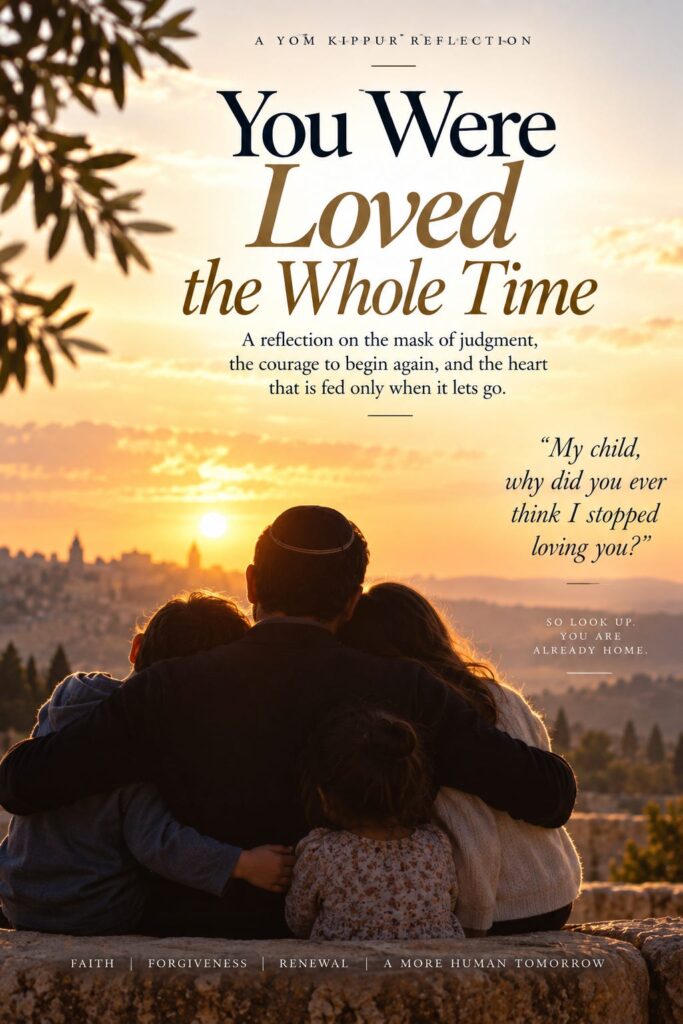
“My child, why did you ever think I stopped loving you?”
Somewhere tonight a Father is standing in a hallway with His arms crossed, trying very hard to look stern. He is not going to last three seconds.
So look up. You are already home.
Blessings.
Afshine Ash Emrani, M.D., F.A.C.C.
Assistant Clinical Professor, UCLA
David Geffen School of Medicine
Join Our new website
Castle-Connolly Nationwide Top Doctor (Since 2008)
Los Angeles Magazine Super Doctors (every year since 2013)
LA Style Magazine Top 100 Doctors in America (2024)
Subscribe to mynewsletter: substack.com/@afshineemrani
Explore my books: Amazon Author Profile