Writings
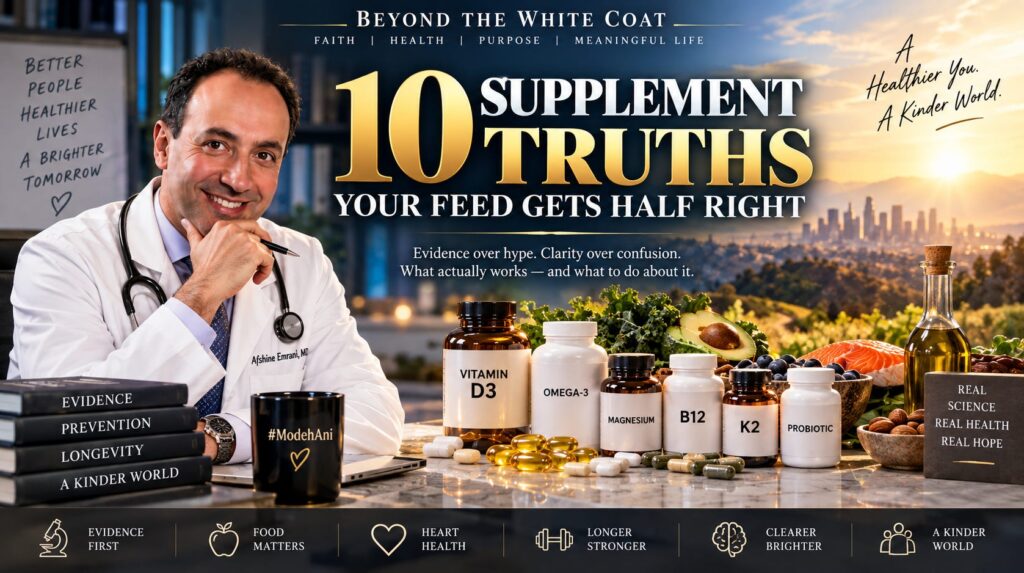
Half of What You Know About Supplements Is Wrong: Stop Taking Advice From People With Discount Codes!
Originally published on Substack.
Dear Friends,
Americans spend over 50 billion dollars a year on supplements, and most of that money is spent on guesses. These are the ten questions I hear most in my office. Here is what the science actually says, and exactly what to do about each.
1. The form of your B12 barely matters. Whether you absorb it does.
Methylated or not, B12 needs stomach acid and a protein called intrinsic factor to get in. That is why people over 60, vegans, and anyone on metformin or an acid blocker run low. Here is the dangerous part: your liver stores three to five years of B12, so deficiency creeps in silently, then shows up as fatigue, numb feet, or memory loss that looks like dementia, sometimes with a perfectly normal blood count. As for folate, methylfolate is fine, but ordinary folic acid works for most people and is the only form proven to prevent birth defects.
Do this: ask for a B12 level. If it is borderline, add a methylmalonic acid test. If you are low, 1,000 mcg by mouth daily works as well as injections for most people. Skip the MTHFR gene panel. It rarely changes anything.
2. Vitamin D is a hormone. Test first, then dose.
Plain D3, 1,000 to 2,000 IU with your largest meal, brings most people into range. Calcifediol truly is absorbed better and works faster, and it is a smart option when your level will not move because of gut, liver, or weight issues, since body fat traps vitamin D. But more is not better. In a trial of more than 25,000 adults, vitamin D did not prevent heart attacks, and megadoses push calcium to dangerous levels.
Do this: check a 25-OH vitamin D level, aim for 30 to 50, recheck in 3 months. Do not exceed 4,000 IU a day without monitoring.
3. The one vitamin D cofactor that matters: magnesium.
Your body cannot activate vitamin D without it, and roughly half of Americans do not eat enough. A normal blood test can fool you, because less than 1 percent of your magnesium is in your blood. Diuretics and acid blockers drain it further. Boron has almost no human evidence. And do not supplement vitamin A: excess weakens bone, harms the liver, and causes birth defects.
Do this: magnesium glycinate or citrate, 200 to 400 mg at bedtime, unless you have kidney disease. Avoid magnesium oxide, which mostly works as a laxative. One ounce of pumpkin seeds gives you about 150 mg. Bonus: better sleep, fewer leg cramps, fewer palpitations.
4. Vitamin K2: promising, not proven.
The theory is elegant. K2 switches on a protein that keeps calcium out of your arteries and sends it to bone, and the MK-7 form stays in the blood for days. In a large Dutch study, people who ate the most K2 had about half the rate of fatal heart disease. But that was diet, not pills, and when K2 supplements were tested in randomized trials, calcification did not slow. It is reasonable at 90 to 180 mcg daily if you take calcium and vitamin D. Natto, aged cheese, and egg yolks supply it naturally.
Do this: if you take warfarin, never start or stop K2 without calling us. It can cancel your blood thinner. Eliquis and Xarelto are not affected.
5. Pantethine lowers cholesterol a little. It is not a statin.
At 600 to 900 mg a day, small studies show LDL falling about 10 percent. No study shows it prevents a single heart attack. And here is something the internet will not tell you: in a trial where patients who had quit statins for side effects took statin, placebo, or nothing in random months, 90 percent of their symptoms showed up on the placebo too. The symptoms were real. The cause usually was not the statin.
Do this: if a statin truly does not agree with you, we have proven options: ezetimibe, bempedoic acid, and PCSK9 injections. Add psyllium fiber, 10 grams a day, for another 5 to 10 percent off your LDL.
6. For headaches, magnesium beats zinc.
Zinc has thin evidence, and long-term use drains copper, causing anemia and nerve damage. Doctors first learned this from patients who overused zinc-containing denture cream and lost feeling in their legs. Magnesium (400 to 600 mg) and riboflavin (400 mg) have real trial support for preventing migraine.
Do this: if you use zinc, stay under 25 mg and stop after a few weeks. And if you have migraine with aura, tell me before using estrogen. Aura alone roughly doubles stroke risk, and estrogen plus smoking multiplies it.
7. Salt water: medicine for a few, poison for most.
If you have POTS or faint when you stand, extra salt, 2 to 3 liters of fluid, and compression stockings are real therapy. A remarkable trick for that group: drinking 16 ounces of plain water quickly can raise blood pressure 20 points or more within minutes. But for anyone with high blood pressure, heart failure, or kidney disease, added salt is dangerous. Pickling salt, sea salt, pink Himalayan salt: same sodium, no difference. About 70 percent of the sodium you eat never touches your salt shaker. It comes from bread, soups, sauces, deli meat, and restaurants, where one entree can exceed a full day’s limit.
Do this: know which group you are in. If you are unsure, ask me.
8. Coconut oil does not burn fat. It raises LDL.
Coconut oil is about 82 percent saturated fat, more than butter and more than double lard. It is not MCT oil. Half of it is lauric acid, which your body handles like any other saturated fat, and in pooled trials it raised LDL by about 10 points compared with other plant oils.
Do this: cook with extra-virgin olive oil. For blood sugar, walk after meals. Even 2 to 5 minutes of light walking measurably blunts the glucose spike, and 10 to 15 is better. Eat your vegetables and protein before your starch. Both are free.
9. Pycnogenol lowers blood pressure about 3 points. Your habits can lower it 20.
The DASH diet drops systolic pressure about 11 points in people with hypertension. Every 2 pounds lost is worth roughly 1 point. And the surprise winner in a recent analysis of 270 trials was not running. It was isometric exercise: wall sits, four rounds of 2 minutes, three times a week, lowered pressure about 8 points. Stack these and you rival a medication.
Do this: never trade a prescribed pill for a supplement. If you add one, tell us, because the effects stack and pressure can drop too far.
10. For UTIs, skip the silver.
Colloidal silver does not cure infections, and it can turn your skin blue-gray permanently. The condition is called argyria and no treatment reverses it. What actually prevents recurrent UTIs: drinking an extra 1.5 liters of water a day, which cut infections nearly in half in a randomized trial. After menopause, vaginal estrogen reduces recurrences by more than half. Cranberry extract helps modestly, and methenamine is a non-antibiotic prescription that performs nearly as well as daily antibiotics.
Do this: burning with fever, chills, or back pain is a same-day call, not a home remedy. A bladder infection can reach the kidneys and bloodstream within days.
How to spot bad health advice in five seconds: it explains a mechanism instead of showing an outcome, it is certain about everything, and it ends with a discount code.
The rule behind all ten: test, do not guess. Food first. And before you buy anything, send us a photo of the bottle. That one message can save you money, and sometimes far more than money.
The body is wiser than any trend. Our job is to listen to it, measure it, and give it what it truly needs.
Forward this to the person in your life with a cabinet full of supplements.
Blessings.
Afshine Ash Emrani, M.D., F.A.C.C.
Assistant Clinical Professor, UCLA
David Geffen School of Medicine
Join Our new website
Castle-Connolly Nationwide Top Doctor (Since 2008)
Los Angeles Magazine Super Doctors (every year since 2013)
LA Style Magazine Top 100 Doctors in America (2024)
Subscribe to mynewsletter: substack.com/@afshineemrani
Explore my books: Amazon Author Profile