Writings
Your Penis Is Trying to Warn You About a Heart Attack: Erectile Dysfunction
Originally published on Substack.
I am a heart doctor. For more than twenty-five years, men have walked into my office in Tarzana to talk about chest pain, cholesterol, blood pressure.
Then, at the very end, hand already on the doorknob, comes the real question.
“Doc… one more thing. Things aren’t working like they used to.”
Here is what I tell every one of them, and what I want every man reading this to hear:
Your erection is the check engine light of your heart.
Not a metaphor. Physiology.
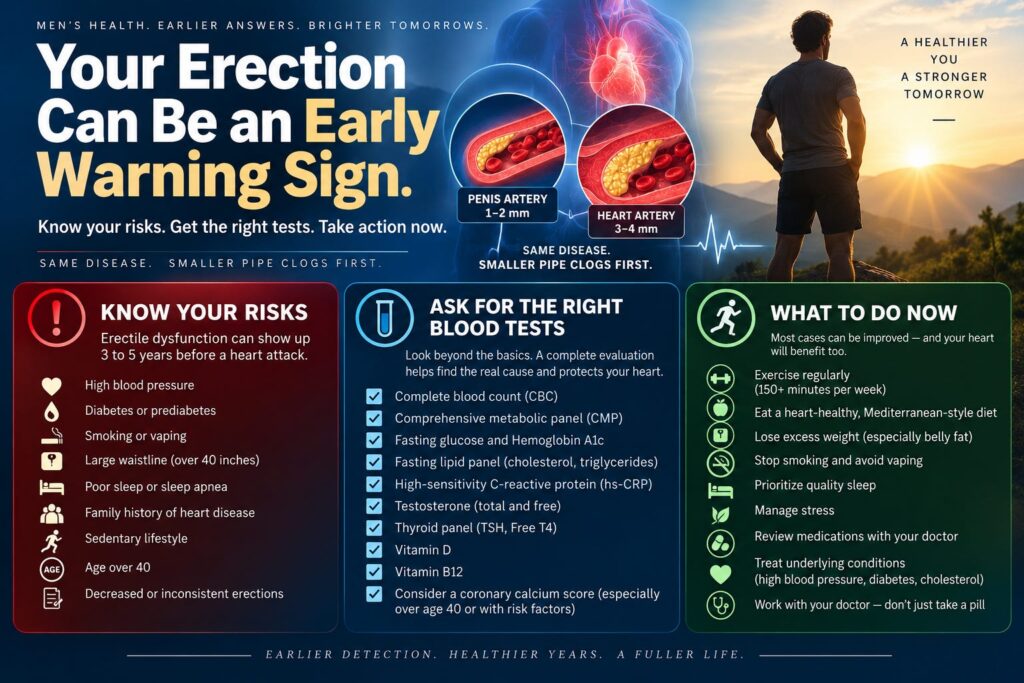
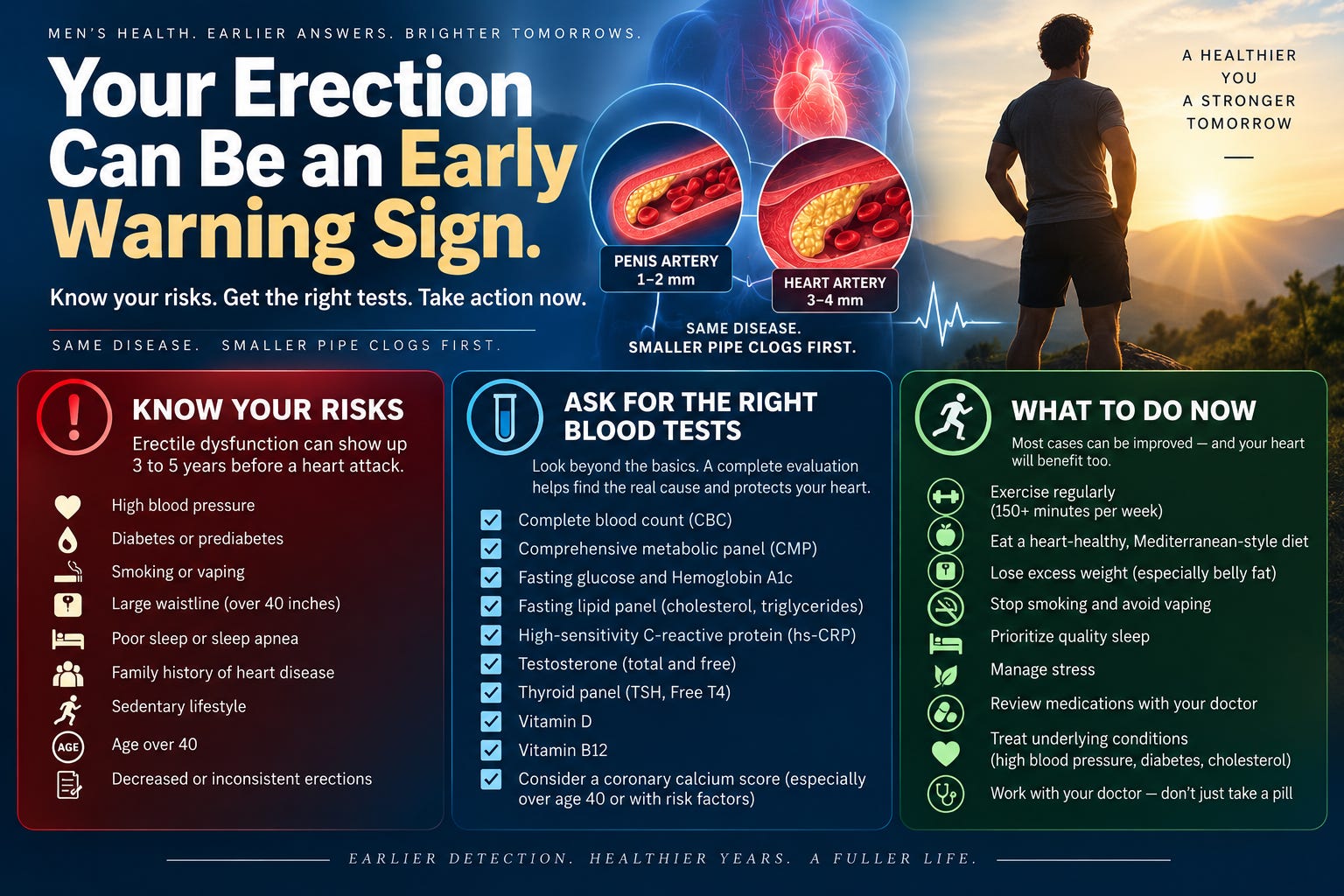
The arteries that supply the penis are about 1–2 millimeters wide. The coronary arteries feeding your heart are about 3–4 millimeters. The same disease — plaque, inflammation, stiff and damaged vessel lining — attacks both at the same time. But the smaller pipe clogs first.
That is why erectile dysfunction often shows up three to five years before a heart attack.
So when a man tells me his erections are weaker, I don’t hand him a pill and send him home. I open his chart and start looking for the heart attack he hasn’t had yet.
This handbook is everything I would tell you if you sat across my desk. No shame. No snake oil. Just what works.
Save it. Forward it to a man you love. It may be the most important thing he reads this year.
The 60-Second Version (Screenshot This)
-
ED is often a heart symptom. It can show up 3 to 5 years before a heart attack.
-
Low desire is not the same as weak erections. Low desire points to hormones. Weak erections point to blood vessels.
-
Ask for 10 blood tests, not 2. The list is in Part 3.
-
If you’re over 40 with ED, ask about a coronary calcium score.
-
Most supplements are marketing. A few fix real deficiencies. Test first.
-
Exercise, weight loss, no smoking, and real sleep beat every pill.
-
Never mix an ED pill with nitroglycerin. Ever.
The 60-Second Self-Check
Tick every line that is true for you. Be honest. Nobody is watching.
-
My erections are less firm than they were two years ago
-
I wake up with an erection less than once a week
-
I sometimes lose my erection before I’m finished
-
My blood pressure is above 130/80, or I take blood pressure medicine
-
I have diabetes or prediabetes
-
I smoke, vape, or smoked for years
-
My waist is over 40 inches
-
I snore, or I wake up tired no matter how long I sleep
-
My father or brother had heart disease before 55, or my mother or sister before 65
-
I exercise less than 150 minutes a week
0–2 ticks: You’re in good shape. Use this handbook to stay there.
3–5 ticks: Book a doctor’s visit this month. Bring the list in Part 3.
6 or more — or any erection change plus two heart risks: Don’t wait. Ask your doctor for a heart evaluation, not just a prescription.
This is a wake-up call, not a diagnosis. Your doctor can give you a validated questionnaire called the IIEF-5 (SHIM). Write down your ticks today. You’ll retake this on Day 30.
Part 1 — First, the Truth About ED
It is common. Roughly half of men between 40 and 70 have some degree of erectile dysfunction. You are not broken. You are not alone. You are normal — and you are being given information.
It is rarely “just in your head.” In men over 40, most ED is primarily physical: blood vessels, nerves, hormones, medications. The mind almost always joins the party later — one bad night creates the fear that creates the next bad night.
It is a symptom, not a diagnosis. “ED” tells you what is happening. It never tells you why. The why is where your life is.
A pill treats the erection. A doctor treats the man.
The five engines of an erection
An erection needs five systems to show up at the same time:
-
Blood vessels — healthy lining (the endothelium) that can open wide on command
-
Nitric oxide — the chemical signal that tells those vessels to relax and fill
-
Nerves — the wiring from brain to pelvis
-
Hormones — testosterone sets the desire and the machinery
-
Mind — safety, desire, presence
When something fails, one of these five is almost always the culprit. Usually more than one. The rest of this handbook walks through each.
Six myths that keep men suffering in silence
Myth: “It’s just age.” Age raises the risk. It doesn’t make it normal. Plenty of men in their seventies function well. When erections fade, something is causing it.
Myth: “I’m too young for this.” In one study, about one in four men seeking help for new ED was under 40. Young men with ED deserve the same workup, not a shrug.
Myth: “If it works sometimes, I’m fine.” Inconsistent erections are often the earliest stage of vessel disease. This is the best time to act, not a reason to wait.
Myth: “Testosterone will fix it.” Testosterone mainly drives desire. If your desire is fine but your erections aren’t, the problem is usually your blood vessels. Testosterone won’t unclog an artery.
Myth: “ED pills are dangerous for the heart.” For most men with stable heart disease, they are safe. The danger is mixing them with nitrates (Part 6).
Myth: “Natural supplements are safer than pills.” Many “natural” enhancement products have been caught hiding real prescription drugs — in unknown doses.
Part 2 — Is It Your Testosterone? 12 Signs Men Miss
Testosterone doesn’t just drive sex. It drives energy, muscle, mood, motivation, bone, and blood. Low testosterone rarely announces itself. It whispers.
Listen for these:
-
Your desire has quietly disappeared. Not your performance — your wanting.
-
Morning erections have become rare. These are your body’s nightly self-test. When they fade, pay attention.
-
You’re tired in a way sleep doesn’t fix.
-
Your belly is growing while your muscles are shrinking — even though your habits haven’t changed.
-
You’re short-tempered, flat, or low — and can’t say why.
-
Your focus has gone soft. Brain fog, lost words, lost edge.
-
You recover slowly from workouts.
-
You shave less often. Body and facial hair thin out.
-
Your semen volume has dropped.
-
You’re sleeping badly — or your partner says you snore or stop breathing at night.
-
Hot flashes or sweats. Yes, men get them too.
-
A fracture from a minor fall, or a bone density scan showing thinning.
Three or more? Get tested (Part 3).
Three things most men — and many doctors — get wrong
-
Test in the morning. Testosterone peaks early. Draw blood before 10 a.m., ideally fasting.
-
Test twice. One low number is a reading. Two low numbers are a diagnosis. Guidelines generally consider a total testosterone below about 300 ng/dL, on two separate mornings, with symptoms, as low.
-
Ask why it’s low. Obesity, poor sleep, sleep apnea, alcohol, opioids, diabetes, and pituitary problems all lower testosterone. Fix the cause and the number often comes back on its own.
My cardiologist’s warning: Never start testosterone from a strip-mall clinic without a full workup. Testosterone can raise your red blood cell count and thicken your blood. It needs a real doctor, real labs, and real monitoring. And if you ever want children, tell your doctor first — testosterone therapy can shut down sperm production.
Part 3 — The Blood Work: 10 Tests Every Man With Weaker Erections Deserves
If your erections are changing, this is the panel I want you to walk into your doctor’s office and ask for. Screenshot it.
The heart tests (the ones nobody orders)
1. Lipid panel + ApoB. Cholesterol is the classic. But ApoB counts the actual number of plaque-forming particles. It is the single best blood test for artery risk, and most men have never had it.
2. Lipoprotein(a) — once in your life. A genetic cholesterol particle that silently drives heart attacks. About one in five people have high levels. Diet doesn’t change it. Knowing does. One test, once, and you know forever.
3. hs-CRP. A marker of inflammation in your blood vessels. Inflamed vessels don’t dilate well — anywhere.
The metabolic tests
4. HbA1c and fasting glucose (ask for fasting insulin too). Diabetes is one of the most powerful causes of ED — it damages both vessels and nerves. Many men with weaker erections have prediabetes and don’t know it. Fasting insulin can reveal insulin resistance years before the sugar rises.
5. Comprehensive metabolic panel. Kidney and liver function. Both affect hormones and the medications you may need.
The hormone tests
6. Morning total testosterone + free testosterone + SHBG. Total testosterone alone can mislead. SHBG is the protein that binds testosterone; free testosterone is what your body can actually use.
7. If testosterone is low: LH, FSH, and prolactin. These tell your doctor whether the problem is in the testes or the brain. A high prolactin can point to a pituitary issue — rare, but you don’t want to miss it.
8. TSH (thyroid). An underactive or overactive thyroid can quietly flatten desire and performance.
The fuel tests
9. Vitamin D and vitamin B12. Low vitamin D is linked to ED and heart disease. Low B12 damages nerves — and erections depend on nerves. Both are cheap to check and easy to fix.
10. CBC and PSA. A complete blood count screens for anemia (fatigue, low drive). A PSA is a conversation to have with your doctor, and a must before any testosterone therapy.
And two tests that aren’t blood
-
Your blood pressure — at home, for a week. High blood pressure is ED’s silent partner.
-
A coronary calcium (CAC) score. For men over 40 with ED, this is the test I love. A quick CT scan, no needle, no dye. It shows me plaque in the heart arteries directly. A score of zero is one of the most reassuring numbers in medicine. A high score changes everything.
If you remember one line from this handbook: a man with ED and no known heart disease should be evaluated like a man with heart risk — because he is one.
Exactly what to say to your doctor
Most men never bring it up. Or they mumble it at the door. Read this out loud. Word for word is fine.
“My erections have changed over the past few months. I’ve read that ED can be an early sign of heart disease, and I want my heart checked — not just a prescription. Can we test my ApoB, Lp(a), HbA1c, and a morning testosterone? And am I a candidate for a coronary calcium score?”
If your doctor waves it away, find another doctor. You just told them about a possible early warning of heart disease.
Part 4 — Food, Vitamins & Supplements: What’s Real and What’s Marketing
The supplement aisle is where hope goes to get robbed. Here is my honest sorting, by the engine each one feeds.
Feed the nitric oxide engine
-
Leafy greens and beets. Spinach, arugula, beetroot, and celery are rich in natural nitrates, which your body converts into nitric oxide. Beetroot lowers blood pressure in trials. Surprising detail: the good bacteria in your mouth help with this conversion, and antiseptic mouthwash can blunt it.
-
Watermelon and L-citrulline. Citrulline converts into arginine, the raw material for nitric oxide, more reliably than arginine itself. Small trials show modest benefit in mild ED.
-
Cocoa, berries, and pomegranate. Flavonoids support the vessel lining. The data is stronger for heart health than for erections — which, as you now know, is the same thing.
Correct the deficiencies (test first, then fix)
-
Vitamin D. Low levels are linked to ED. Correcting a deficiency makes sense; mega-dosing when your level is normal does not. Choose D3.
-
B12 and folate. They keep homocysteine — an artery-damaging amino acid — in check, and B12 protects nerves. Men over 50, plant-based eaters, and men on metformin or long-term acid blockers are most often low.
-
Zinc. Needed to make testosterone. If you’re deficient, correcting it helps. If you’re not, more won’t make you more of a man — and too much depletes copper. Oysters are nature’s richest source.
-
Magnesium (glycinate, at night). Supports sleep, and sleep is testosterone. A week of five-hour nights can drop a young man’s testosterone by 10–15%.
The “medicine-strength” nutrients — only with your doctor
-
Niacin (vitamin B3). In one trial of men with ED and high cholesterol, high-dose niacin improved moderate-to-severe ED. But that is a drug dose, with flushing and liver risks. Not a DIY project.
-
Omega-3s. Excellent for triglycerides and inflammation. Eat fish two to three times a week before you reach for capsules; high-dose fish oil has been linked to atrial fibrillation.
The herbs — interesting, not proven
-
Korean red ginseng has the most human data of any herb for erections — modest benefit in small trials.
-
Tongkat ali may nudge testosterone in stressed or low-T men. Quality varies wildly.
-
Maca may help desire without changing testosterone.
-
Horny goat weed (icariin) looks good in rats. Rats are not you.
The one I tell men to avoid
-
Vitamin E supplements. Get it from nuts and olive oil. In a large trial, men taking high-dose vitamin E had more prostate cancer.
⚠️ Heart patients, read this twice. “Male enhancement” gas-station pills have repeatedly been found by the FDA to contain hidden prescription ED drugs. If you take nitroglycerin or any nitrate for your heart, one of those pills can drop your blood pressure to a dangerous level. Never buy what you can’t trace.
What to cut — this matters as much as anything you add
Sugary drinks. Ultra-processed food. Processed meat. Excess salt. Trans fats. Heavy alcohol. Every one of them attacks the vessel lining that your erection depends on.
The best-studied “supplement” for erections is a Mediterranean diet. Vegetables, olive oil, legumes, fish, nuts, whole grains. In men with metabolic syndrome, it has improved erectile function in clinical trials.
Your erection grocery list
Take this to the store.
-
Greens: spinach, arugula, kale, celery
-
Roots and fruit: beets, watermelon, berries, pomegranate, citrus, kiwi
-
Protein: salmon, sardines, mackerel, oysters, eggs, lentils, chickpeas
-
Fats: extra-virgin olive oil, avocado, almonds, walnuts, pumpkin seeds
-
Treats that help: dark chocolate (70% or higher), in small amounts
-
Leave on the shelf: soda, juice, chips, packaged pastries, deli meats, anything fried
Part 5 — The Four Things That Beat Every Pill
If supplements are the whisper, these are the shout.
1. Move your body — about 160 minutes a week. In research pooling multiple trials, roughly 40 minutes of moderate-to-vigorous aerobic exercise four times a week for six months meaningfully improved erections. Brisk walking counts. Cycling counts. Your treadmill is a sex medication.
2. Lose the belly. In a well-known Italian trial, about one in three obese men with ED regained normal function through weight loss and exercise alone. Belly fat converts testosterone into estrogen. Every inch matters.
3. Stop smoking. Today. Smoking damages the vessel lining within minutes and for years. It is the fastest way to age your arteries — all of them.
4. Guard your sleep — and get checked for sleep apnea. If you snore, wake up exhausted, or your partner has seen you stop breathing, ask for a sleep study. Untreated sleep apnea crushes testosterone, raises blood pressure, and strains the heart. Treating it can transform both your nights and your mornings.
Bonus: train your pelvic floor. Kegel exercises aren’t only for women. In one trial, men who did pelvic floor exercises improved erectile function significantly. Squeeze as if stopping urine midstream, hold 5 seconds, release. Ten reps, three times a day.
Part 6 — The Pills, the Heart, and the Questions Men Are Afraid to Ask
“Are ED pills safe for my heart?” For most men with stable heart disease — yes. Sildenafil, tadalafil, and their cousins are well studied. Sex itself is roughly the effort of climbing two flights of stairs briskly. If you can do that without chest pain or breathlessness, your heart can generally handle sex. If you can’t, see me — or your cardiologist — first.
The one absolute rule: Never combine an ED pill with nitrates (nitroglycerin, isosorbide). The combination can cause a dangerous collapse in blood pressure. If you ever have chest pain after taking an ED pill, tell the ER staff immediately so they don’t give you nitroglycerin.
“Could my medications be the problem?” Possibly. Some older blood pressure drugs, water pills, certain antidepressants, and some prostate medications can affect erections. Never stop a heart medication on your own. Ask your doctor — there are often equally effective alternatives that are kinder to your sex life.
“Is it all in my head?” Sometimes the head is where it ends up. If you still get firm morning erections or can get firm alone but not with a partner, anxiety may be the main player. A good sex therapist or counselor is not a sign of weakness. It is a sign of a man who wants his life back.
Go to the ER — don’t wait — if:
-
An erection lasts more than 4 hours
-
You have chest pain during or after sex
-
ED appears suddenly along with numbness, weakness, or bladder/bowel changes
See your doctor soon if:
-
Your erections have changed over months
-
You have new pain, a bend, or a lump in the penis
-
You have ED plus any heart risk factor: high blood pressure, diabetes, high cholesterol, smoking, family history of early heart disease
Part 7 — Your 30-Day Reset
Print this. Put it on the fridge.
Week 1 — Know your numbers
-
☐ Book a doctor’s visit. Bring the Part 3 list.
-
☐ Check your blood pressure at home, morning and evening, for 7 days.
-
☐ Notice your morning erections. Just notice.
Week 2 — Clean the fuel
-
☐ Cut sugary drinks to zero.
-
☐ One big plate of leafy greens a day. Add beets twice this week.
-
☐ Fish twice this week.
-
☐ Alcohol: no more than a few drinks, total.
Week 3 — Move and sleep
-
☐ 40 minutes of brisk movement, 4 days this week.
-
☐ Kegels, 3 times a day.
-
☐ In bed 7–8 hours. Screens off 30 minutes before.
-
☐ If you snore: ask about a sleep study.
Week 4 — Review and reconnect
-
☐ Review your labs with your doctor. Ask about ApoB, Lp(a), and a calcium score if you’re over 40.
-
☐ Correct any true deficiencies — under guidance.
-
☐ Talk to your partner. Not about the problem. About the plan.
Day 30 — Retake the self-check. Compare your ticks with Day 1. Write the number down. Then do it again on Day 90. Blood vessels heal slowly, but they do heal.
For the Women Who Love Them
Many men will never read this on their own. But you might — and you might be the reason he gets checked.
What you may notice before he says anything: He avoids intimacy or makes excuses at bedtime. He snores, gasps at night, or is exhausted all day. He is irritable or withdrawn. He seems embarrassed and changes the subject.
How to raise it:
-
Not in the bedroom. Pick a calm, ordinary moment.
-
Make it about his heart, not his performance. “I read that this can be an early heart warning. I want you around for a long time.”
-
Say “we.” “Let’s figure this out together.”
-
Offer to go to the appointment with him.
It is not about you. It is almost never about attraction. It is about arteries.
Forward him this handbook. It may be the most loving thing you do this year.
A Final Word — From the Heart
In my tradition, the heart is not just a pump. It is the seat of desire, of will, of connection.
It is no accident that the same arteries carry both.
When a man loses his erections, he often feels he is losing something of himself. I want you to see it differently. Your body is not betraying you. It is talking to you — early, while there is still time to listen.
Many men I’ve treated tell me, years later, that the night things stopped working was the night that saved their life. It sent them to a doctor. The doctor found the blocked artery, the diabetes, the sleep apnea. They changed. They are still here.
The body always tells the truth. The wise man listens while it is still whispering.
Take care of your heart. Everything else follows.
Blessings.
Afshine Ash Emrani, M.D., F.A.C.C.
Assistant Clinical Professor, UCLA
David Geffen School of Medicine
Join Our new website
Castle-Connolly Nationwide Top Doctor (Since 2008)
Los Angeles Magazine Super Doctors (every year since 2013)
LA Style Magazine Top 100 Doctors in America (2024)
Subscribe to mynewsletter: substack.com/@afshineemrani
Explore my books: Amazon Author Profile
If this handbook helped you, do three things:
-
Subscribe — every week I translate the medicine of the heart into the language of your life.
-
Forward this to one man you love. He won’t ask. Help him anyway.
-
Restack it. Somewhere, a man is ignoring his check engine light.
-
Ask me in the comments: What’s the one question about this you’ve never dared ask a doctor? I’ll answer the best ones in a future post. No names needed.
For more on what twenty-five years inside the exam room taught me about bodies, fear, and healing, read my book Beyond the White Coat.
This handbook is for education only and is not medical advice. Every man is different. Speak with your own physician before starting, stopping, or changing any medication, supplement, or treatment.