Writings
The GLP-1 Revolution Is Bigger Than Weight Loss — And the List Keeps Growing
Originally published on Substack.
When GLP-1 drugs first arrived, we all thought we were looking at weight-loss pills in a syringe.
We were wrong. We were looking at something much bigger.
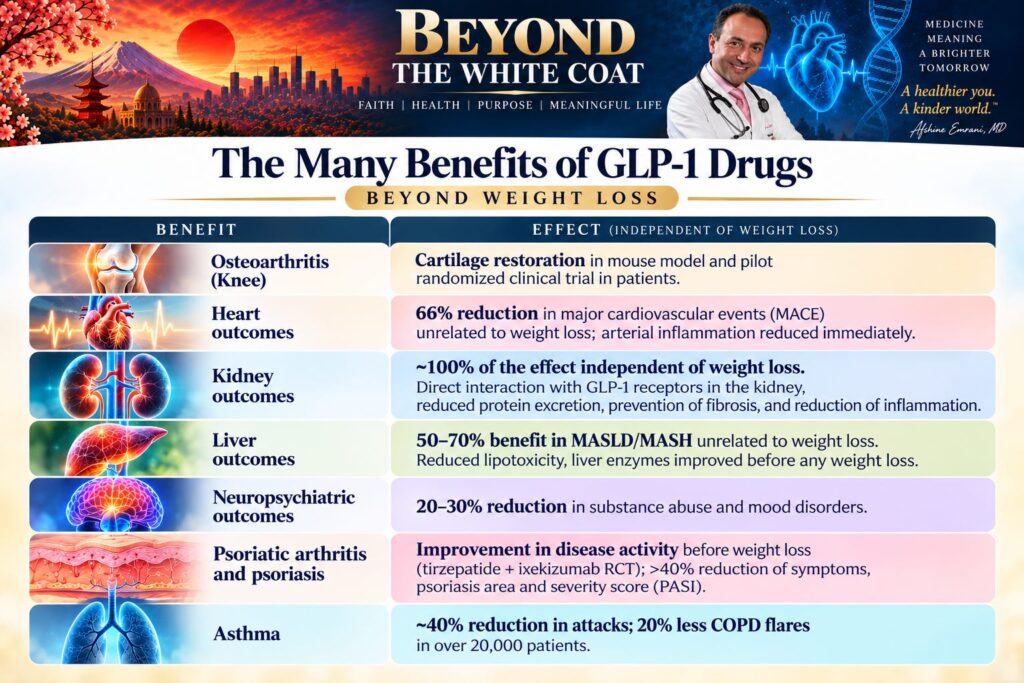
In my cardiology practice, I now see patients whose hearts, kidneys, livers, and joints are improving in ways that don’t line up neatly with the number on the scale. The research is catching up to what clinicians are seeing at the bedside. A growing body of evidence shows that these medicines have powerful effects that appear to be independent of weight loss.
This is one of the most exciting developments I have seen in medicine in my career. Here is the updated list.
The Growing List of Benefits Beyond the Scale
❤️ Heart: the benefit starts before the weight comes off
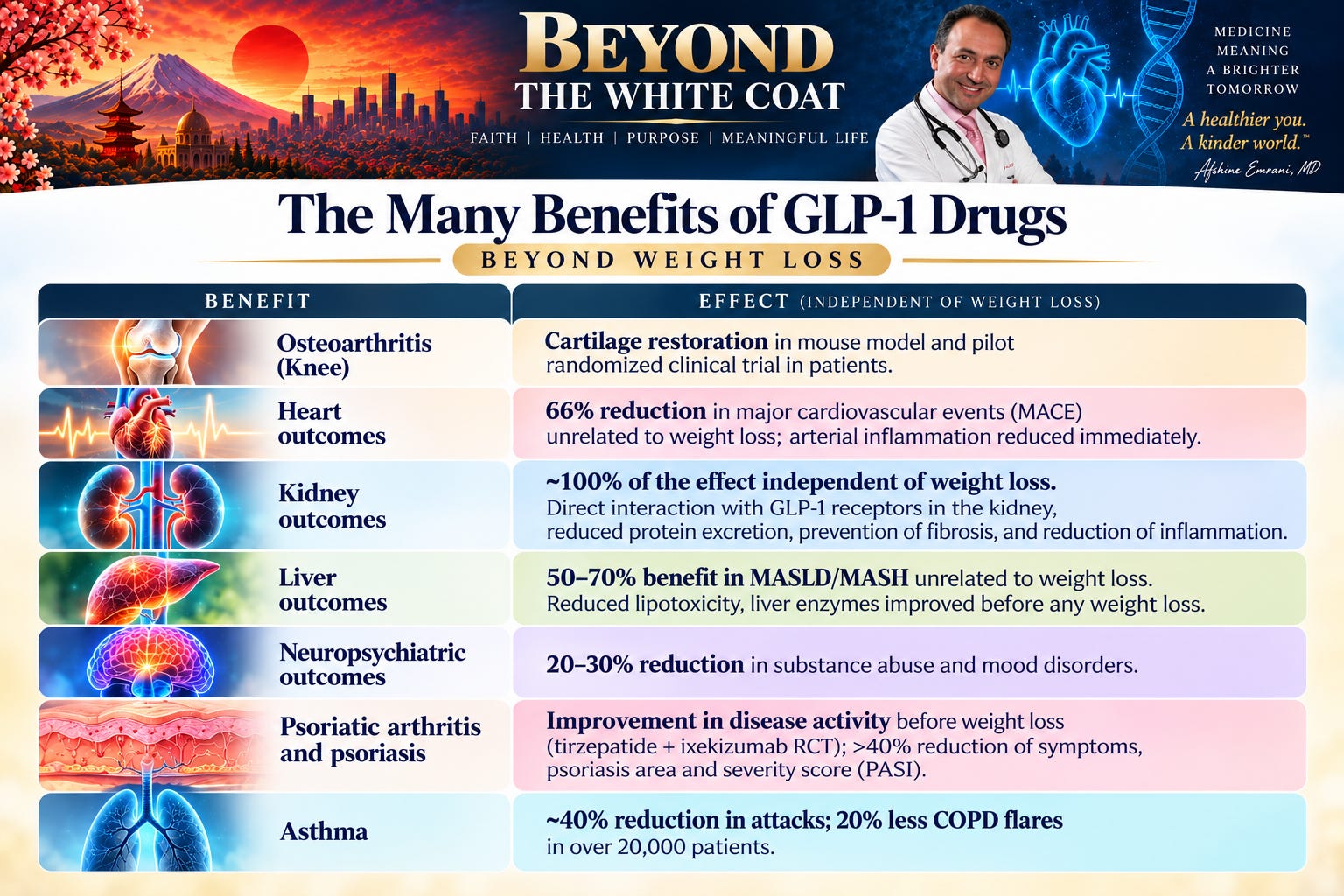
In an analysis published in The Lancet (Deanfield, 2025), roughly two-thirds of the cardiovascular benefit seen with semaglutide, meaning fewer heart attacks, strokes, and cardiovascular deaths, was unrelated to weight loss. Arterial inflammation also appears to fall early, well before significant weight is lost.
The takeaway: these drugs are not only shrinking the patient. They are calming the artery.
🫘 Kidneys: possibly the strongest weight-independent signal
Studies across Nature Medicine and the Journal of Clinical Investigation suggest that nearly all of the kidney protection happens independent of weight loss. GLP-1 receptors sit in the kidney itself, and activating them is associated with less protein leakage, less fibrosis (scarring), and less inflammation.
🧬 Liver: reversing the silent epidemic
Fatty liver disease (now called MASH) affects tens of millions of people and often goes unnoticed until it is advanced. Current analyses suggest 50–70% of the liver benefit is unrelated to weight loss, and liver enzymes can improve before any meaningful weight comes off. New work in Cell Metabolism showed semaglutide acting directly on liver blood-vessel cells, and reversing MASH in mice that could not lose weight.
🦵 Knees: cartilage, not just comfort
A 2026 Cell Metabolism report described cartilage restoration in a mouse model, plus a pilot randomized trial in patients. And in Lilly’s Phase 3 TRIUMPH-4 trial of retatrutide, knee-osteoarthritis pain scores dropped by roughly three-quarters from baseline. Osteoarthritis has long been a “manage it until replacement” disease. That story may be changing.
🧠 Brain and mood: the early signals
A large preprint (medRxiv, April 2026) reported 20–30% reductions in substance-use and mood-disorder outcomes among people on GLP-1 drugs. This is early, observational, and not yet peer-reviewed, so I’m treating it as a promising signal, not a conclusion. But the signal is hard to ignore.
🔬 Psoriasis and psoriatic arthritis
In a Phase 3 trial presented at the American Academy of Dermatology in March 2026, tirzepatide combined with ixekizumab improved disease activity before significant weight loss, with more than a 40% reduction in PASI (psoriasis area and severity) scores.
🌬️ Asthma and COPD
Data presented at the European Respiratory Society show roughly 40% fewer asthma attacks and 20% fewer COPD flare-ups across more than 20,000 patients. Less inflammation means easier breathing.
💤 Sleep apnea
Tirzepatide (Zepbound) is already FDA-approved for moderate-to-severe obstructive sleep apnea in adults with obesity. That is a real, on-label benefit beyond the scale.
The common thread? Inflammation. GLP-1 signaling appears to turn down chronic inflammation through direct, weight-independent pathways. Inflammation sits underneath heart disease, kidney disease, fatty liver, arthritis, autoimmune conditions, and probably much of aging itself.
Ozempic and Wegovy (semaglutide): the one that proved the point
Semaglutide is the molecule that opened the door.
-
Wegovy is approved for chronic weight management and to reduce the risk of heart attack, stroke, and cardiovascular death in adults with established cardiovascular disease and overweight or obesity (the SELECT trial showed about a 20% reduction in major cardiovascular events).
-
Ozempic is approved for type 2 diabetes, and also to reduce kidney disease progression and cardiovascular events in people with diabetes and chronic kidney disease (the FLOW trial).
-
Semaglutide has also shown improvements in heart failure symptoms (STEP-HFpEF) and in liver inflammation and fibrosis (MASH).
Same molecule, different brand names and doses. The brand names reflect labeling, not a different drug.
Mounjaro and Zepbound (tirzepatide): two hormones, bigger effect
Tirzepatide activates both GLP-1 and GIP receptors. In trials, it produced average weight loss of around 20% or more, the strongest of the approved drugs.
-
Mounjaro is approved for type 2 diabetes. Zepbound is approved for chronic weight management and for obstructive sleep apnea in adults with obesity.
-
Tirzepatide has shown striking improvements in fatty liver disease, with large proportions of patients in trials seeing MASH resolution regardless of how much weight they lost.
-
Early data in heart failure, kidney disease, and psoriatic disease are encouraging, and larger outcome trials are ongoing.
Retatrutide: the triple agonist on the horizon
Retatrutide, from Eli Lilly, activates GLP-1, GIP, and glucagon receptors. It is still investigational and is not FDA-approved. But the Phase 3 results announced in 2026 have been remarkable:
-
TRIUMPH-1 (May 2026): average weight loss of 28.3% at the top dose over 80 weeks. Nearly half of participants (45.3%) lost 30% or more of their body weight, a level once associated with bariatric surgery.
-
TRIUMPH-3 (July 2026): about 22.6% weight loss in people with severe obesity and established cardiovascular disease, with improvements in lipids, blood pressure, and inflammation (hsCRP).
-
TRIUMPH-4 (knee osteoarthritis): major weight loss plus meaningful reductions in knee pain.
The glucagon component adds energy expenditure and liver-fat effects on top of everything GLP-1 and GIP already do. Whether it will show weight-independent benefits as broad as semaglutide is the question the field is now asking, and I expect more answers soon.
Your Questions, Answered
Do I need to lose weight to get these benefits? Not necessarily. For the heart, kidneys, and liver especially, a substantial portion of benefit appears independent of weight loss. Weight loss still matters, and many things improve when you lose it. But it’s not the only mechanism.
Does this mean everyone should take a GLP-1 drug? No. These are prescription medicines with real side effects, and they are for people with a medical indication and a physician guiding them. “It might help everything” is not a reason for a healthy person to start one.
What are the most common side effects? Nausea, constipation, diarrhea, vomiting, and reduced appetite, especially during dose increases. Less common but important: gallbladder problems, pancreatitis, dehydration (which can strain the kidneys), and, in rare cases, serious GI issues. Tell your doctor about any severe or persistent abdominal pain.
Is it safe to take long-term? For approved drugs, data now extend several years in large trials, and the cardiovascular and kidney outcomes are encouraging. Long-term data for newer agents are still being gathered. Ongoing monitoring with your physician is essential.
What happens if I stop? Many people regain a significant portion of the weight, and some of the metabolic benefits fade. These are best understood as chronic-disease medicines, not short courses. That is exactly why lifestyle foundations matter so much (see below).
Can I use compounded or “research-grade” versions? I strongly advise against unregulated sources, especially for retatrutide, which is not approved anywhere. Purity, dosing, and safety are unknown.
Will I lose muscle? Some. Part of the weight lost on any powerful weight-loss therapy comes from lean mass. This is the single most important thing you can influence yourself, and the next section is how.
Who should be cautious? People with a personal or family history of medullary thyroid cancer or MEN2, a history of pancreatitis, pregnancy or planned pregnancy, or serious GI disease should discuss this carefully with their physician.
The Part Nobody Puts on the Billboard: Protect Your Muscle and Your Bones
When the scale drops fast, not all of what you lose is fat. A meaningful share of the weight lost on these medications can be lean tissue, and when appetite is suppressed, it gets easy to under-eat protein, under-hydrate, and stop moving. Over time, that raises the risk of weakness, frailty, falls, and bone loss.
Here is the playbook I give my own patients. These are general principles, so check them against your own medical conditions, especially kidney disease or heart failure.
1. Protein: make every bite count
When appetite is small, protein density matters. A common target for people losing weight is roughly 1.2 to 1.6 grams of protein per kilogram of body weight per day, adjusted by your physician for your kidney function and overall health. Prioritize protein first at each meal: eggs, Greek yogurt, fish, poultry, legumes, tofu, cottage cheese, protein shakes if needed.
2. Lift something heavy, twice or three times a week
This is non-negotiable. Resistance training is the strongest signal you can send your body to keep muscle and bone. Weights, bands, machines, or body-weight work. Progressive overload matters: gradually do more over time. Add walking every day for heart and metabolic health.
3. Hydration: the quiet hero
These drugs can blunt thirst, and vomiting or diarrhea can dehydrate you quickly. Dehydration is a real risk to the kidneys. Sip water throughout the day, and add electrolytes if you are losing fluids. If you have heart failure or kidney disease, ask your physician how much fluid is right for you.
4. Bone health: don’t wait for a fracture
Weight loss of any kind can reduce bone density. Support your skeleton with:
-
Adequate calcium (preferably from food) and vitamin D, with levels checked
-
Weight-bearing and resistance exercise
-
Enough total calories and protein
-
A conversation with your doctor about bone density screening (DEXA) if you are postmenopausal, older, or at higher risk
5. Sleep, alcohol, and stress
Poor sleep and heavy alcohol use both work against muscle and bone. Protect sleep. Keep alcohol modest.
6. Track the right numbers
Don’t just watch the scale. Track waist circumference, strength, energy, and body composition if you can. The goal is to lose fat and keep the machine strong.
The Bottom Line
The story of GLP-1 drugs is no longer just about weight. It is about inflammation, organ protection, and a new way of treating a cluster of diseases that used to be treated separately. Semaglutide opened the door, tirzepatide widened it, and retatrutide is knocking at the next one.
But these drugs are a powerful tool, not a substitute for the foundations: protein, water, strength training, sleep, and a physician who knows you. Use the medicine, and build the body that can carry the benefits for decades.
If this was useful, share it with someone who is on a GLP-1, or thinking about one. And subscribe, because this list is going to keep growing.
Blessings.
Afshine Ash Emrani, M.D., F.A.C.C.
Assistant Clinical Professor, UCLA
David Geffen School of Medicine
Join Our new website
Castle-Connolly Nationwide Top Doctor (Since 2008)
Los Angeles Magazine Super Doctors (every year since 2013)
LA Style Magazine Top 100 Doctors in America (2024)
Subscribe to mynewsletter: substack.com/@afshineemrani
Explore my books: Amazon Author Profile