Writings
The Six-Year-Old Who Had to Use the Bathroom

Originally published on Substack.
The most important object on any airliner is a door.
It is not the wing, or the engine, or the radar. It is a reinforced, bolted door between the cockpit and the cabin, built after September 11, 2001, to guarantee one thing: that no one in the back can ever reach the people at the controls.
On the morning of September 30, 2026, that door would do its job perfectly.
And for a few terrible minutes, it would be the thing that was going to kill 174 people.

7:05 A.M. — Wheels Up
Flight FZ1073 leaves Dubai on a Wednesday morning in the middle of Sukkot, bound for Tel Aviv.
It is a Boeing 737 MAX 8, and it is full of people going home. There are 174 on board by most counts, and 27 of them are children. Families coming back from Japan, from China, from Thailand. A dentist with his wife and kids. A plumber with his daughters. A banker. An insurance agent. Four passengers carrying both American and Israeli passports.
The plane climbs through the Gulf haze and levels out above thirty thousand feet. The seatbelt sign goes off. Someone closes their eyes.
For two and a half hours, nothing happens.
That is the part that should haunt you. For two and a half hours, it is the most boring flight in the world, and the door stays shut, and nobody on the other side has any reason to wonder what is happening behind it.
Behind the Door
Inside the cockpit sits Captain Smit Machchhar, 39, from Mumbai.
He has been flying for seventeen years and has been a captain for eleven. He is married. He has two children. Years earlier, he trained in New Zealand, where, as his flight school’s chief put it, pilots are taught how to take over if a fellow crew member is incapacitated.
They did not teach him what to do if the other pilot tries to kill him.
His co-pilot asks for permission to pray.
It is not an unusual request on a flight out of the Gulf. The captain agrees.
Then comes a blow to the back of his head.
Then another.
According to the UAE’s attorney general, the weapon is the cockpit’s crash axe, a tool designed to cut through wreckage in an emergency and mounted within reach for exactly that purpose. The captain would later say he tried to stop him, and gave everything he had. He goes down. Blood spreads across the cockpit floor.
And behind the sealed door, the co-pilot’s plan is simple.
Israeli officials say he later told interrogators he planned it before he was even hired. He would kill the captain quietly. He would take the seat. He would bring the aircraft into Tel Aviv on a busy weekday morning in the middle of a holiday week, and instead of landing it at Ben Gurion Airport, he would crash it into the airport itself.
That plan depended on one thing only: silence.
A sealed door. A dead pilot. Nobody in the cabin the wiser until the impact.
Row One
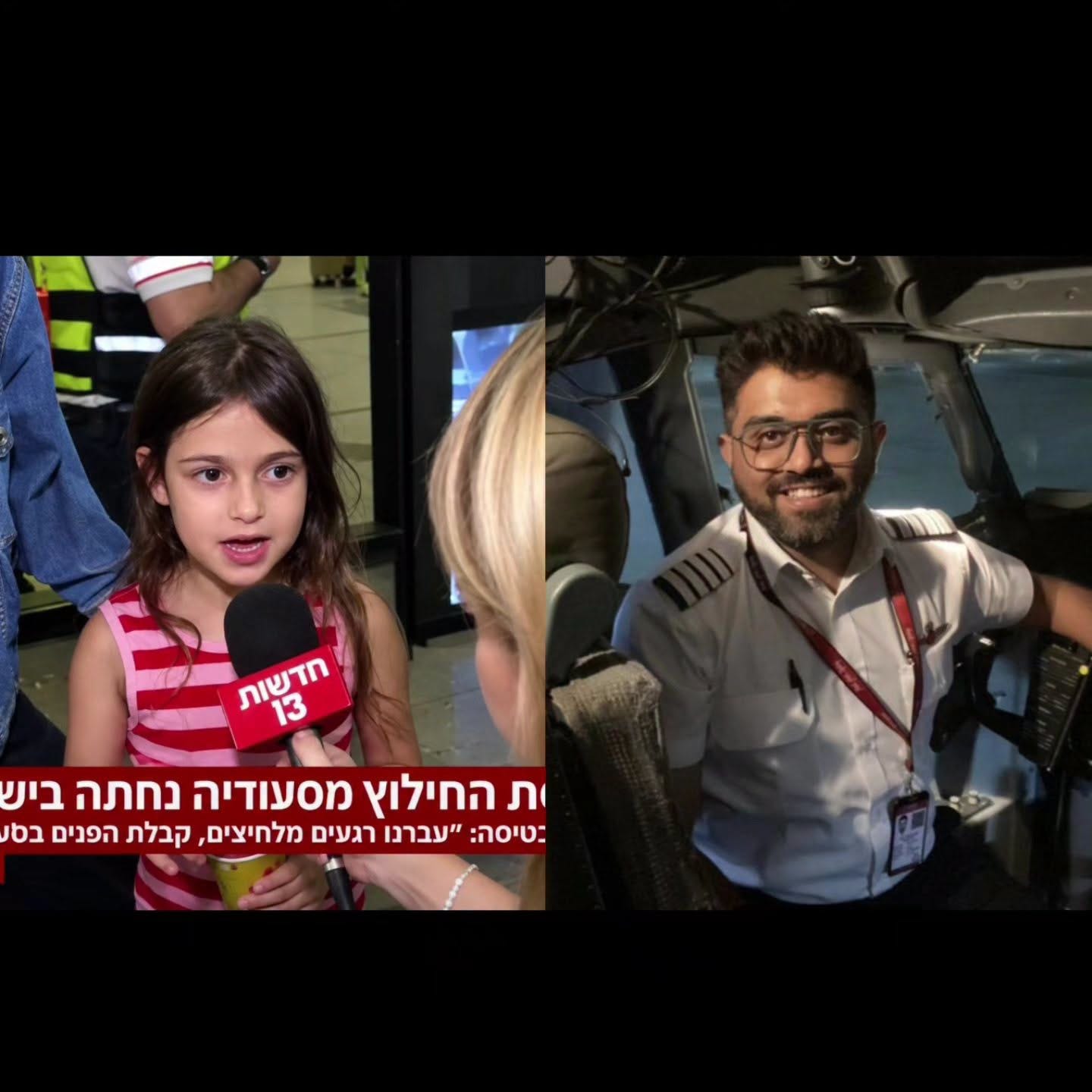
Seated in the very front row are a husband, a wife, and their two young daughters. Tzvika Manes is the CEO of a bank’s underwriting arm. His wife is Tali. The younger daughter, Nina, is six years old.
Nina has to go to the bathroom.
Her mother gets up and goes with her.
The lavatory at the front of the plane sits right beside the cockpit. Tali Manes stands in the narrow space outside the door and waits for her daughter.
And through the wall, she hears something that should not be on an airplane.
Shouting. Thuds. The sounds of a struggle.
She does not dismiss it. She flags down a flight attendant and tells them something is wrong, and asks them to check. Seconds later, the cockpit door opens, and the thing the door was built to hide spills out into the light: blood everywhere, and two men locked in what she would later describe as very sharp fighting moves.
Tali Manes screams.
He is stabbing the pilot.
All around her, passengers look up. They hear the words. They do not understand them.
Then the nose of the plane drops.
9:21 A.M. — The Fall
The aircraft pitches over and goes down.
Flight data would later show it plunging more than 14,000 feet in under thirty seconds. In Reuters’ reconstruction, at its steepest it was losing altitude at roughly 544 feet every second, the kind of trajectory that has ended in some of the worst crashes in aviation history.
Then it steadies.
Then it drops again.
Everything not strapped down leaves the floor. People are flung from their seats. In the cabin, passengers who thought they felt turbulence realize in a few seconds that this is not turbulence. One passenger would describe it as much worse than a free-fall: the aircraft turning on its side, then up, then down.
Children scream.
In the back, a father named Adam Polo pulls his six-year-old son against his chest, while his wife holds their three-year-old daughter. He tells them the thing every parent says. We will be OK. He does not believe it.
Near the middle, a passenger named Daniel Schlichter takes his wife’s hand. The word that crosses his mind is 9/11. He decides that if this is the end, they will go together, and he holds on as tightly as he can.
And in the front, Tzvika Manes hears his daughters screaming a sentence no father is ever supposed to hear.
Dad, we don’t want to die.
He would later say that something in him switched. The banker, the husband, the man in the front row, he said, became an animal. He looked at his wife and his children and made a decision.
We are going to survive.
He stands up and runs forward.
He is not the only one.
The Run
Across the aircraft, men are doing the same thing.
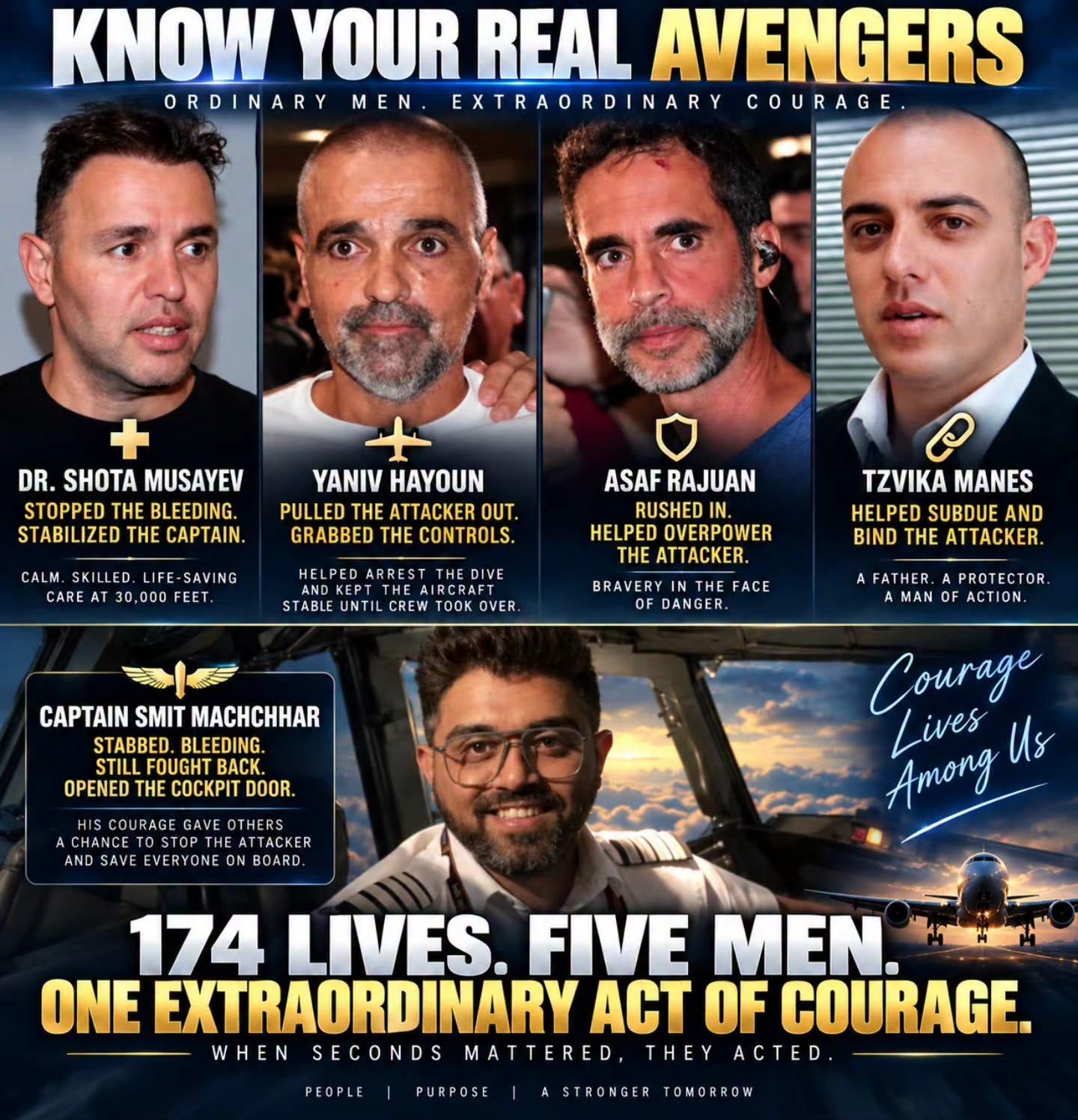
Yaniv Hayoun, a plumber and father of daughters from Ness Ziona, is out of his seat. Assaf Rajuan, an insurance agency owner coming home from a vacation in Thailand, is out of his. Dr. Shota Musaev, a 47-year-old Georgian-born Jewish dentist sitting in row 13 with his family, turns to his wife and says a few words that he will remember for the rest of his life.
I need to go. I love you.
Another passenger, Tal Samuel, would later say that these were ordinary, polite men, men who work in finance and insurance and trade. Nobody who watched them in that moment, he said, would have called them that. They were lions.
They run into the aisle. The plane is still falling. They are running through a cabin where anything not strapped down is airborne.
When they reach the cockpit, the door is not locked.
But it will not open.
The captain, bleeding and barely conscious, has collapsed against it, and his weight is pinned on the other side.
The Door
The men push. They push again.
The captain has done the one thing that makes this moment possible. Before his strength gave out, before he went down, he pulled himself across the floor to a door that was supposed to stay shut and opened it from the inside.
He would describe it later from a hospital bed in Abu Dhabi, weeping, with tubes in his nose and bandages on his head and hands. He was on the floor. He could feel the aircraft going down beneath him. And he told himself:
This is the last push, Smit. Do it. The door is right there.
It opens.
Passengers would say he fell out of the doorway with the co-pilot on top of him, still attacking. The men are on them in an instant. Manes is throwing punches, and does not know if the man has a knife. Hayoun forces his way past, and what he sees inside is the thing that makes his blood run cold: the co-pilot was between the seats, smashing at the instruments, trying to destroy them and disable the aircraft.
Hayoun grabs him in a chokehold.
He drags him out.
Others pile on. The co-pilot fights back. Manes would say he was strong, and probably full of adrenaline. It takes all of them. They tie his wrists and ankles with the cables from the airline’s headphones, and when he thrashes, they tie him again, tighter.
And then the thing that no one expected comes out of his mouth.
He begs them to kill him.
Kill me, kill me, please.
Then he goes quiet.
Nobody at the Controls
The co-pilot is out. The captain is on the floor. The plane is still diving.
Tal Samuel looks through the open door and sees what the passengers have just realized.
There was nobody in the cockpit.
No one at the controls of a falling aircraft.
Yaniv Hayoun does not hesitate. He is a plumber. He has never flown a plane. But he has spent years watching Air Crash Investigation, the television show that reconstructs disasters one minute at a time, where the most important lesson, repeated in episode after episode, is what a pilot does to recover from a dive.
He jumps back into the cockpit.
He pulls back on the controls.
And the nose begins to rise.
The plane levels out.
Later, Prime Minister Netanyahu would ask him how on earth he knew what to do. Hayoun’s answer was five words long.
I watch Air Crash Investigation.
Behind him, the two off-duty pilots who had been sitting quietly in the cabin, relief crew who were supposed to fly a different flight later that day, are finally being reached. One of them was British, according to a passenger. Samuel would say he had to shake them, that the shock had frozen them in their seats. One goes forward at once. The other takes longer to come back to himself.
Then one of them takes over the controls and tells Hayoun he can let go.
Hayoun lets go.
The plane has been saved from the dive.
It has not yet been saved.
Four Hundred Miles Away
While the men fight in the aisle, the alarm spreads across three countries.
The aircraft’s transponder flashes the code for a general emergency. Minutes later, according to flight-tracking data, it flashes the one that means unlawful interference, the code that means hijacking. An Israeli official would later say the transponder went dark entirely for nearly half an hour.
In Israel, a procedure that has been rehearsed for decades switches on.
A committee is roused. A command center is established. The Air Force tries to reach the cockpit and gets no answer. Fighter jets scramble. Israeli airspace is closed. Two flydubai flights are held back at Ben Gurion while security forces try to establish contact with the aircraft.
And two Israeli sources would later tell CBS News something staggering: that Israel was prepared to shoot the plane down, even with more than 150 Israelis aboard, rather than let it reach its target.
If the aircraft got within a certain distance, they said, jets would have crossed into Jordanian airspace.
It never got that close.
About 400 miles from Israel, the plane turned.
It turned away from Tel Aviv, and away from the crowd. It turned toward Saudi Arabia, a country with no diplomatic relations with Israel.
The Israeli jets were called back.
The Saudis scrambled their own.
The Hour of Not Knowing
In the cabin, the plane is finally flying level. But the passengers do not know that. They do not know anything.
For more than an hour, no crew member tells them what has happened. There is no announcement. There is no captain’s voice. Adam Polo, in row 13, still has his son pressed against his chest, when about fifteen minutes after the dive he sees a passenger running out of the cockpit covered in blood.
The only information anyone gets comes from the passengers who stood up.
And suddenly, in the strange logic of terror, everyone is a suspect.
Assaf Rajuan would tell CNN that the passengers did not know where they were headed, or who to trust. They were afraid it might be a hostage situation. They even began to suspect the flight attendants.
Tal Samuel and the others make a decision. They move the crew members away from the scene. They tell them that from now on, the passengers are running this flight.
And then, according to Samuel’s account, they place an Israeli beside every member of the crew. One by one. A guard for every uniform.
It is a plane over a desert, with no one in the cabin knowing where it will land, and a cabin full of frightened families who have just learned that someone they were trusting with their lives tried to kill them all.
Almog Italie, 52, coming home from two weeks in Japan, holds his own family steady. In situations like this, he would say later, you have to remain calm to stay alive. He tells his wife and children to stay in their seats and do nothing that might cause chaos.
They stay in their seats.
On the Cockpit Floor
In the cockpit, Dr. Shota Musaev is on his knees in blood.
He has just helped to subdue a murderer. Now he turns his attention to the man that murderer was trying to kill. The captain is conscious. He is bleeding from the head, the neck, the arm, and the hands. The cockpit is covered in it. There is no first-aid kit that can stop what is happening. Musaev uses strips of cloth, and his own two hands, and a dentist’s calm.
The captain tells him two things. He is thirty-nine. He has two children.
Then he asks for help. Help me, please.
Musaev tells him everything will be all right.
Beside him, as the plane flies on, the captain does something the dentist will never forget. He prays.
He prays the whole time. A Hindu pilot from Mumbai, praying to Hanuman on the floor of a cockpit, with his blood on the hands of a Georgian Jew who is trying to keep him alive, while the plane carrying them both flies on over a Saudi desert with a stranger at the controls.
Musaev would later say he was afraid they were going to lose him.
He turned to a steward and told him there was no time left. The plane had to be put on the ground.
Tabuk
Roughly 10:45 UAE time, the aircraft touches down at Tabuk, in northwestern Saudi Arabia.
The wheels hit the runway. And the cabin of Flight FZ1073 does something that cabins do not do: it erupts.
Polo, who describes himself as a cynical man not easily moved, would call it one of the most emotional moments of his life.
But there is one more fear.
Tzvika Manes looks down at his hands and his shirt. They are covered in blood. They are Israelis, in a Saudi airport, in a country that has no diplomatic ties to their own. He is afraid they will be arrested.
The door opens.
They are not arrested.
They are welcomed.
Saudi authorities take care of the wounded. They bring food. They make sure the captain reaches a hospital. The co-pilot is taken into custody.
Later that day, a replacement aircraft arrives. Some passengers are afraid to board it. But they want to go home. So they do.
And that evening, the people of Flight 1073 land in Tel Aviv, where families are waiting, and a crowd breaks into cheers.
Yaniv Hayoun walks through the arrivals gate with the captain’s blood still on his shirt.
The Man at the Center
Smit Machchhar survived.
Airlifted to Abu Dhabi, he would speak a few days later by video to the Prime Minister of India. He wiped away tears as he told the story. He described lying on the floor with the plane falling around him, and the last push, and the door.
“I know God saved me,” he said.
And the Israeli passengers said it back to him. They called him the first hero of that flight. Not just because he opened the door, though he did. Because, as Assaf Rajuan put it, he had an amazing fight with the attacker. He really fought him.
The dentist says that when he closes his eyes, he can still see the captain’s face.
What Is Known, and What Is Not
The UAE’s attorney general has described the incident as the “planning and attempted” commission of a terrorist act. Israeli officials, and a source who spoke to NPR, say the co-pilot intended to crash into Ben Gurion Airport and appears to have acted alone. Investigators are still working to establish a motive and whether anyone else was involved. The co-pilot is in custody in the UAE.
Reports differ on some figures: the headcount (172 to 180, depending on the source), the depth of the dive (14,000 to 17,000 feet), and whether the weapon was a knife or the crash axe. This account uses the figures confirmed by multiple outlets and notes where they differ.
What no source disputes is this: a plane aimed at a crowd landed safely in the desert, and every person aboard walked off of it alive.
The Miracles
Count the margins.
1. A little girl had to go. Not a minute earlier, not a minute later. The only place on that aircraft where a passenger could hear what was happening in the cockpit was the lavatory beside it, and the only person standing there was a mother who did not send her child alone.
2. A mother who listened, and did not stay quiet. Tali Manes heard it, told the crew, and when the door opened and she saw the blood, she screamed. Without her scream, nobody in that cabin knows.
3. A captain who did not die. An axe, repeated blows to the head, wounds to the neck and arms, and still he lived long enough to find the door.
4. The door opened from the inside. The one barrier on the plane designed to keep help out was opened by the one man who could, at the one moment it could matter. As the dentist put it, if that cockpit had remained locked, they probably could not have done anything.
5. The right men in the right rows. A plumber, a banker, an insurance agent, a dentist. They were not soldiers or air marshals. They were fathers, and they ran toward the screaming when every instinct told them to run away.
6. A doctor in row 13. Dr. Shota Musaev ran toward a fight, not toward a patient, and then became the medic the captain needed. Without him, Smit Machchhar does not reach Tabuk alive.
7. A man who watched too much television. A plumber who knew nothing about flying, and a hobby his own family may have teased him about, held the exact piece of knowledge that mattered for the exact seconds it mattered.
8. An empty seat, and a man who filled it. At the moment there was no one at the controls of a diving aircraft, someone was already running toward them.
9. They got there while there was still something to save. The co-pilot was trying to destroy the instruments. Every second he was left alone with them was a second closer to a plane that could not be recovered.
10. The plane did not break. A 737 MAX that plunged thousands of feet in under thirty seconds, twice, held together and flew again.
11. Two pilots in the cabin. Two off-duty flydubai pilots happened to be aboard, likely as backup for tired crews on long, rerouted flights. One passenger was sitting beside them and knew immediately who they were. Without them, the plane might have been level, but nobody aboard could have landed it.
12. A cabin that held. For more than an hour, nobody told the passengers anything. A man told his family to stay in their seats and keep calm. By one passenger’s account, a group of strangers put a guard beside every crew member and kept control of a cabin full of frightened families.
13. It turned the other way. The plane that was meant to arrive over Tel Aviv at midmorning during the holiday week turned toward Saudi Arabia, and Israeli forces that were reportedly ready to make the hardest decision imaginable never had to face it.
14. They were welcomed. Passengers who feared arrest for the blood on their clothes were received with food, medical care, and kindness in a country with no ties to their own.
15. The date. It was the fifth day of Sukkot, the festival when Jews leave the safety of their homes and sit in fragile huts, trusting that something larger than walls is protecting them. The flight number was 1073. The third anniversary of October 7 was one week away.
Remove any one of those fifteen things and the story ends differently.
Remove two, and it ends in fire.
The Hebrew phrase for what happened is Siyata Dishmaya, help from Heaven. Sometimes it arrives as a parting of the sea. And sometimes it arrives in the shape of a six-year-old girl who simply needs to use the bathroom, a mother who is paying attention, a Hindu pilot’s last push on a bloodied door, and a plumber who watched too much television.
One hundred and seventy-four people went home.
They did not get there by chance.
Sources: CBS News (Sept. 30 passenger accounts; Oct. 3 and Oct. 4 reporting, including interviews with the passengers); Reuters explainer via Al-Monitor (Oct. 3); NPR (Oct. 5); CNBC (Oct. 1, Oct. 3); Ynet (Sept. 30, Hayoun, Rajuan, Manes, Musaev interviews); Jerusalem Post (Tal Samuel’s account); Calcalist; The Daily Beast / New York Times (Manes); ABC News / Good Morning America (Musaev); AP (Machchhar’s account to Prime Minister Modi; passenger heroes); Gulf News (timeline); The Free Press (Hayoun); Yahoo News (Almog Italie); CNN live coverage (Rajuan).
Blessings.
Afshine Ash Emrani, M.D., F.A.C.C.
Assistant Clinical Professor, UCLA
David Geffen School of Medicine
Join Our new website
Castle-Connolly Nationwide Top Doctor (Since 2008)
Los Angeles Magazine Super Doctors (every year since 2013)
LA Style Magazine Top 100 Doctors in America (2024)
Subscribe to mynewsletter: substack.com/@afshineemrani
Explore my books: Amazon Author Profile