Writings
The Peptide Gold Rush: What’s real, what’s hype, and what nobody knows yet.
Originally published on Substack.
A few years ago, the only people who talked about peptides were researchers and physicians. Now they come up at the gym, on podcasts, in Beverly Hills drip lounges, and in my exam room. People ask me about BPC-157 the way they used to ask about fish oil.
So let’s sort it out. Some peptides have earned their place. Some might eventually. And some are being injected by thousands of people based on rat studies and good marketing.
First: what is a peptide?
A peptide is a short chain of amino acids, which makes it a small protein. Your body uses peptides as messengers: one cell sends a signal and another cell responds.
Insulin is a peptide. So is oxytocin. So are Ozempic, Wegovy, Mounjaro and Zepbound. Some of the most important drugs in modern medicine are peptides.
That is why “peptide therapy” is a meaningless phrase. It’s like saying “plant therapy.” Broccoli is a plant. So is hemlock. Each peptide has to be judged on its own evidence.
The three questions I ask about any peptide
-
Has it been tested in humans, in a real controlled trial? Results in mice or petri dishes don’t count yet.
-
Did it help people with a specific condition, or did it help everyone? A drug that works for one disease isn’t automatically an anti-aging drug.
-
Is the vial actually what the label says? Correct dose, sterile, pure, not degraded.
Most of the peptides people buy online fail at least one of these questions. Many fail all three.
🟢 GREEN: Proven, for specific uses
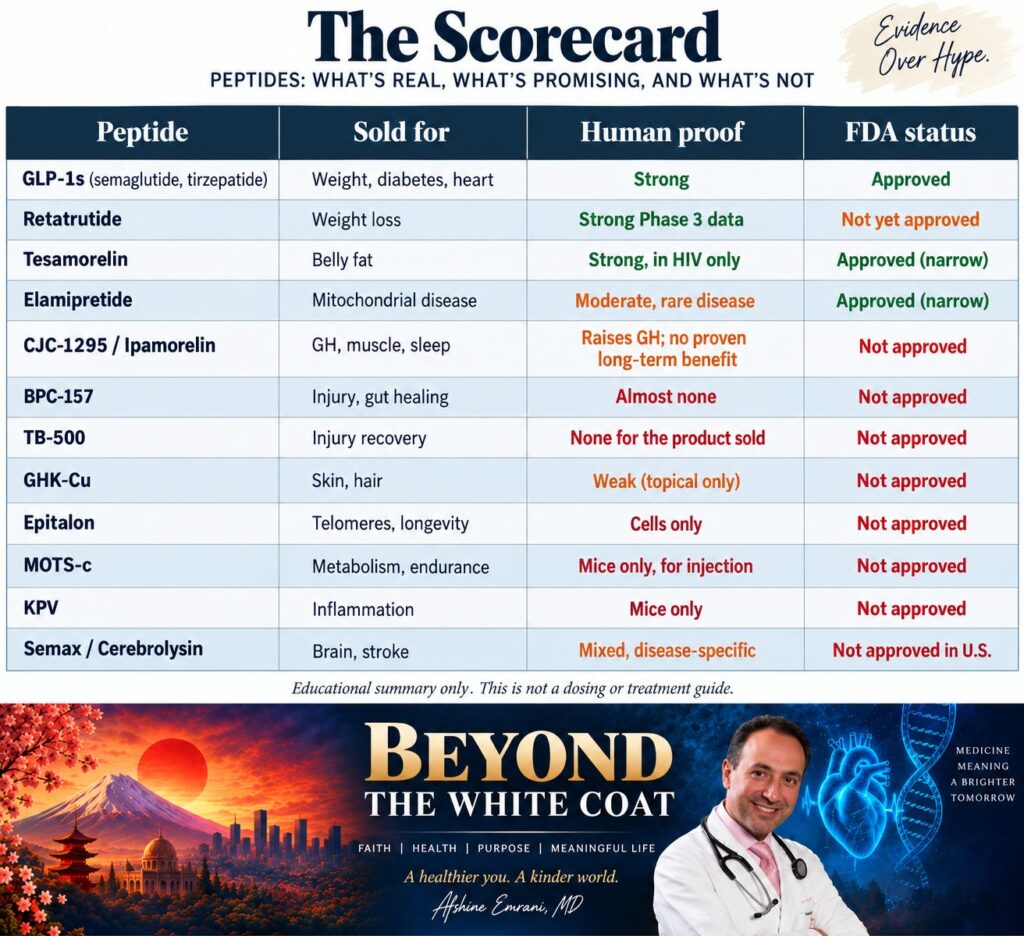
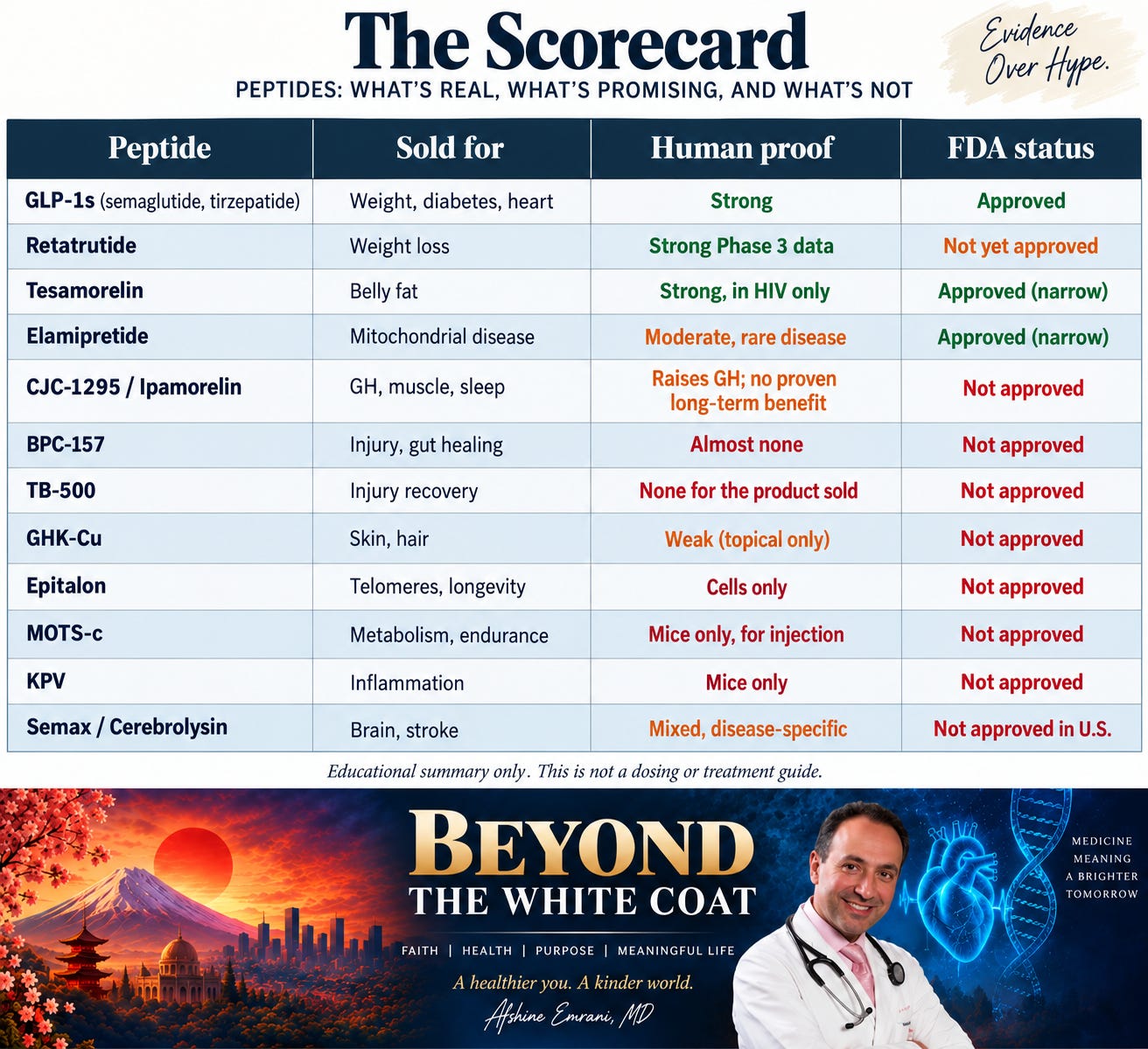
GLP-1 drugs (semaglutide, tirzepatide). These have strong evidence. They cause major weight loss and better blood sugar, and semaglutide has been shown to reduce heart attacks and strokes in people with heart disease. As a cardiologist, I consider this the real peptide revolution.
Retatrutide (the next generation, not yet approved). It hits three hormone receptors instead of one or two. In Lilly’s Phase 3 trial, the top dose produced an average weight loss of about 28% at 80 weeks, roughly what we see after bariatric surgery. That’s remarkable. However, the vials sold online as “retatrutide” are not the drug from the trial. In Australia, a product labeled retatrutide turned out to contain semaglutide, and someone ended up with a torn esophagus.
Tesamorelin. It is FDA-approved for one thing: reducing belly fat in people with HIV-related fat redistribution. It is not a general weight-loss or longevity drug. Side effects include joint pain, fluid retention and higher blood sugar.
Elamipretide (SS-31, brand name Forzinity). It targets mitochondria and received accelerated approval in 2025 for Barth syndrome, a rare genetic disease. The approval was based on muscle strength, and a confirmatory trial is still required. It is not approved for healthy people.
Bottom line: “FDA-approved” means approved for a specific product, at a specific dose, for a specific disease. It never means “proven to slow aging.”
🟡 YELLOW: Does something real, but the benefit is unproven
CJC-1295 and ipamorelin, often sold together as a “stack,” raise your growth hormone and IGF-1 levels. That effect is real and measurable. But does more growth hormone mean a longer, healthier life? The evidence points in the opposite direction:
-
In mice, lower growth hormone signaling extends lifespan.
-
People in Ecuador born with a genetic resistance to growth hormone (Laron syndrome) have strikingly low rates of cancer and diabetes.
-
When healthy older adults were given growth hormone in trials, they developed fluid retention, joint pain and glucose intolerance, and some developed diabetes.
Feeling stronger and sleeping better is not the same as aging more slowly. Biology involves trade-offs. Speaking as a heart doctor, I’d add that rapid heart rate and flushing have been reported with CJC-1295. I want to know about that before a patient starts it, not after.
🔴 RED: Lots of excitement, very little human proof
BPC-157 is marketed for tendons, ligaments and the gut. It has impressive results in animals. In humans, there are a few small uncontrolled case reports and a safety pilot that included two people. It has not been tested in a single randomized trial for healing.
TB-500 is supposedly related to thymosin beta-4, a natural healing peptide. Lab testing has found that some products sold as TB-500 contain only a short fragment of it. Research on the full-length molecule doesn’t transfer to the fragment, or to whatever is actually in the vial. Combined with BPC-157, it’s sold as the “Wolverine stack.” Unfortunately, the name is the strongest part of the evidence.
GHK-Cu is a copper peptide used in skin products. Even for topical use, the evidence is modest and mixed. The claims that injecting it rejuvenates your body or regrows your hair are well beyond any data.
Epitalon is sold for telomeres and longevity. It lengthens telomeres in cell cultures, but there is no evidence it does so in a living human or extends life. There is also a concern: cancer cells rely on telomerase to keep dividing, and that is the same system Epitalon is designed to activate.
MOTS-c may be the most interesting biology on this list. It’s a peptide encoded by your mitochondria, which means your cells’ power plants send signals of their own and help regulate metabolism and stress responses. Your body naturally produces more of it during exercise. However, there is no evidence that injecting synthetic MOTS-c makes humans healthier. The positive treatment results so far come from mice.
KPV has anti-inflammatory effects in mouse models of colitis, and there’s very little human data beyond that.
Semax and Cerebrolysin have been used for stroke and brain injury in Russia and Eastern Europe. The trials are small, mixed and specific to those diseases. One major review of Cerebrolysin in stroke found no reduction in deaths and a possible increase in serious side effects. Neither has been shown to keep a healthy brain young.
The vial problem
Even if a peptide works, the next question is what’s actually in your syringe. There are three very different categories:
-
FDA-approved drug: a specific product, inspected and reviewed for a specific use.
-
Compounded drug: legally prepared by a pharmacy under certain rules, but the finished product is not FDA-approved.
-
“For Research Use Only”: not approved for human use at all. Printing that label doesn’t make it safe to inject.
Words like “pharmaceutical grade,” “doctor prescribed” or “compounded” sound reassuring. Often nobody has verified the dose, sterility or purity. With injections, contamination can cause infections. Impurities and clumped peptides can trigger immune reactions. When you stack three or four peptides, you have no interaction data, and if something goes wrong you can’t tell which one caused it.
What happened in July: An FDA advisory panel reviewed seven popular peptides, including BPC-157, TB-500, MOTS-c, KPV, Semax and Epitalon, and voted 8–6 to recommend allowing BPC-157 in pharmacy compounding. That vote is advisory, not binding. FDA’s own scientists had found very little quality evidence. Even if the FDA eventually agrees, that would make BPC-157 legal to compound. It would not mean it’s proven to work.
What’s coming next
The next step is gene therapy: instead of injecting a peptide again and again, you give your body instructions to make the protein itself. Companies are already testing this offshore with follistatin, a protein that blocks the brakes on muscle growth.
The difference is important. A peptide injection clears from your body within hours or days. Genetic instructions can keep producing a protein for a long time, and you can’t simply stop taking it. Muscle-limiting signals like myostatin exist for reasons we don’t fully understand. Pushing on a biological network carries more risk than it appears to.
What I tell my patients
-
Start with what’s proven. Exercise, strength training, sleep, blood pressure control, LDL cholesterol, and blood sugar will do more for your lifespan than any vial. If you qualify for a GLP-1, that’s a peptide with real evidence behind it.
-
Never inject grey-market products. If you can’t verify the source, you don’t know what you’re injecting.
-
Don’t stack. If you try something, try one thing at a time with a defined goal and a physician tracking your labs.
-
Get a baseline first. That means blood sugar, IGF-1, blood pressure, heart rhythm, and age-appropriate cancer screening, especially before using anything that affects growth hormone or telomerase.
-
Tell your doctor. We can’t see peptides on a medication list unless you tell us.
What we know vs. what we don’t
What we know
-
Peptides are powerful medicine. GLP-1 drugs prove it.
-
Several popular peptides have real effects on the body, such as raising growth hormone or reducing inflammation in animals.
-
Grey-market vials are often mislabeled, underdosed, or contaminated.
-
Changing a lab number is not the same as living longer.
What we don’t know
-
Whether any peptide slows human aging.
-
The long-term safety of BPC-157, TB-500, MOTS-c, Epitalon, KPV or injectable GHK-Cu.
-
What happens when you stack them.
-
Whether raising growth hormone in healthy adults helps or harms over decades.
Some of today’s popular peptides will probably fail. A few will turn out to be useful for a narrow condition. One or two may become important medicines. The science is moving quickly, and I find that exciting.
But curiosity should make you demand more evidence before you inject something, not less. Your body is not a beta test.
Blessings.
Afshine Ash Emrani, M.D., F.A.C.C.
Assistant Clinical Professor, UCLA
David Geffen School of Medicine
Join Our new website
Castle-Connolly Nationwide Top Doctor (Since 2008)
Los Angeles Magazine Super Doctors (every year since 2013)
LA Style Magazine Top 100 Doctors in America (2024)
Subscribe to mynewsletter: substack.com/@afshineemrani
Explore my books: Amazon Author Profile