Writings
Fish Oil Failed the Brain Test. Here’s What It Does to Your Heart.
Originally published on Substack.
Millions of people swallow fish oil every morning to protect their memory. A new two-year trial says it doesn’t work.
What happened
Keck Medicine of USC researchers, here in Los Angeles, randomized 365 adults aged 55 to 80 who rarely ate fish. Nearly half carried APOE4, a gene variant linked to higher Alzheimer’s risk. Half took 2,000 mg of DHA a day. Half took placebo. The results were published in eBioMedicine.
The DHA reached the brain. Levels in spinal fluid rose about 17% by six months. But after two years, memory scores were the same in both groups. So was hippocampal shrinkage. This was the best-case setup: low fish intake, high genetic risk, a high dose, and proof the molecule reached its target. It still failed.
What most people get wrong
Most people assume fish oil at least helps the heart. The data is messier.
VITAL (NEJM, 2019) gave 25,871 adults about 1 gram of omega-3 a day for a median of 5.3 years. Major cardiovascular events did not drop significantly.
STRENGTH (JAMA, 2020) gave 13,078 high-risk patients 4 grams of EPA plus DHA. No benefit: events were 12.0% versus 12.2%. New atrial fibrillation rose from 1.3% to 2.2%.
REDUCE-IT (NEJM, 2019) is the one big win. Four grams a day of purified prescription EPA, icosapent ethyl, cut major events from 22.0% to 17.2% in 8,179 high-risk patients. But the placebo was mineral oil, which raised LDL and inflammation in the placebo group. Cardiologists still argue how much that inflated the benefit.
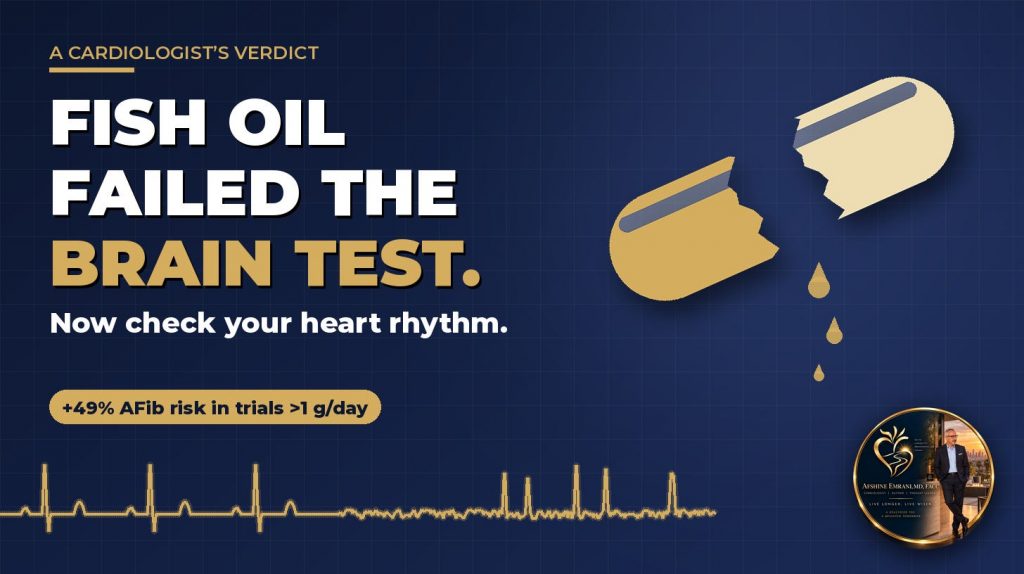
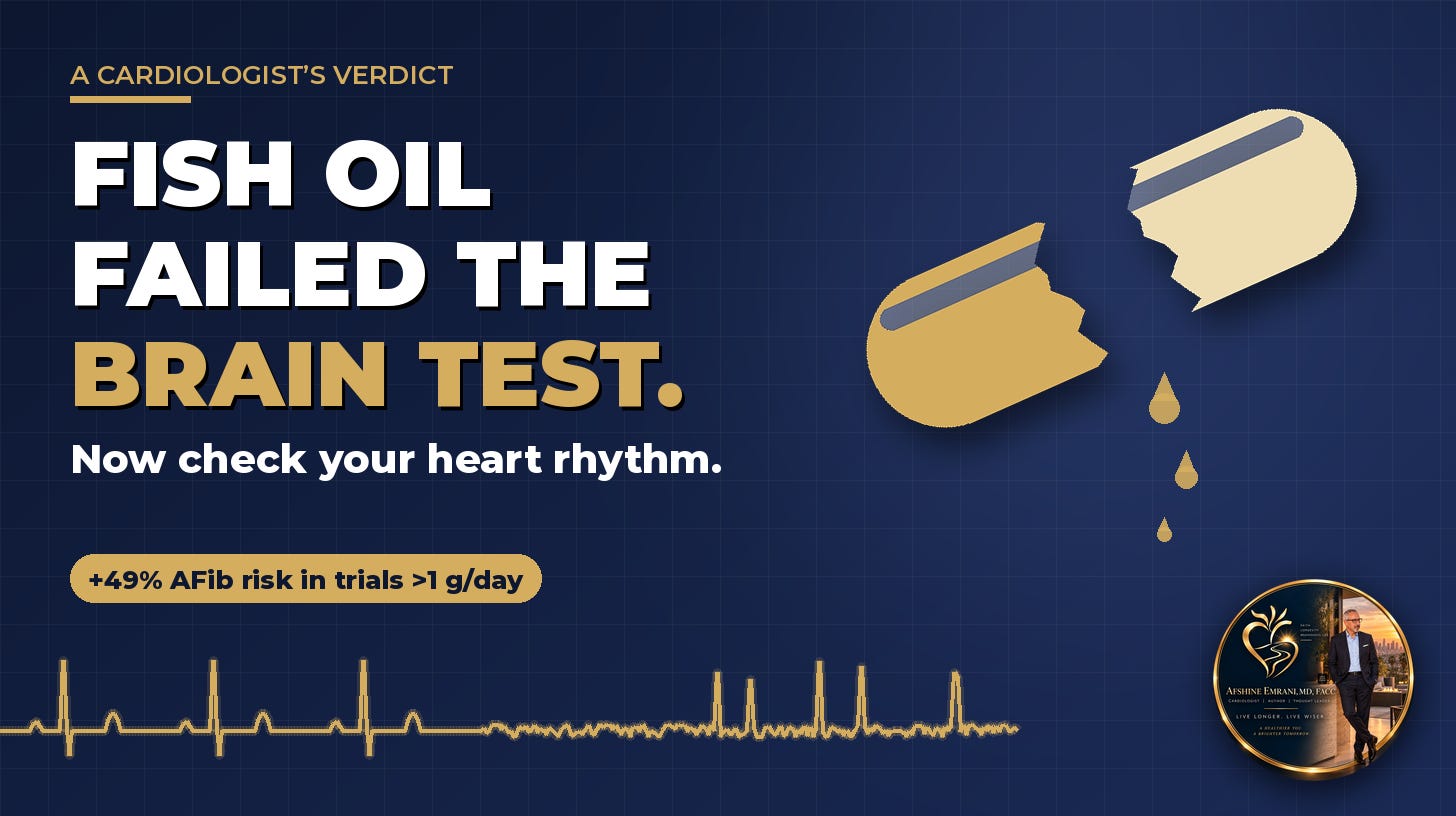
Now the number nobody prints on the bottle. A 2021 meta-analysis in Circulation pooled 7 trials and 81,210 patients. Omega-3 supplements were linked to a 25% higher risk of atrial fibrillation. In trials using more than 1 gram a day, the risk was 49% higher.
What I tell my patients
Fish oil is not a brain drug. It is not a reliable heart drug either, except in one specific form for one specific kind of patient. And for some people, the rhythm risk is real.
Your action plan
-
Stop taking fish oil to prevent memory loss. The most targeted trial we have found no benefit. Put that effort into blood pressure, sleep and exercise.
-
Read your label. Add up the EPA and DHA. If you are above 1 gram a day, ask your doctor whether that dose is worth the atrial fibrillation risk.
-
Watch your rhythm. If you have palpitations, a history of AFib, or a watch that flags an irregular rhythm, tell your doctor you take fish oil and ask for an ECG.
-
Know the one exception. If you have heart disease or diabetes, already take a statin, and still have high triglycerides, ask your cardiologist about prescription icosapent ethyl. It is the only omega-3 with a positive outcomes trial. It is not the warehouse-store capsule.
-
Eat fish instead of swallowing it. Salmon, sardines or mackerel twice a week gives you omega-3 with real food attached.
-
Measure what matters. Ask for apoB and a one-time Lp(a). They tell you more about your heart than any supplement shelf.
The deeper point
A long life is rarely found in a capsule. It is built from habits that cost little and ask for patience: walking, sleeping, eating real food, and knowing your numbers.
Are you still taking fish oil? Tell me why in the comments.
This is education, not medical advice.
Sources: USC DHA trial, eBioMedicine · VITAL, NEJM 2019 · REDUCE-IT, NEJM 2019 · STRENGTH, JAMA 2020 · Gencer et al., Circulation 2021
Blessings, Ash
Want the evidence on 433 longevity questions, graded? Get my book LONGEVITY UNMASKED on Amazon: https://www.amazon.com/dp/B0HNZ3MG41 · Explore it free at longevityunmasked.com
If this was useful, subscribe and forward it to one person who needs it.