Writings
What I Tell Patients Who Think Blood Pressure Targets Were Lowered to Sell Pills
Originally published on Substack.
A patient brought me a screenshot last week: “They lowered the numbers so more people buy pills.” He wasn’t angry at me. He was angry at a system he no longer trusts. If you’ve seen that same post, here’s what I tell him — and what the evidence actually says.
In SPRINT (NEJM 2015), 9,361 adults at high cardiovascular risk without diabetes were randomized to a systolic target under 120 versus under 140. Intensive treatment cut the rate of heart attack, stroke, heart failure, or cardiovascular death by about 25% (1.65% vs 2.19% per year; hazard ratio 0.75) and cut all-cause death (hazard ratio 0.73). There was a real cost: more hypotension, fainting, electrolyte problems, and acute kidney injury. SPRINT used unattended automated office readings, which run lower than a rushed clinic cuff — so “under 120” in that trial is not the same as a hurried reading in a noisy hallway.
STEP (NEJM 2021) in adults 60–80 in China also favored a tighter target (110–130 vs 130–150). The 2017 ACC/AHA guideline moved the hypertension threshold to 130/80 because outcome trials, not textbooks, changed. Old rules of thumb (”100 plus your age”) came before any randomized proof that treating blood pressure prevents strokes. The claim that “more people now qualify for treatment” is half right. The claim that targets moved to sell pills is not what the trials show.
What I tell patients:
-
Measure at home correctly — seated, back supported, arm at heart level, two readings, morning and evening for a week — then bring the log.
-
Your target is a conversation with your doctor, not a viral post. Age, frailty, kidney function, and fall risk matter.
-
For many with stage 1 and low risk, lifestyle comes first. For high risk, medicine saves lives — and side effects are real, so we watch them.
-
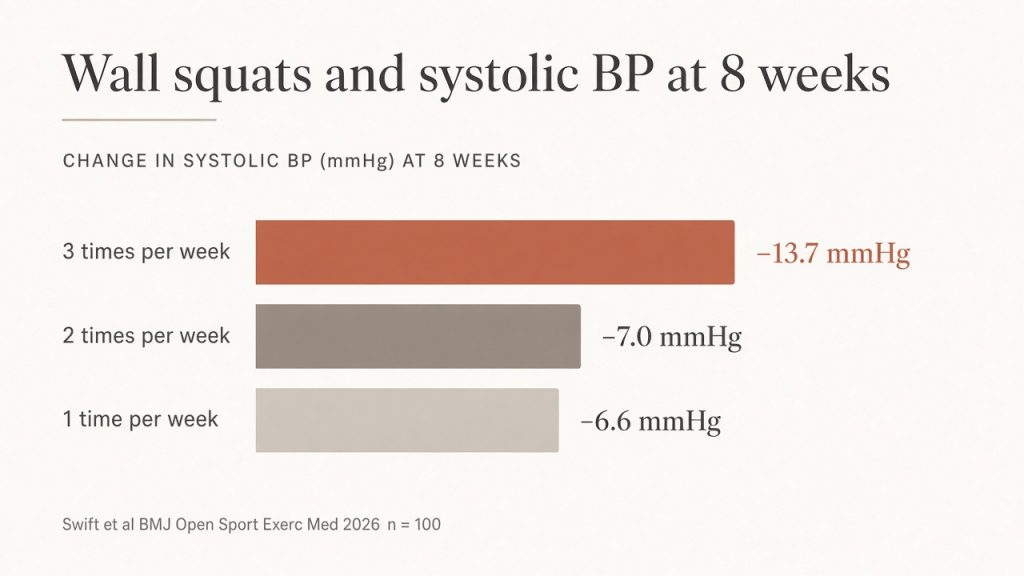
A new tool: isometric wall squats. Swift et al. (BMJ Open Sport & Exercise Medicine, 2026; n=100; mean age ~37; systolic 120–140, not on BP meds) had people do four 2-minute wall-squat holds, three times a week for four weeks, then 3, 2, 1, or 0 sessions a week. At eight weeks, continuing three times a week dropped systolic pressure about 13.7 mmHg from baseline; twice a week about 7.0; once a week about 6.6. Stopping erased the benefit. Caveats: small, short, young, not diagnosed hypertension, no heart-attack or stroke outcomes yet. Ask before you start if your pressure is uncontrolled or you’ve had a recent cardiac event.
The half-truth in the viral claim is that lower thresholds mean more conversations about treatment. The whole truth is that those conversations exist because randomized trials showed fewer strokes and deaths — and because we finally have simple tools, including a wall and a timer, that some people can try while we wait for bigger outcome studies.
If your cuff number has you scared or skeptical, bring both the number and the skepticism. They’re both data.
Blessings, Ash
Further reading: SPRINT NEJM 2015; STEP NEJM 2021; Swift et al. BMJ Open Sport Exerc Med 2026;12:e003172; ACC/AHA 2017 hypertension guideline.
More at DoctorEmrani.com