Writings
Why I Don’t Recommend Prenuvo full-body MRI “screening”
Originally published on Substack.
Short answer: If you are healthy and have no symptoms, don’t get a Prenuvo scan. Here’s why, in the order that matters most to you.
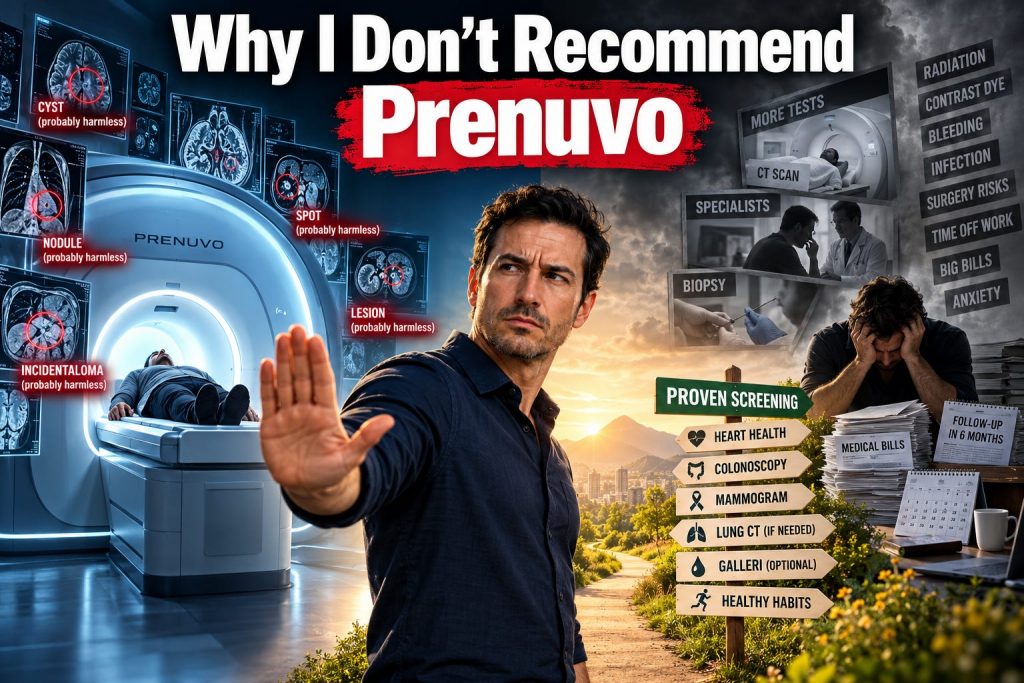
1. The scan will almost certainly find something
Out of every 100 healthy people scanned:
-
95 are told something looks abnormal.
-
About 30 are sent for more tests.
-
Only 1 or 2 actually have cancer.
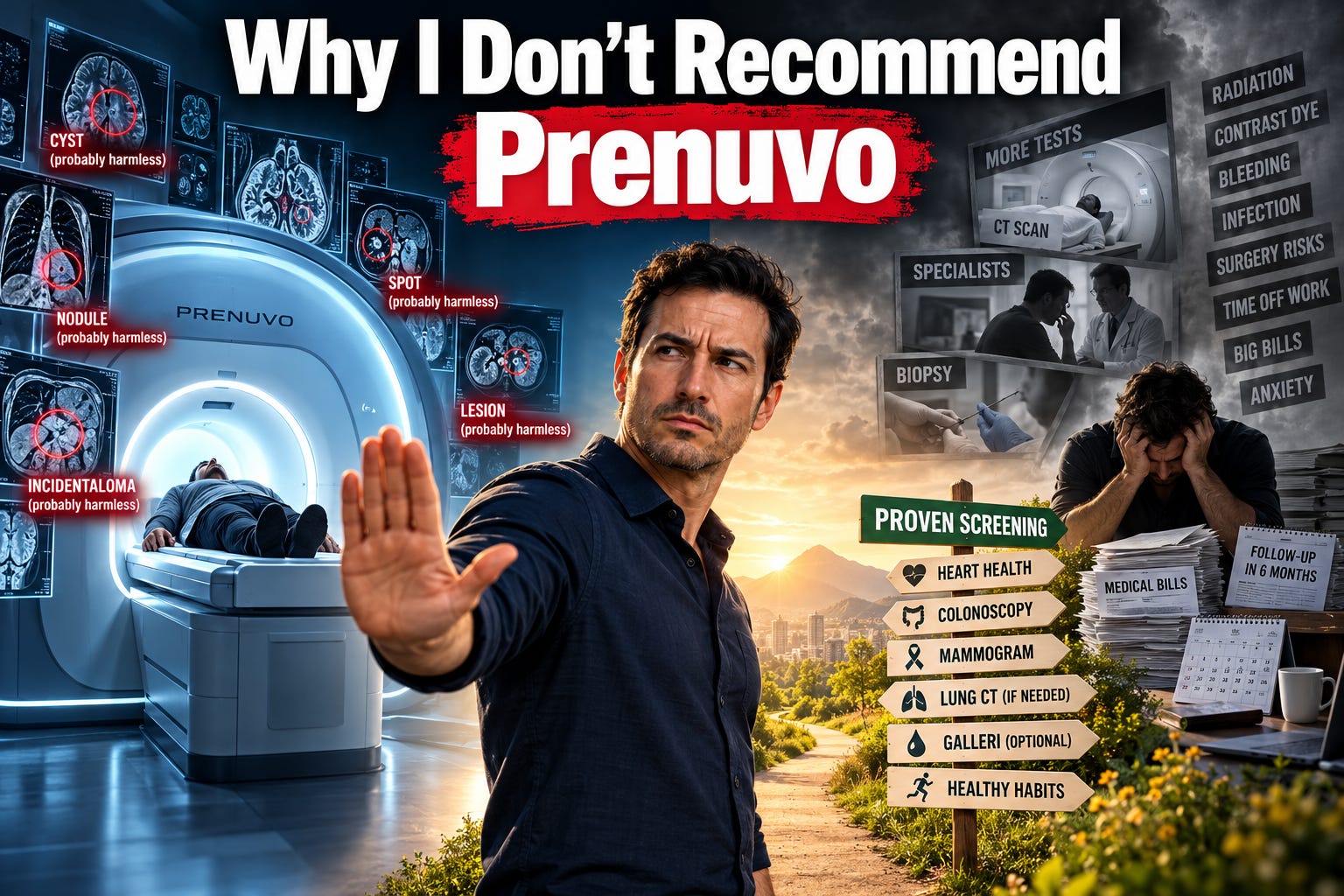
Most findings are harmless cysts, nodules and spots. Doctors call them “incidentalomas.” They were never going to hurt you — but once they’re on a report, they have to be dealt with.
2. More tests can hurt you
A harmless “spot” on your kidney leads to a CT scan. The CT is unclear, so you see a specialist. Then maybe a biopsy. Then a repeat scan in six months.
Each step has real risks: radiation, contrast dye, bleeding, infection, surgery complications. Plus time off work and bills insurance may not pay. You walked in healthy. You walk out a patient.
3. It finds “cancers” that would never have harmed you
Some cancers grow so slowly they never cause a problem in your lifetime. Many small thyroid, prostate and kidney cancers are like this. Once found, almost everyone gets them treated — and treatment can leave lasting side effects. Finding them doesn’t help you. It just turns you into a cancer patient.
4. The worry is real
Waiting weeks for a biopsy result is miserable. So is being told to “keep an eye on” a nodule for years. That anxiety is a real harm.
5. A clean scan does not mean you’re safe
MRI misses things. And a normal scan today says nothing about next year. The patient I worry about most is the one who skips a colonoscopy because “my Prenuvo was clean.”
6. There’s no proof it helps you live longer
Not one randomized trial shows full-body MRI saves lives in healthy people. Scans do find cancer in about 1.6% of people — but finding a cancer is not the same as saving a life. Mammograms, colonoscopy and lung CT for smokers all proved they reduce deaths. Full-body MRI has not.
7. Healthy people get mostly false alarms
This is simple math. When you test people who are unlikely to be sick, most “positive” results are wrong — even with a great machine. Screening works best when it’s aimed at people who actually have a real chance of the disease.
8. It’s expensive — and you’re the experiment
Prenuvo’s whole-body scan is about $2,500. The shorter scan is about $1,200. Memberships cost more. Insurance usually pays nothing, and the follow-up tests add up.
Prenuvo is running a 10-year, 100,000-person study to find out whether its scan works — and participants pay to join. The answer isn’t in yet. If you buy a scan today, you’re part of the experiment.
9. Don’t trust stories — trust data
“My friend’s scan found a tumor just in time.” I’m glad for that person. But you never hear about the people who had needless biopsies and years of worry.
In August 2026, Andrew Huberman posted that his neurosurgeon friends do lifesaving surgeries every month because of curiosity scans. Doctors pushed back hard. USA Today reported that he advises Function, a company that sells full-body MRI. When the storyteller has a financial tie to the product, be skeptical.
10. What the medical experts say
No major medical society recommends full-body MRI for healthy people.
-
American College of Radiology (2023): not enough evidence to recommend it; no proof it extends life.
-
Canadian Association of Radiologists (2025): policy statement against it.
-
American Academy of Family Physicians: on its Choosing Wisely “don’t do” list.
-
The Netherlands: screening healthy people with whole-body MRI isn’t allowed.
-
JAMA (May 2026): two radiologists titled their review “Buyer Beware” and concluded the harms likely outweigh the benefits.
Who should get a whole-body MRI
People with certain inherited cancer syndromes (like Li-Fraumeni), and some patients with blood cancers like multiple myeloma. If you have a strong family history or a known gene mutation, talk to your doctor. This article is about healthy people buying a scan “just to check.”
What to do instead
Spend your money and effort on tests proven to save lives:
-
Know your heart numbers: blood pressure, LDL cholesterol, blood sugar, and Lp(a) once.
-
Coronary calcium score if you’re borderline for a statin.
-
Colon cancer screening starting at 45.
-
Mammograms and cervical screening on schedule.
-
Low-dose lung CT if you’ve smoked heavily.
-
Talk about PSA if you’re a man in your 50s or 60s.
-
Aortic ultrasound once for men 65–75 who have ever smoked.
-
The basics: don’t smoke, move daily, sleep well, eat real food, limit alcohol.
Want more than standard screening? Consider Galleri
If you’re 50 or older and want to go beyond the standard tests, I believe the Galleri blood test is a much better choice than a full-body MRI. Galleri looks for DNA that cancers shed into the blood. It covers many cancers that have no screening test today, such as pancreatic, ovarian, liver and esophageal cancer.
Why it beats Prenuvo:
-
Very few false alarms. In the FDA’s review of the PATHFINDER 2 study, only 0.15% of people got a false-positive result — about 1 in 700. With full-body MRI, 95 out of 100 people are told something looks abnormal.
-
A positive result usually means something. About 3 out of 4 people who tested positive actually had cancer.
-
It tells doctors where to look. It predicted where the cancer was more than 90% of the time. That means a focused workup, not a fishing trip.
-
It has been tested in a randomized trial. The NHS-Galleri trial followed 142,000 people in England. By the third year, people who got the test had 26% fewer stage IV cancers, and 25% fewer cancers found in the emergency room. Full-body MRI has no randomized trial at all.
-
It’s a simple blood draw and costs less. No incidentalomas, and the average price is around $700.
-
It’s close to FDA approval. An FDA advisory panel voted in favor in September 2026. A final decision is expected in 2027.
What it can’t do:
-
It misses most cancers. It caught about 1 in 3 cancers diagnosed within a year — only about 1 in 4 breast cancers and 1 in 10 prostate cancers. A negative test is not an all-clear. Keep your mammogram, colonoscopy and other proven screening.
-
Its big trial missed its main goal. It did not reduce stage III and IV cancers combined, and we don’t yet know if it lowers deaths.
-
A positive result still means more tests. Most people who tested positive had at least one invasive procedure, such as a biopsy or scope.
-
It’s not FDA-approved yet and usually isn’t covered by insurance.
My take: Galleri isn’t proven to save lives yet either. But it’s built the right way — few false alarms, a focused workup, and real randomized data. If you want one more layer on top of proven screening, this is where I’d spend the money. Not on a $2,500 MRI.
Bottom line
Prenuvo sells peace of mind. What most healthy people get is harmless findings, more tests, and a big bill. Until a real trial proves it saves lives, save your $2,500 and do what’s proven. If you want one more layer, ask your doctor about Galleri.
— Dr. Afshine Emrani, MD, FACC
For general education only, not personal medical advice. If you have symptoms, a strong family history or a known genetic risk, talk with your own doctor.