Writings
10 Habits I Prescribe More Than Any Pill
Originally published on Substack.
I’ve been a cardiologist for over twenty-five years. Here’s what I’ve learned: the difference between the 70-year-old who hikes and the 70-year-old who can’t get out of a chair was almost never one big decision. It was ten small ones, repeated for decades, mostly unglamorous, mostly ignored.
None of these are new. That’s the point. They’ve survived every fad because they work. I’m not perfect at them either. But I’ve looked at the receipts, and the receipts are brutal.
Read to the end. There’s one at #9 most doctors have never even ordered for you.
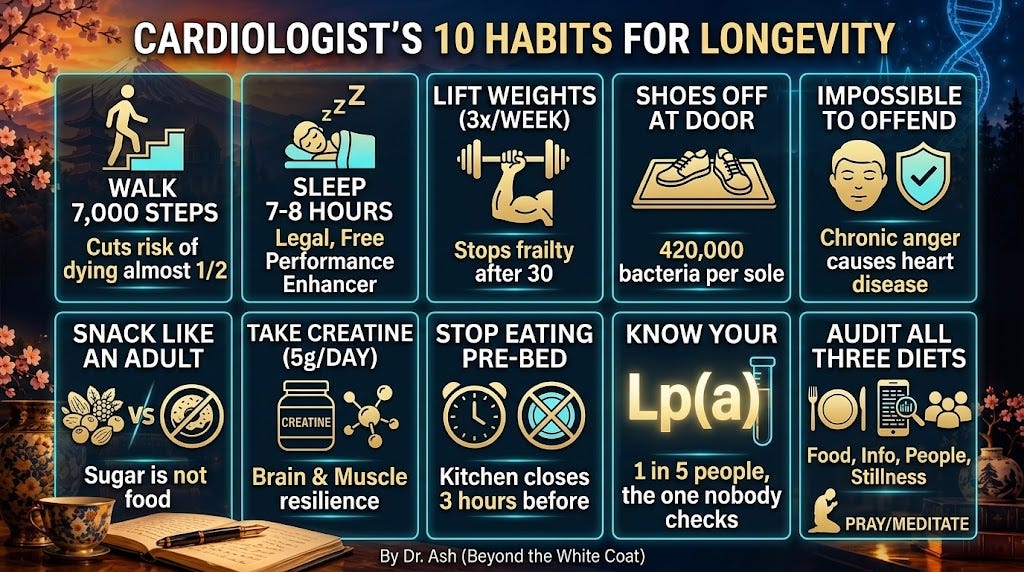
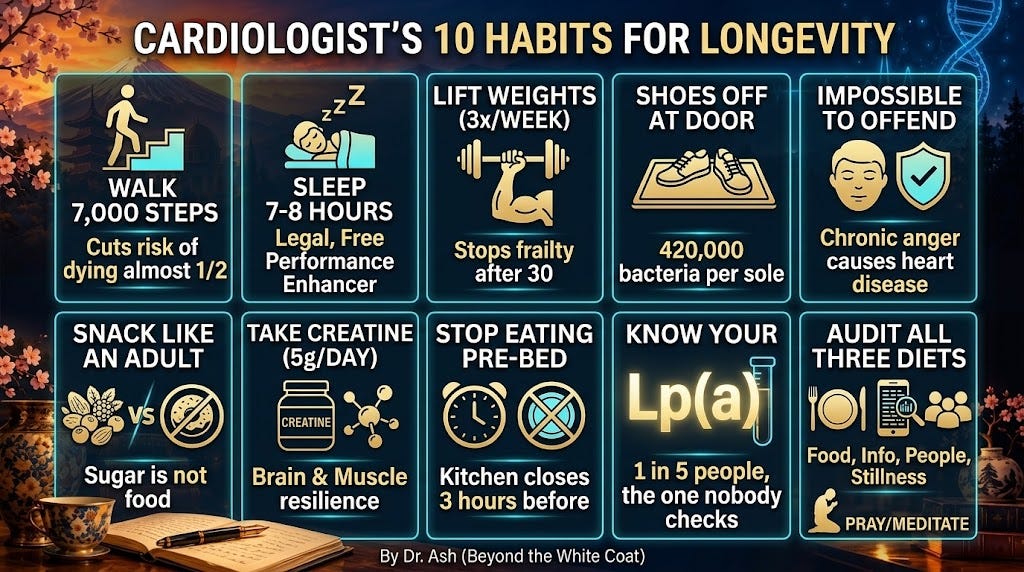
1. Walk 7,000 steps a day. It cuts your risk of dying almost in half.
The largest analysis ever done on this, 57 studies, over 160,000 people, published in The Lancet Public Health last year, found that people walking 7,000 steps a day had a 47% lower risk of death than people walking 2,000. Also: 25% less cardiovascular disease, 38% less dementia, 22% less depression, 28% fewer falls.
The average American walks about 4,000.
Ten thousand was a marketing number from a 1960s Japanese pedometer. Seven thousand is the science. And the benefits start climbing at 3,000, so if you’re at 4,000 today, every extra thousand counts.
This one habit outperforms almost every supplement on your shelf. Yet people will spend $200 a month on pills and refuse to park at the far end of the lot.
Do this: Walk after every meal for 10 minutes. That’s 3,000 steps you didn’t have, and it flattens your blood sugar spike while you’re at it.
2. Sleep is the only performance-enhancing drug that’s legal, free, and works every time.
You spend a third of your life doing it. There is no system in your body that doesn’t degrade when you cut it short: blood pressure, insulin sensitivity, testosterone, memory, immune function, appetite hormones, your ability to not snap at your spouse.
People who consistently sleep under six hours have higher rates of heart attack, stroke, obesity, and early death. This is not controversial in medicine. It’s just inconvenient.
Protect 7 to 8 hours like your future depends on it. It does.
Do this: Same wake time every day, including weekends. Wake time anchors the whole clock. Everything else follows.
3. Lift weights three times a week. After 30, it stops being optional.
You lose 3 to 8 percent of your muscle mass every decade after 30, and it accelerates after 60. Muscle is not vanity. It’s your glucose sink, your metabolic reserve, your bone density, and the only thing standing between you and a fall that ends your independence.
I’ve seen what “frail” looks like on a hospital bed. It’s not a number on the scale. It’s a person who can’t stand up without help. Strength training is what keeps you the person who gets up.
Do this: Squat, hinge, push, pull, carry. Two or three sets each, three days a week, progressively heavier. You don’t need a program. You need consistency and a barbell, or a pair of dumbbells, or your own body weight to start.
4. Take your shoes off at the door.
A University of Arizona microbiology study swabbed the bottoms of shoes and found fecal bacteria on 96% of them, roughly 420,000 bacteria per sole on average, including E. coli. Public restroom floors, sidewalks, gas station pavement. All of it comes home with you and ends up where your kids crawl and your dog sleeps.
Half the world figured this out centuries ago. The rest of us are still tracking the parking lot across the kitchen.
Do this: Bench by the door. House slippers. Non-negotiable for guests too. It’s not rude. It’s respect.
5. Become almost impossible to offend.
Thick skin is a cheat code. If you are easily triggered, you are easily manipulated, by algorithms, by advertisers, by the person at work who knows exactly which button to push.
Every offense you carry is cortisol you’re paying interest on. Chronic anger and hostility are independent risk factors for heart disease. I’ve seen the angiograms.
Forgive quickly. Not because they deserve it. Because you don’t deserve to carry it.
Do this: When something stings, wait 24 hours before responding. Ninety percent of the time, it won’t need a response at all. Let go. Then let go again.
6. Snack like an adult. Sugar is not food.
Most snacks are dessert with better marketing. Refined sugar spikes insulin, crashes energy, drives inflammation, and trains your brain to want more at 3 p.m. tomorrow.
The rule is simple: protein, fiber, or fat. Never naked sugar.
Snacks that actually work:
-
A handful of almonds, walnuts, or pistachios
-
Greek yogurt with berries and cinnamon
-
Two hard-boiled eggs
-
Apple or pear with almond butter
-
Hummus with cucumber, carrots, or bell peppers
-
Cottage cheese with cherry tomatoes and olive oil
-
Edamame with sea salt
-
A square of 85% dark chocolate when you need something sweet
Do this: Never keep the thing you can’t stop eating in the house. Willpower is for the grocery store, not the pantry.
7. Take creatine. Five grams. Every day.
Creatine monohydrate is one of the most studied supplements on earth, with decades of trials showing gains in strength, lean mass, and recovery, and a growing body of evidence for memory, processing speed, and cognitive resilience under stress and sleep deprivation. The safety data in healthy adults is extensive.
Most people still think it’s for bodybuilders. It’s for anyone who wants to keep their muscle and their mind.
The dose is 3 to 5 grams daily. You do not need to load. You do not need 10 or 15 grams. More is not better; more is just expensive urine.
Do this: 5 grams of plain creatine monohydrate in water or coffee, every day. Check your kidney function with your doctor first if you have any history of kidney disease. It will nudge your creatinine on a lab panel, which is normal and not damage, but your doctor should know you’re taking it.
8. Stop eating three hours before bed.
Your body has a clock. Insulin sensitivity is highest in the morning and falls at night. Eat the same meal at 9 p.m. instead of 6 p.m. and you’ll get a bigger glucose spike, burn fewer calories digesting it, and wake up hungrier. That’s not theory; that’s what controlled studies show when they feed people identical meals at different times.
Late eating also wrecks your sleep. Lying down with a full stomach means reflux, fragmented sleep, and a groggy morning. And the hours after dinner are where most of the damage happens anyway: the chips, the ice cream, the “just one more.”
Do this: Kitchen closes three hours before bed. Water, herbal tea, nothing else. Your sleep will improve within a week.
9. Know your numbers. Especially the one nobody checked.
You know your weight. You probably know your blood pressure. You might know your cholesterol.
But there’s a test called Lipoprotein(a), Lp(a), that one in five people carries at a dangerously high level, and almost nobody has been tested for it. It’s genetic. Diet and exercise barely move it. It significantly raises your risk of heart attack, stroke, and aortic valve disease, and it explains a huge share of the “healthy” people who drop dead at 52 with no warning.
You need it once in your life. It’s a simple blood test. Most doctors never order it.
Do this: At your next physical, ask for four things: blood pressure, ApoB (a better measure than LDL), Lp(a), and fasting insulin or HbA1c. If your Lp(a) is high, you and your doctor now know to be aggressive about everything else. Knowledge is the whole game here.
10. Audit your three diets: food, information, people.
Junk food and junk inputs compound the same way. So do junk relationships.
You already know the food part. Now look at the other two. What are you consuming for the first ten minutes of your morning? Who are the five people you spend the most time with, and how do you feel after you leave them? Energy vampires are real, and their bill is due every single day.
And the third pillar, the one my medical training never mentioned but my patients taught me: pray. Talk to God. I’ve spent decades watching what happens to people who face a diagnosis with faith versus without it. The ones who pray heal differently. They sleep differently. They forgive differently. Whether you call it prayer, meditation, or gratitude, five minutes of it a day is the cheapest intervention I know with the highest return.
Do this: Phone out of the bedroom. First 30 minutes of the day belong to you, not the feed. Cut one draining relationship this month. Add five minutes of prayer or stillness before you check anything.
The 90-day gap
Do these consistently for 90 days and you will be in better shape, physically and mentally, than 90% of the people around you. Not because they’re hard. Because almost nobody does them.
The gap at 40 between people who did this and people who didn’t is noticeable. At 50 it’s obvious. At 70 it’s brutal. One is traveling and picking up grandchildren. The other is in my waiting room, wondering how it happened so fast.
It didn’t happen fast. It happened one skipped walk, one late meal, one more hour of scrolling at a time.
Start today. Not all ten. Pick two. The one that feels easiest and the one that scares you most.
Then forward this to the person you want sitting next to you at 80.
Blessings.
Afshine Ash Emrani, M.D., F.A.C.C.
Assistant Clinical Professor, UCLA
David Geffen School of Medicine
Join Our new website
Castle-Connolly Nationwide Top Doctor (Since 2008)
Los Angeles Magazine Super Doctor (Since 2010)
LA Style Magazine Top 100 Doctors in America (2024)
Subscribe to mynewsletter: substack.com/@afshineemrani
Explore my books: Amazon Author Profile