Writings
CHRONIC STRESS: What it does. How to undo it!
Originally published on Substack.
Chronic stress does not live in your calendar. It lives in a loop that runs from brainstem to gut to immune cells and back again.
The loop was built to save you from a short threat — a predator, a fall, a fight. It fires, it protects you, it stands down. But modern life never sends the all-clear. So the loop keeps running. And what it produces is not “feeling stressed.” It’s something quieter and more expensive: a gradual rewrite of your sleep, your metabolism, your immune system, your arteries, and the very circuits your brain uses to turn danger off.
This is a field guide to what that rewrite actually does — and how to reverse it with actions that reach the two cables most people skip.
The system that never clocks out
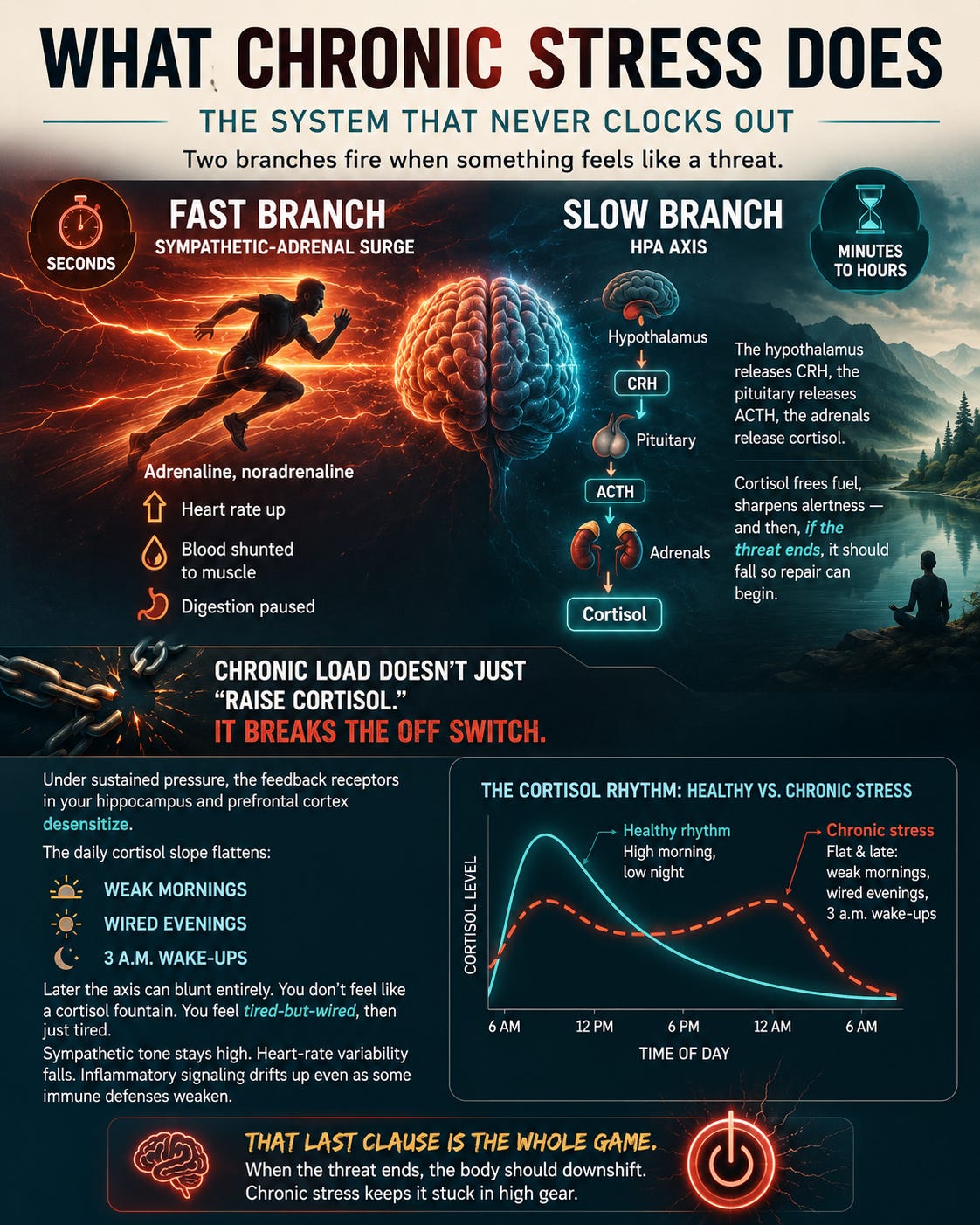
Two branches fire when something feels like a threat.
The fast branch is the sympathetic-adrenal surge: adrenaline, noradrenaline, heart rate up, blood shunted to muscle, digestion paused. This takes seconds.
The slow branch is the HPA axis. The hypothalamus releases CRH, the pituitary releases ACTH, the adrenals release cortisol. This takes minutes to hours. Cortisol frees fuel, sharpens alertness — and then, if the threat ends, it should fall so repair can begin.
That last clause is the whole game.
Chronic load doesn’t just “raise cortisol.” It breaks the off switch.
Under sustained pressure, the feedback receptors in your hippocampus and prefrontal cortex desensitize. The daily cortisol slope flattens: weak mornings, wired evenings, 3 a.m. wake-ups. Later the axis can blunt entirely. You don’t feel like a cortisol fountain. You feel tired-but-wired, then just tired. Sympathetic tone stays high. Heart-rate variability falls. Inflammatory signaling drifts up even as some immune defenses weaken.
That cumulative wear has a name: allostatic load. It is the bill for staying switched on.
What the rewrite actually does
Brain. Under long glucocorticoid exposure, memory circuits in the hippocampus prune their branches. The amygdala gets louder. Prefrontal braking gets weaker. Rumination isn’t a character flaw — it’s the same threat circuit firing with no body to run.
Sleep. Cortisol is a wake hormone. Evening leftover plus sympathetic residual fragments your deep sleep. Sleep loss then raises the next day’s reactivity. The loop feeds itself.
Metabolism. Fuel gets biased toward glucose and visceral storage. Insulin gets sloppy. Sex hormones and thyroid output get deprioritized. Midsection fat isn’t only calories — it’s a local cortisol amplifier.
Vessels. Psychosocial load tracks with cardiovascular risk in observational studies. The plausible paths: pressure load, endothelial strain, clotting tendency, low-grade inflammation. Stress is not “the cause of every heart attack.” It is part of the milieu that makes injury and clot more likely.
Immunity. Acute cortisol damps inflammation. Chronic dysregulation does the opposite over time — more inflammatory chatter, worse recovery after the hard month, and the classic collapse on the first day of vacation.
None of this requires a dramatic life. Unfinished decisions, rumination, late-night light, isolation, and a gut that keeps sending threat packets are more than enough.
The missing off-switch: your vagus nerve
The vagus is the main parasympathetic highway. Here’s the fact that reframes everything: roughly 80% of its fibers run up — from body to brain, not the other way around.
It reports on gut stretch, inflammation, heart rhythm, and whether the world feels safe enough to digest. When vagal tone is high, your heart rate varies beautifully beat to beat, inflammation quiets, and the HPA axis can finally stand down. When tone is low, the body stays “on call.”
You don’t “find your vagus.” You train the conditions that recruit it. Ranked by mechanism and evidence — not by how photogenic they look:
1. Resonance-frequency breathing (the strongest at-home lever). Breathe at roughly 4.5–7 breaths per minute — your personal resonance frequency, often near six — so your blood-pressure waves and heart rhythm lock into phase. Baroreceptors fire. Brainstem nuclei recruit vagal outflow. Meta-analyses show meaningful drops in anxiety and gains in HRV after weeks of practice. Five to twenty minutes daily beats an occasional hour. No sensor? Inhale 4, exhale 6–8. Sit or lie down, nose in, slow out, ten minutes after waking or before bed.
2. Cold on the face — not a personality contest. Cold water on the forehead and eyes triggers the mammalian diving reflex through the trigeminal nerve, which pulls in vagal bradycardia. A bowl of cold water or a 20–30 second face dunk is closer to the physiology than a heroic ice bath. Full-body plunges are a stressor — useful for some, destabilizing if you’re already flattened, sleep-broken, or cardiac-risk. Face first. Short. Then breathe.
3. Voice: hum, sing, gargle. The vagus innervates the larynx and pharynx. Vibration plus a long exhale is the point — not volume. Sixty to 180 seconds of a comfortable hum after a hard meeting is enough. The evidence is thinner than for paced breathing, but the risk is near zero. Use it as a spike-breaker, not a religion.
4. Exercise that finishes the sprint. A walk, a set of stairs, a shake-out after conflict completes the motor pattern the alarm started. Moderate aerobic and Zone 2 work raise HRV over weeks. Redlining daily on an already-loaded axis is more threat, not more tone.
5. Social safety. A calm voice, eye contact, physical presence — these are direct ventral-vagal inputs. Isolation isn’t neutral; it’s a biological amplifier of load. Schedule people the way you schedule training.
6. Devices: taVNS and implanted VNS. Implanted cervical VNS is a real medical therapy for specific epilepsy, treatment-resistant depression, and some inflammatory conditions — not a wellness gadget. Transcutaneous auricular VNS (taVNS) stimulates the ear’s auricular branch and shows shifts toward parasympathetic dominance with mixed psychophysiology. Parameters matter enormously: site, frequency, duration, sham quality. Consumer neck clips routinely outrun the data. If you try one, treat it as an experiment with published settings. Pacemakers, active implants, or certain ear conditions — ask a clinician first.
7. Mostly hype. Endless “vagus hacks,” ice-bath identity, and gadgets promising to reset your nervous system in four minutes. Breathing, sleep, movement, and people still do most of the work.
A practical stack for most bodies: resonance breathing daily, a face-cold or cool-shower finish a few times a week, a hum when the spike hits, a walk after meals, protected sleep. Add taVNS only when the basics are already boringly consistent.
The other cable: the gut
The gut is not a side quest. It is a second stress organ, and it talks to your brain four ways at once.
-
Neural. Vagal afferents and spinal pain fibers carry stretch, toxin, and immune signals up to the brainstem, then to the hypothalamus and limbic system. Your enteric nervous system can run digestion without you — but it still reports upstairs.
-
Immune. When the barrier leaks, fragments like LPS and peptidoglycan meet pattern-recognition receptors. Cytokines (IL-6, TNF-α, IL-1β) then activate the HPA axis and microglia.
-
Endocrine. Cortisol and CRF change motility, mucus, and permeability. Enteroendocrine cells release serotonin, GLP-1, and PYY — signals that also hit vagal endings.
-
Metabolic. Microbial short-chain fatty acids (butyrate, acetate, propionate), tryptophan metabolites, and bile-acid products shape inflammation, barrier tightness, and even the daily timing of your cortisol.
Here’s the part that makes chronic stress so sticky — it’s a two-way street:
Stress → CRF and sympathetic drive scramble motility, thin the mucus layer, loosen tight junctions. Microbiome diversity drops. Opportunists rise. Those microbes and their fragments then push the HPA axis back on. Germ-free animals show exaggerated stress-hormone responses to restraint — and colonizing them early can reset the set point. Newer work shows the microbiota even helps keep your daily cortisol rhythm on schedule. Wipe the microbes, and both the brain’s stress clock and the daily glucocorticoid wave drift.
That is one reason nights feel wrong when the gut is wrong.
So “fix stress and the stomach follows” and “fix the gut and anxiety vanishes” are both half-true. They’re the same circuit.
What to do with that:
-
Feed the barrier, not a brand. Plant fiber, resistant starch, and fermented foods give microbes the substrate for butyrate — the fuel of your colon cells and a signal that tightens junctions. If fiber wrecks you at first, go slow. That’s adaptation, not a moral failing.
-
Cut the daily hits that open the gate. Alcohol, ultra-processed meals, all-day grazing, and late heavy dinners keep insulin and CRF elevated the same night the HPA is trying to fall. A 3-hour buffer before bed isn’t dogma — it’s fewer glucose swings demanding a nocturnal cortisol mop-up.
-
Use microbes as a tool, not a miracle. Human probiotic evidence is strain-specific and modest. A multi-strain product for 8 weeks is a reasonable experiment if bloating, urgency, or post-meal brain fog are part of your stress picture. Stool tests as identity are mostly theater.
-
Recruit the vagus from below. Slow eating, warmth, not working through lunch, a walk after the meal — all afferent inputs. The same nerve that slows the heart tells the brain the gut is not under siege.
The reversal protocol
Pills without safety, completion, and rhythm are expensive coping. Do this in order.
Daily, non-negotiable
-
Light. Outside light in your eyes within 30 minutes of waking — no sunglasses for that window. The HPA clock takes its cue from your retina, not your intentions.
-
Water, then coffee. Early cortisol is already climbing. Stacking caffeine on an empty, dry system is a reliable morning-anxiety machine. Cut caffeine by noon if sleep is thin.
-
Ten minutes of resonance breathing. Longer exhale. Same time each day. This is your vagal set.
-
Walk after the main meal. No phone. Glucose stays quieter; the vagus stays in the conversation.
-
Close one loop. One decision, one message, one unfinished task. Background tabs are cortisol.
-
Dark, cool, phone in another room. Cortisol is a wake signal. Light and the “is something incoming?” pulse keep the night sympathetic.
When the spike hits
Hum for 60 seconds. Or splash cold on your face. Or take the stairs. Complete the cycle the alarm started — then one long exhale.
Weekly
Real social contact on the calendar. One environment audit: who leaves you smaller? Heat plus a brief cool if you tolerate it. Skip heroic cold if your sleep collapses afterward.
Food that serves the axis
Protein early if mornings shake. Plants and fermented foods if the gut can take them. Last calories earlier. Enough carbohydrate around training so the axis isn’t scavenging. Not a religion of macros — just fewer emergency pulses.
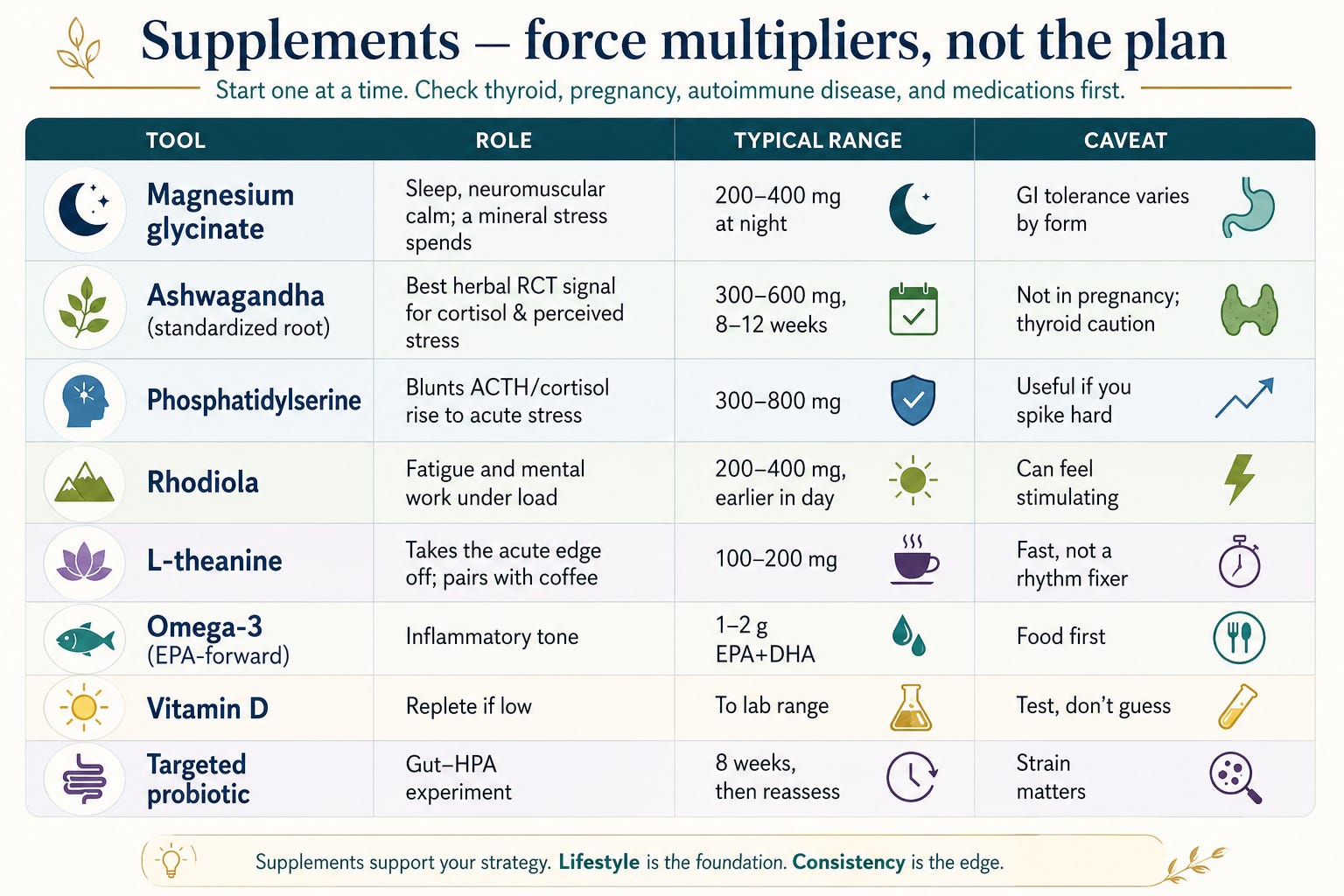
Supplements — force multipliers, not the plan
Start one at a time. Check thyroid, pregnancy, autoimmune disease, and medications first.
How you’ll know the hardware is changing
Don’t worship a single cortisol number. Watch a cluster over four to eight weeks:
-
Sleep latency and 3 a.m. wake count
-
Morning energy vs. afternoon crash
-
Resting heart rate and HRV trend
-
How fast you come down after a spike
-
Bloating, urgency, post-meal fog
-
Patience and empathy — chronic load shrinks the social brain
Rhythm and caffeine changes can move sleep in days. Body composition and “I feel like myself again” take 6–12 weeks if the load built over years. That’s appropriate. You’re retraining a clock, a nerve, and an ecosystem — not flipping a switch.
The sentence to keep
Your body is not broken. It is still running a program that used to keep you alive. The program cannot tell a notification from a predator, or a restless gut from a wound.
You do not out-think a loop that lives in the brainstem, the vagus, the immune system, and the microbes that set your daily cortisol wave. You give the loop proof: light at dawn, a long exhale, a finished sprint, a meal that doesn’t keep the night on call, people who are safe, and fewer hours rehearsing lions that are not in the room.
Do the boring pieces first. Use cold, voice, and devices as accessories. Feed the barrier. Measure more than mood.
Give it thirty honest days.
Blessings.
Afshine Ash Emrani, M.D., F.A.C.C.
Assistant Clinical Professor, UCLA
David Geffen School of Medicine
Join Our new website
Castle-Connolly Nationwide Top Doctor (Since 2008)
Los Angeles Magazine Super Doctor (Since 2010)
LA Style Magazine Top 100 Doctors in America (2024)
Subscribe to mynewsletter: substack.com/@afshineemrani
Explore my books: Amazon Author Profile