Writings
HELD BENEATH AN OPEN SKY
Originally published on Substack.
I spent much of my childhood believing that life would eventually become easier. School was difficult for me in ways I did not always know how to explain. Other children seemed to read a page and simply understand it; I sometimes had to wrestle with the same words until they surrendered their meaning. So I learned early to work harder, to prepare, to carry the quiet fear of falling behind. Years later came medical school, residency, cardiology, marriage, children, aging parents, and patients whose phone calls sometimes carried the worst news of their lives. Somewhere along the way, I stopped waiting for the easy part. Medicine taught me that there is always another test result, another scan, another family worried about someone they love. Physicians are not exempt from being human because we wear white coats. We carry our patients, our families, our regrets, our unfinished conversations, and the expectation that somehow we should hold all of it without trembling. Perhaps growing older is discovering that life does not become lighter. We simply become more skilled at carrying what is heavy.
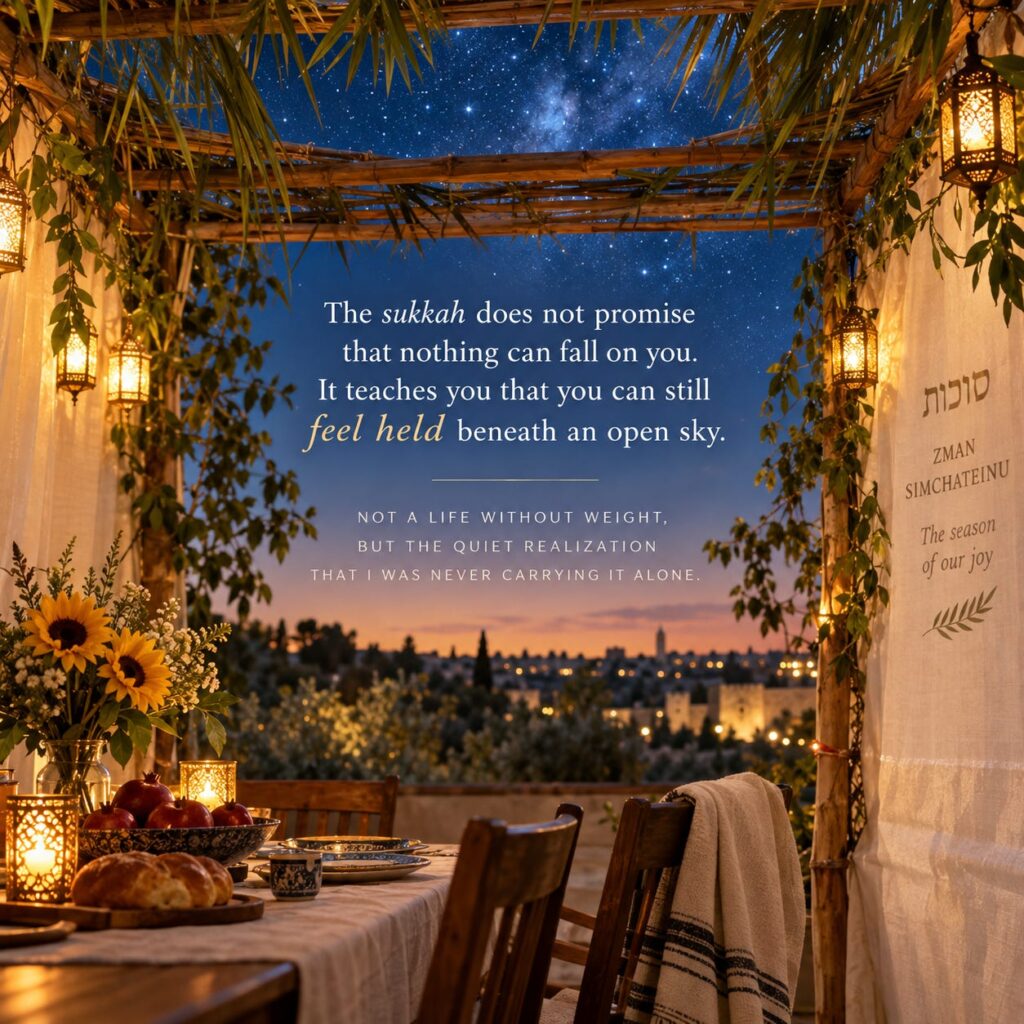
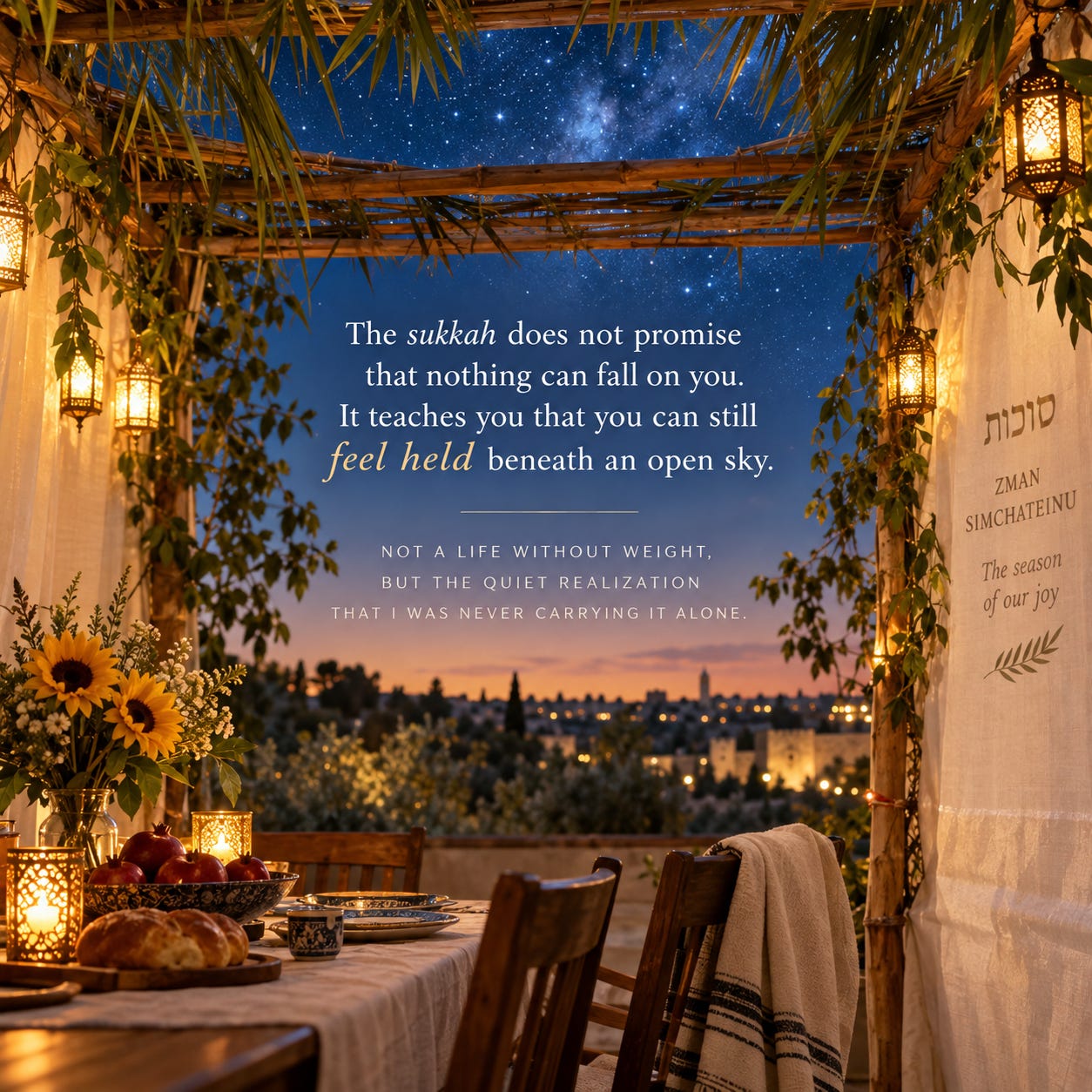
But Judaism introduced me to a radically different possibility: perhaps God never asked us to carry everything. I feel this most powerfully when Yom Kippur ends and Sukkot arrives almost before we have caught our breath. We spend Yom Kippur examining ourselves with almost surgical intensity. We confess. We remember. We confront the distance between who we are and who we hoped to become. Then Judaism does not tell us to remain in the synagogue analyzing ourselves. It sends us outside. Build a fragile hut. Eat there. Sing there. Look through a roof deliberately constructed so it cannot completely protect you, and notice the stars. The sukkah does not promise that nothing can fall on you. It teaches you that you can still feel held beneath an open sky. We spend enormous energy trying to make life secure: controlling blood pressure, screening for cancer, saving money, protecting our children, planning for every contingency. These things matter. But eventually every human being encounters something that cannot be controlled. Sukkot whispers: security was never the same thing as certainty. Real security is knowing Who remains with you when certainty disappears.
Maybe that is why Sukkot feels increasingly precious to me as I grow older. I no longer enter the sukkah expecting seven days without problems. The phone may still ring. Someone I love may still be struggling. My children will have journeys I cannot walk for them. My parents will not be here forever. Neither will I. The sukkah does not ask me to pretend otherwise. It asks me to loosen my grip. Sit down. Look around. Notice who is at the table. Taste the food. Hear the laughter. Thank God for this fragile, breathtakingly beautiful life while it is actually happening. Perhaps that is why the Torah calls Sukkot zman simchateinu—the season of our joy. Not because everything has finally been fixed, but because joy was never supposed to wait until everything was fixed. We spend half our lives asking God to remove the uncertainty, while God may be asking us to discover Him inside it. When Sukkot ends, I will put the white coat back on. The responsibilities will still be waiting. But I hope to carry them differently: responsible for much, but not responsible for everything. Perhaps that is what faith finally becomes: not a life without weight, but the quiet realization that I was never carrying it alone.
Wishing you a joyous season of overcoming.
Come walk with me.
Afshine Ash Emrani, M.D., F.A.C.C.
Assistant Clinical Professor, UCLA
David Geffen School of Medicine
Join Our new website
Castle-Connolly Nationwide Top Doctor (Since 2008)
Los Angeles Magazine Super Doctors (every year since 2013)
LA Style Magazine Top 100 Doctors in America (2024)
Subscribe to mynewsletter: substack.com/@afshineemrani
Explore my books: Amazon Author Profile