Writings
My Executive Physical Blood Test menu—and the conversation you deserve after the results arrive.

Originally published on Substack.
I went out to dinner with a couple of friends recently, and they told me something I could not get out of my head.
They were paying $18,000 between them to a “concierge doctor” for an executive health assessment.
From their description, the service largely amounted to ordering bloodwork at Quest. They still had to pay for the laboratory tests separately. And afterward, they barely received time with the doctor to understand what the results meant.
I have not reviewed their agreement, their medical records, or the exact tests ordered. But the experience they described bothered me.
People are willing to invest in their health. They want to catch trouble early. They want to stay strong, think clearly, and be present for the people they love.
They deserve to understand what they are paying for.
You should never leave an expensive physical knowing more about the bill than about your body.
A thorough physician assessment has real value: the history, examination, judgment, explanation, treatment decisions, and follow-up. Many blood tests themselves are established laboratory services available through a regular physician.
So let me do you a favor.
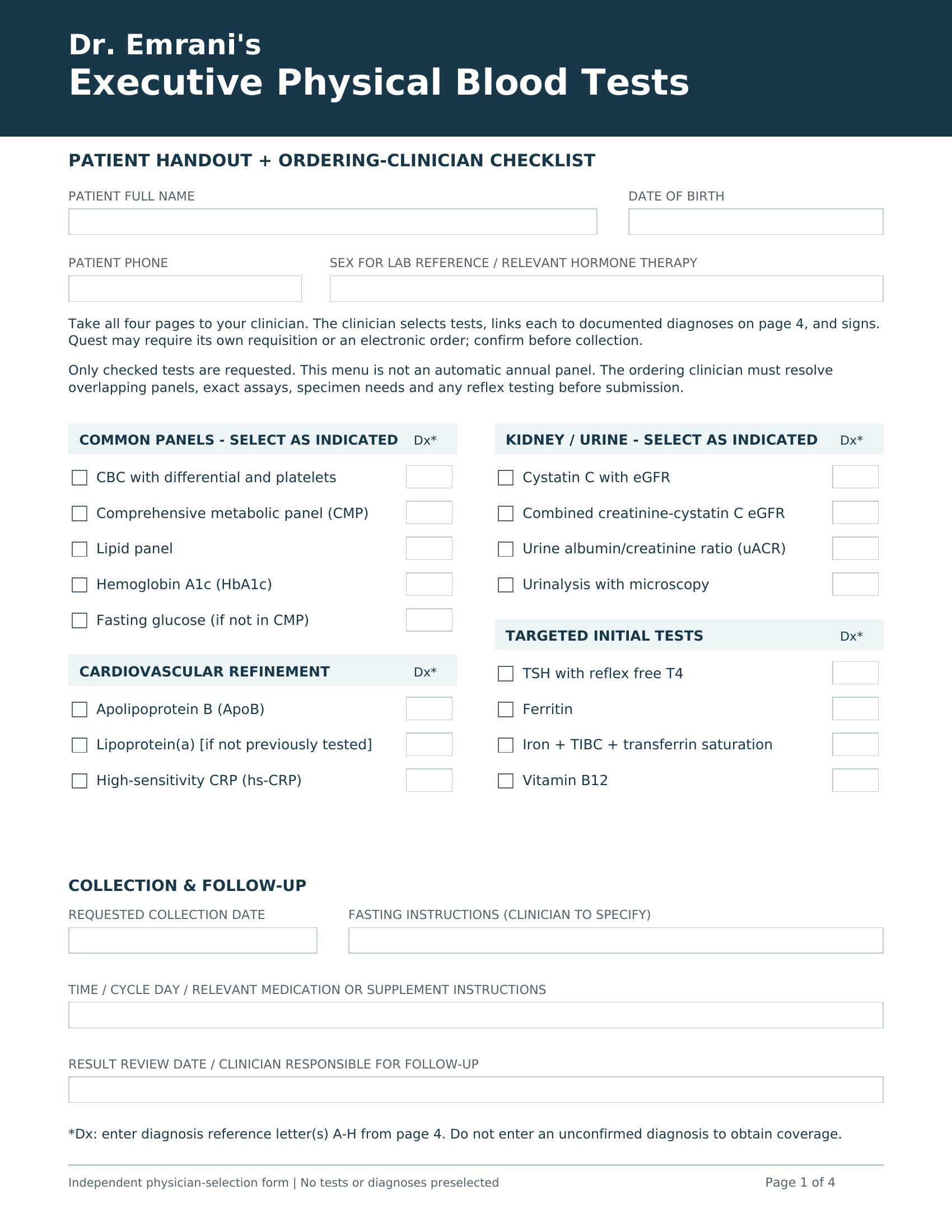
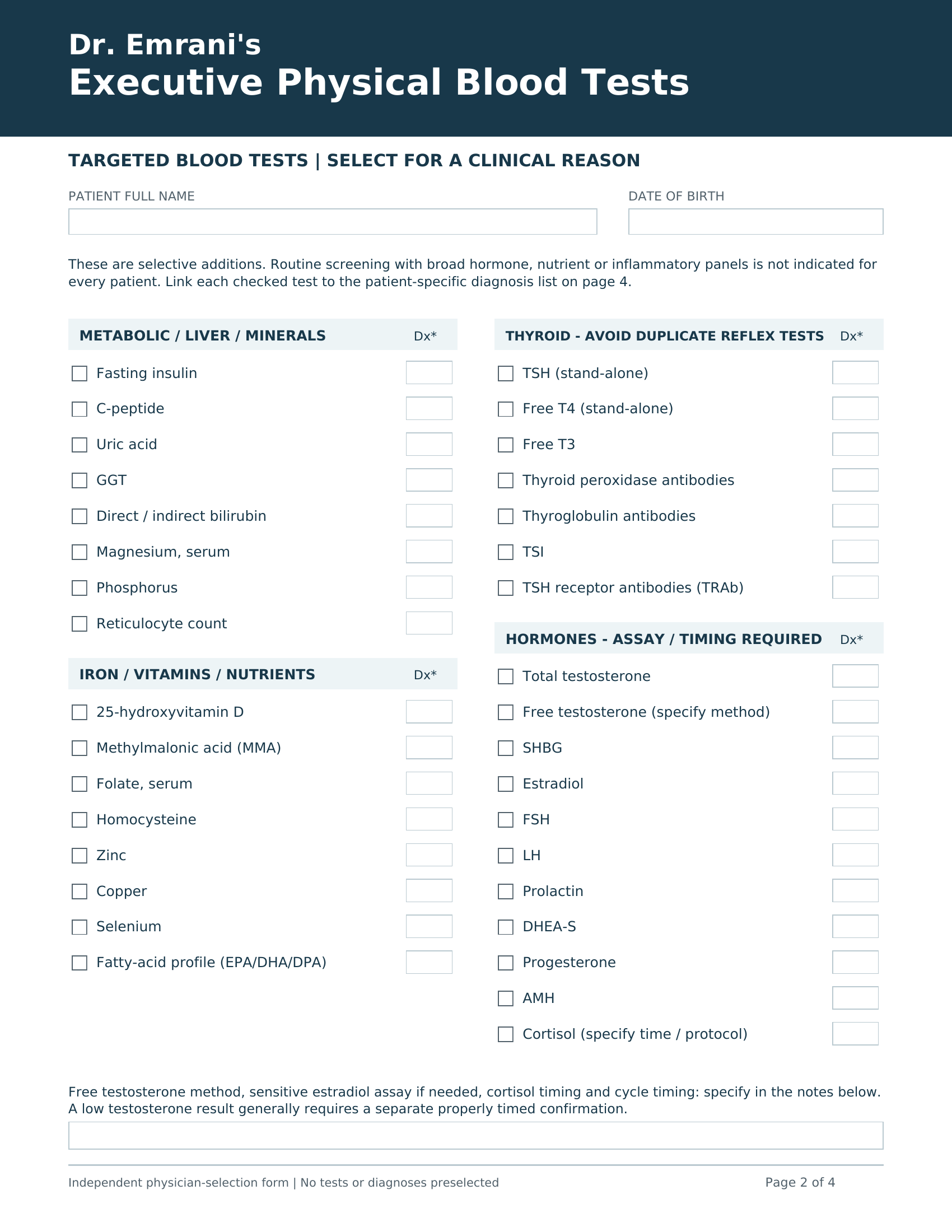
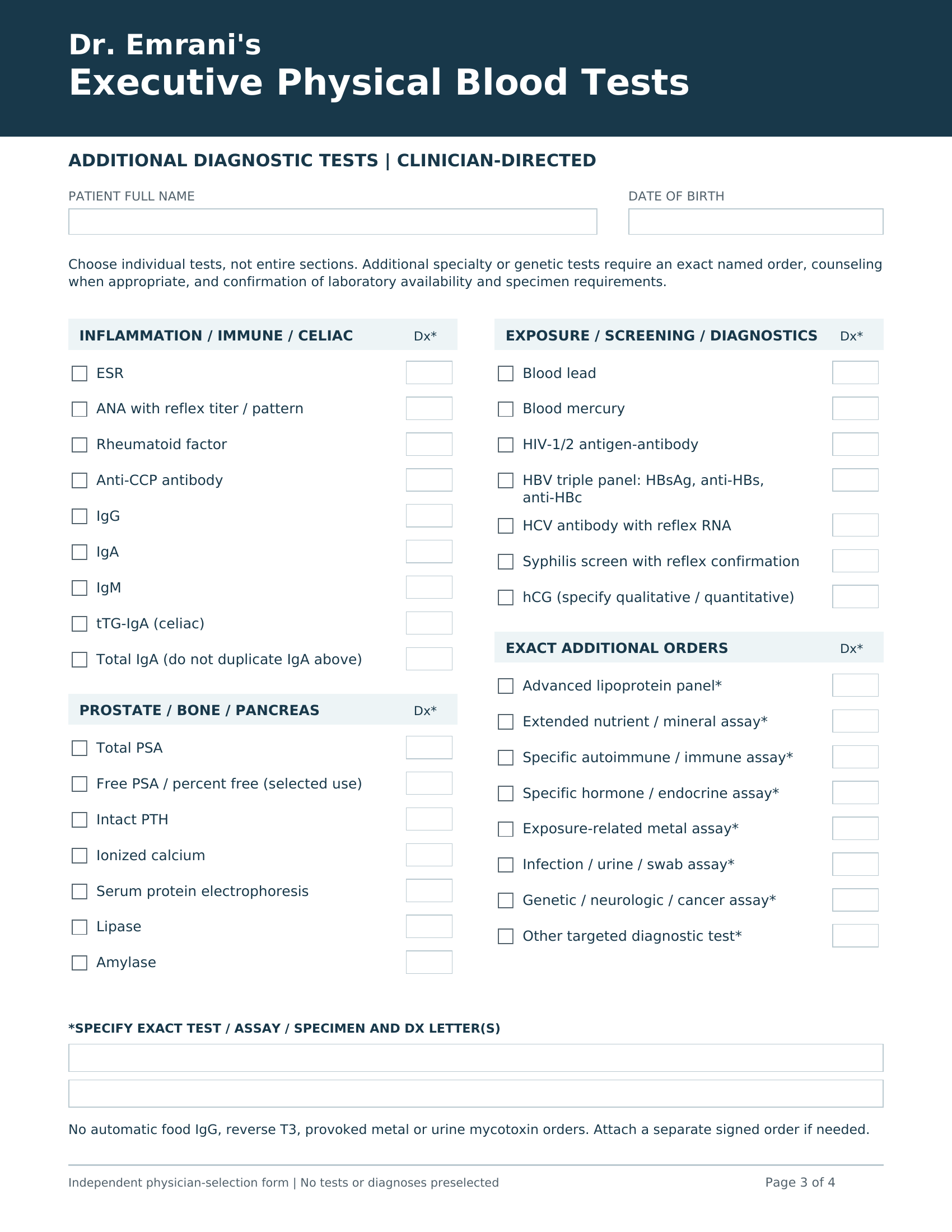
Below is an organized menu of tests to discuss with your doctor before purchasing an executive or longevity package.
It is not a claim that my friends received this exact menu. It is a way to make the conversation—and the options—clear.
The lab report should be the beginning of your care, not the end of your appointment.
EMRANI EXECUTIVE PHYSICAL BLOOD TEST
A comprehensive menu for a personalized physician assessment
This is a selection menu. Your doctor should choose tests based on your age, symptoms, family history, medications, previous results, and goals. Everyone does not need every test, and every test does not need repeating annually.
Many individual markers are already included in a CBC, metabolic panel, or lipid panel.
01 — HEART & CHOLESTEROL
Understand cholesterol, lipoprotein particles, and inherited cardiovascular risk.
Lipid assessment
-
Total cholesterol
-
LDL cholesterol
-
HDL cholesterol
-
Triglycerides
-
Non-HDL cholesterol — calculated
-
Total cholesterol/HDL ratio — calculated
Additional risk assessment
-
Apolipoprotein B — ApoB
-
Lipoprotein(a) — Lp(a)
-
High-sensitivity C-reactive protein — hs-CRP
Selected advanced options
-
LDL particle number
-
Small LDL and medium LDL
-
LDL pattern and peak size
-
Large HDL
-
Apolipoprotein A-I — ApoA-I
-
ApoB/ApoA-I ratio — calculated
What matters: Lp(a) should generally be measured at least once in adulthood. ApoB can help refine risk assessment. Advanced particle testing should have a specific purpose rather than duplicate other results.
02 — BLOOD SUGAR & METABOLIC HEALTH
Look for diabetes risk and investigate specific metabolic concerns.
Established screening options
-
Fasting glucose
-
Hemoglobin A1c — HbA1c
Selected additional tests
-
Fasting insulin
-
C-peptide
-
Uric acid
-
Leptin
-
Adiponectin
-
Oral glucose tolerance test — when indicated
Calculated or specialized measures
-
HOMA-IR, calculated from fasting glucose and insulin
-
Laboratory-specific insulin-resistance scores
What matters: Fasting insulin and HOMA-IR do not have one universally accepted diagnostic cutoff for everyone. Leptin and adiponectin are not routine screening requirements.
03 — BLOOD COUNT & IMMUNE CELLS
Evaluate blood cells, anemia, and other findings in the appropriate clinical context.
Complete blood count with differential
-
White blood cell count
-
Neutrophils
-
Lymphocytes
-
Monocytes
-
Eosinophils
-
Basophils
-
Red blood cell count
-
Hemoglobin and hematocrit
-
MCV, MCH, MCHC, and RDW
-
Platelet count and mean platelet volume
Additional tests when needed
-
Reticulocyte count
-
Blood type and Rh factor — when there is a reason to document them
What matters: Most of this section is one CBC order, not a collection of separate blood tests.
04 — LIVER HEALTH & BLOOD PROTEINS
Assess liver-related findings and protein levels.
-
ALT
-
AST
-
Alkaline phosphatase — ALP
-
Gamma-glutamyl transferase — GGT
-
Total bilirubin
-
Albumin
-
Total protein
-
Globulin — calculated
-
Albumin/globulin ratio — calculated
Selected follow-up
-
Direct and indirect bilirubin
-
FIB-4 calculation in an appropriate liver-risk assessment
What matters: A comprehensive metabolic panel already includes most of these measurements. GGT is usually ordered separately. FIB-4 uses existing results and age rather than another blood draw.
05 — KIDNEY HEALTH
Assess filtration and investigate possible kidney damage.
Blood tests and calculations
-
Creatinine
-
Blood urea nitrogen — BUN
-
Estimated glomerular filtration rate — eGFR
-
BUN/creatinine ratio
-
Cystatin C — when additional clarification is needed
-
Combined creatinine–cystatin C eGFR — when appropriate
Companion urine test
-
Urine albumin-to-creatinine ratio — uACR
What matters: Blood albumin and urine albumin answer different questions. uACR is particularly relevant in diabetes, hypertension, and other kidney-risk settings.
06 — ELECTROLYTES & MINERALS
Assess fluid balance, mineral abnormalities, and medication-related concerns.
-
Sodium
-
Potassium
-
Chloride
-
Bicarbonate/total carbon dioxide
-
Calcium
-
Magnesium — selected testing
-
Phosphorus — selected testing
What matters: A CMP already includes sodium, potassium, chloride, bicarbonate, and calcium. Confirm the magnesium assay and specimen rather than assuming RBC magnesium is always superior.
07 — THYROID
Investigate thyroid symptoms and clarify abnormal thyroid results.
Usual starting point when testing is indicated
-
TSH, often with reflex free T4
Targeted additions
-
Free T3
-
Thyroid peroxidase antibodies — TPO antibodies
-
Thyroglobulin antibodies
-
Thyroid-stimulating immunoglobulin — TSI
-
TSH receptor antibodies — TRAb
-
Thyroxine-binding globulin — TBG
What matters: These tests answer different questions. A complete thyroid panel is not automatically needed. Reverse T3 does not belong in routine screening.
08 — IRON, VITAMINS & NUTRITION
Investigate suspected deficiencies, excesses, or absorption problems.
Iron assessment
-
Ferritin
-
Serum iron
-
Total iron-binding capacity — TIBC
-
Transferrin saturation — calculated
Selected vitamin and nutrient tests
-
25-hydroxyvitamin D
-
Vitamin B12
-
Methylmalonic acid — MMA
-
Folate
-
Homocysteine
-
Zinc
More specialized options
-
Copper
-
Selenium
-
Iodine
-
Vitamin A — retinol
-
Vitamin E — tocopherols
-
Coenzyme Q10
-
Chromium
-
Molybdenum
What matters: Select testing for a clinical reason. Routine vitamin D screening is not recommended for generally healthy adults. Homocysteine is not a universal longevity target, and lowering it has generally not reduced heart attacks or strokes.
09 — FATTY-ACID PROFILE
Optional assessment of measured fatty-acid status.
-
EPA
-
DHA
-
DPA
-
Total omega-3
-
Arachidonic acid
-
Linoleic acid
-
Total omega-6
-
Omega-6/omega-3 ratio
-
Arachidonic acid/EPA ratio
What matters: Results depend on the specimen and laboratory method. These ratios are not stand-alone instructions for supplements or restrictive diets.
10 — REPRODUCTIVE & SEX HORMONES
Investigate specific symptoms, reproductive questions, or treatment needs.
Select according to the person and the clinical question
-
Total testosterone
-
Free testosterone
-
Sex hormone-binding globulin — SHBG
-
Estradiol — E2
-
Follicle-stimulating hormone — FSH
-
Luteinizing hormone — LH
-
Prolactin
-
DHEA-S
Additional reproductive testing
-
Progesterone — appropriately timed
-
Anti-Müllerian hormone — AMH
-
hCG — pregnancy testing when indicated
Specialist endocrine options
-
Dihydrotestosterone — DHT
-
Androstenedione
-
Insulin-like growth factor 1 — IGF-1, with age-adjusted interpretation
What matters: These are not universal annual tests. Timing, symptoms, menstrual stage, and medications affect interpretation. A low testosterone result generally requires confirmation with another properly timed morning measurement.
11 — ADRENAL ASSESSMENT
Evaluate a specific suspected endocrine disorder.
-
Cortisol — with appropriate timing and testing protocol
-
DHEA-S — already listed above
What matters: A random cortisol level does not measure how stressful your life is. Tests marketed for “adrenal fatigue” do not establish a recognized diagnosis.
12 — INFLAMMATION & AUTOIMMUNITY
Investigate clinical signs of inflammatory or autoimmune disease.
Selected initial tests
-
hs-CRP — already listed in cardiovascular assessment
-
Erythrocyte sedimentation rate — ESR
-
ANA, with titer and pattern when applicable
-
Rheumatoid factor
-
Anti-CCP
Specialist-directed options
-
Anti-dsDNA
-
Chromatin, Sm, and RNP antibodies
-
SSA/Ro and SSB/La antibodies
-
Scl-70, centromere, and Jo-1 antibodies
-
Complement C3 and C4
-
Anticardiolipin and beta-2-glycoprotein antibodies
-
Selected additional rheumatoid-factor isotypes or citrullinated-protein antibodies
What matters: Broad antibody panels should not be used to search indiscriminately for “hidden autoimmunity.” A positive antibody alone is not a diagnosis.
13 — IMMUNOGLOBULINS & CELIAC TESTING
Answer specific questions about immune function or possible celiac disease.
Immune evaluation
-
IgG
-
IgA
-
IgM
-
IgG subclasses — when indicated
Celiac evaluation
-
Tissue transglutaminase IgA — tTG-IgA
-
Total IgA
-
Selected IgG-based or deamidated gliadin peptide tests
What matters: Celiac testing usually needs to be performed while the patient is consuming gluten. The choice of additional antibodies depends on the initial results and IgA status.
14 — PROSTATE, PANCREAS & BONE
Prostate assessment
-
Total PSA
-
Free PSA and percent-free PSA — selected use
Pancreatic assessment
-
Lipase
-
Amylase
Bone and mineral assessment
-
Calcium
-
Selected ionized calcium
-
Intact parathyroid hormone — PTH
-
Phosphorus
-
25-hydroxyvitamin D, when indicated
-
Serum protein electrophoresis — when investigating a relevant protein disorder
What matters: PSA testing requires a discussion of benefits and limitations. Amylase and lipase do not screen for pancreatic cancer. Bone-related bloodwork does not replace bone-density testing when appropriate.
15 — ENVIRONMENTAL EXPOSURES
Investigate a credible exposure history.
-
Lead
-
Mercury
-
Selected arsenic or aluminum testing
-
Selected PFAS testing
-
Urinary BPA — a specialty exposure measurement
What matters: Specimen choice matters, and detection alone does not prove toxicity. Chelator-provoked urine testing should not be used to diagnose chronic metal poisoning.
16 — INFECTIONS & SEXUAL HEALTH
Choose recommended screening or testing driven by symptoms and exposure.
-
HIV antigen/antibody testing
-
Hepatitis B screening tests
-
Hepatitis C antibody, with appropriate confirmation
-
Hepatitis A testing when indicated
-
Syphilis testing
-
Gonorrhea and chlamydia testing
-
Trichomoniasis testing when indicated
Selected diagnostic investigations
-
Lyme and other exposure-relevant infections
-
EBV, CMV, or other viral testing when clinically justified
What matters: Some tests use urine or swabs rather than blood. Positive viral IgG often reflects past exposure. Routine herpes blood screening in asymptomatic people is generally not recommended.
17 — COMPANION URINE TESTING
Separate from the blood menu.
Urinalysis, with microscopy when indicated
-
Specific gravity and pH
-
Protein, glucose, and ketones
-
Blood and bilirubin
-
Nitrite and leukocyte esterase
-
Red and white blood cells
-
Bacteria, epithelial cells, casts, and crystals when reported
Kidney-risk assessment
-
Urine albumin-to-creatinine ratio — uACR
What matters: Urine findings require clinical interpretation. Bacteria in a sample do not automatically mean an infection needs treatment.
18 — SPECIALTY TESTING: A SEPARATE CONVERSATION
These options belong in a separate discussion about what the result can reliably tell us and how it would change care.
Advanced cardiovascular tests
Selected fibrinogen, oxidized LDL, myeloperoxidase, Lp-PLA2, TMAO, specialized lipoprotein scores, or cardiovascular genetic testing.
Cognitive and genetic assessment
Selected APOE testing, neurofilament light chain, amyloid-beta measurements, or phosphorylated tau in an appropriate specialist pathway. These are not routine dementia prediction for healthy adults.
Multi-cancer detection
An optional discussion of tests such as Galleri, including false positives, false negatives, costs, and follow-up. These tests do not replace established screening, and reduced overall cancer mortality has not been established.
Digestive investigations
Selected stool calprotectin, pancreatic elastase, pathogen testing, H. pylori testing, or breath testing. Broad microbiome and organic-acid panels have limitations and should not be marketed as definitive measurements of “gut health” or “mitochondrial health.”
Tests I would keep out of an automatic executive package
Food IgG panels, reverse T3, chelator-provoked metal tests, urine mycotoxin panels, and routine MTHFR testing. Inclusion in a functional-medicine catalog does not establish clinical value.
WHAT TO ASK BEFORE YOU PAY
“Which of these tests are appropriate for me? Which are already included in standard panels? What will I owe? What would an abnormal result change? And when will we sit down to review everything?”
Ask your laboratory and clinician about fasting, collection timing, and supplement interference. Do not stop prescribed medication on your own.
Then ask for a written plan with three things:
My most important risks.
My next steps.
My follow-up date.
That is where an executive physical earns its value.
Bloodwork cannot replace a careful history, an examination, blood pressure assessment, appropriate cancer screening, or a serious conversation about sleep, exercise, nutrition, and mental health.
My friends wanted what most of us want: more healthy years with the people they love.
They deserved a clear explanation of how their care would help them get there.
You deserve to understand your health at every price point.
Save this menu. Bring it to your next appointment. Share it with someone considering an executive physical.
If you would like a follow-up explaining these results in plain English, comment LABS. Please keep personal medical results out of public comments.

Blessings.
Afshine Ash Emrani, M.D., F.A.C.C.
Assistant Clinical Professor, UCLA
David Geffen School of Medicine
Join Our new website
Castle-Connolly Nationwide Top Doctor (Since 2008)
Los Angeles Magazine Super Doctor (Since 2010)
LA Style Magazine Top 100 Doctors in America (2024)
Subscribe to mynewsletter: substack.com/@afshineemrani
Explore my books: Amazon Author Profile
Educational menu for individualized clinician selection. This is an independently organized guide, not an affiliation with or endorsement by Mark Hyman or Function Health.
Sources and further reading
-
Published Function testing appendix—historical detail; confirm current availability