Writings
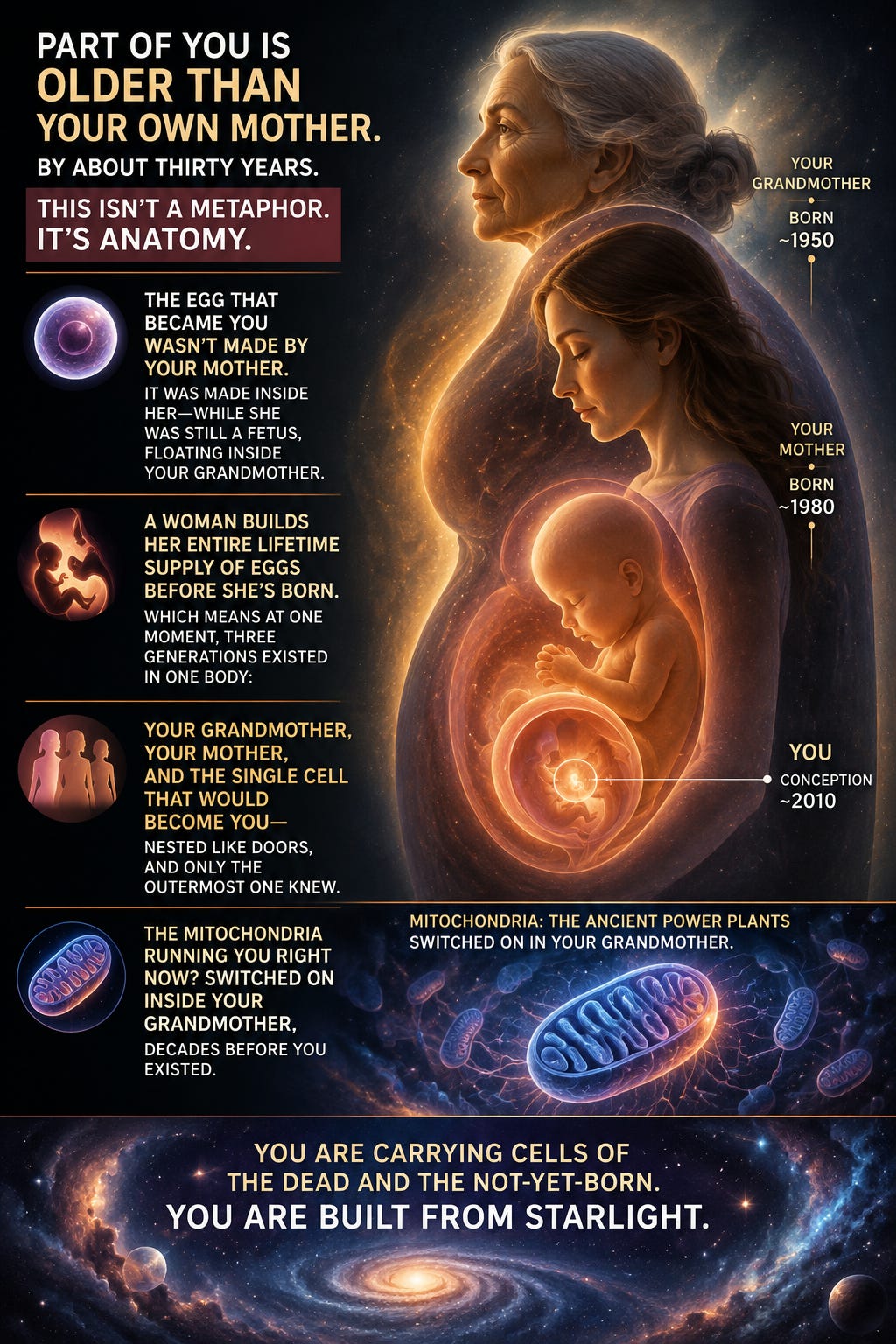
Part of you is older than your own mother!
Originally published on Substack.
Start with the strange fact and follow it back.
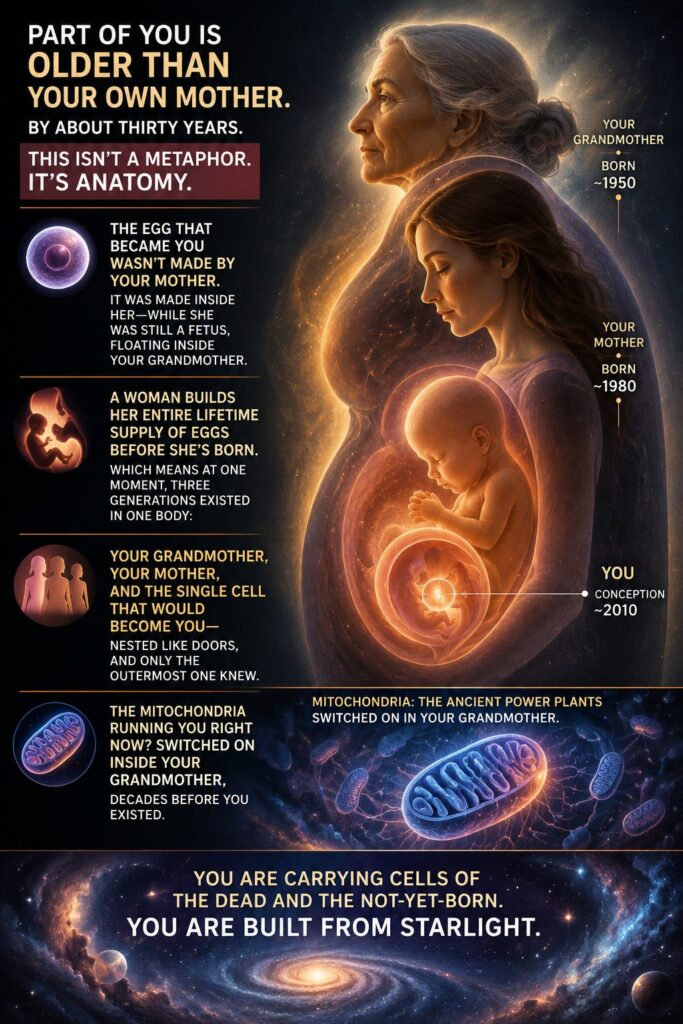
The egg that became you was not made by your mother. It was made inside her — while she herself was still a fetus, unfinished, curled and floating inside your grandmother.
Here is how that happens. A female builds her entire lifetime supply of eggs before she takes a single breath. By around 20 weeks in the womb she already holds six to seven million of them — more than she will ever have again. Then the number begins to collapse, before she is even born. By delivery day she is down to one or two million. It keeps falling every day she is alive. Out of that whole vast reserve, only about 400 will ever be released.
So run the sequence backward and watch what it forces you to admit. At one exact moment, your grandmother’s body contained your mother. And your mother — still a fetus, still months from her first cry — already contained the single cell that would one day become you.
Three generations. One body. Stacked inside each other like a set of nested doors, and only the outermost one had any idea it was happening.
Now do the arithmetic, because this is where a curiosity turns uncanny. A woman born in 1976 grew from an egg that formed around 1946 — three decades before her own birthday, inside a body that had not yet been born itself. A piece of her was quietly present at a moment she would spend her whole life filing under ancient history.
Two honest caveats, because the truth holds up better without exaggeration. First: an egg carries only half your genetic code, so the cell waiting inside your grandmother was half of you, not all of you. Second: a handful of mouse studies have hinted that females might manufacture a few new eggs in adulthood — but the finding is disputed, and nobody is rewriting the textbooks over it.
What is not in dispute is the timing. Your mother never made that egg. She was assembled around it. It was already there, waiting, while her body was still building itself.
The engines were switched on before you existed
Then there is the part with no caveat at all.
The mitochondria — the microscopic engines inside every one of your cells, the machinery that turns food into usable energy, the reason you are warm and moving and reading this — come only from the egg. Only from the mother. Never from the father, not one of them.
Which means the mitochondria running you at this exact second were switched on inside your grandmother’s body, decades before you existed. And if you are a woman with a daughter, the engines powering her entire life were assembled inside you — while you carried her, without the faintest idea what you were building.
Now pull that thread as far as it goes. Your mitochondria came from your mother. Hers from her mother. Hers from her mother. An unbroken chain, mother to daughter to daughter, that never once passes through a man and never once skips a generation.
Follow it back far enough and every living human being on Earth arrives at the same woman. Scientists call her Mitochondrial Eve. She lived in Africa somewhere around 150,000 to 200,000 years ago. She was not the only woman alive in her time — but she is the one from whom every single person now breathing inherits their mitochondria, in a line that has not broken once in seven or eight thousand generations.
The engine humming in your cells tonight is, in the most literal biochemical sense, the same lineage of engine that hummed in a woman who watched the Ice Age from the inside. Nothing about you is as new as you feel.
The cells that never leave
You have probably heard that your body replaces every cell every seven years, so that you are constantly becoming a brand-new person. It is a lovely idea. It is also mostly false.
Some of your cells are never replaced. Not once. You will die with the exact same ones you were born with — or older.
The lens of your eye is one. The cells at its very center were made before you were born and are never renewed, never swapped out. You are reading these words through tissue as old as you are — older, at the core.
Most of the neurons in your cerebral cortex are another. The thinking part of your brain runs, for a lifetime, on cells you have had since the beginning. And your heart — the organ I have spent my life listening to — turns over so slowly that most of its muscle cells are as old as you are. You will very likely die with many of the ones you were born with still beating.
And the oldest cells of all, in a woman’s body, are the eggs. Formed before her birth. Frozen mid-division, holding their breath, for decades. The cell that became you may have waited, silent and paused, for thirty or forty years before its moment came. There is nothing else in human biology that waits that long to do its one job.
Your mother is still carrying you. So are you carrying your children.
Here is the fact that undoes people.
When a woman is pregnant, cells do not only flow from mother to child. They cross the placenta in both directions. Some of the baby’s cells migrate into the mother — and they do not leave when the pregnancy ends. They stay. For years. For decades. Possibly for the rest of her life.
They have been found woven into the mother’s blood, her skin, her thyroid, her liver. In a 2012 study, researchers examined the brains of women who had died and found male DNA lodged inside the brain tissue of the majority of them — cells that could only have come from the sons they once carried, still present in the mother’s brain many years later.
The word for this is microchimerism, and it means something plain and staggering: your mother has almost certainly been carrying living pieces of you inside her body, in her organs, in her brain, since the day you were born.
And as a cardiologist, this is the part that stops me. In animal studies, when a mother’s heart is injured, fetal cells from her pregnancy travel to the wound, settle into the damaged muscle, and begin to take on the identity of heart cells — as if the child were trying to help repair the mother from the inside. Fetal cells have been found nestled in human maternal hearts as well. Whether they truly heal us is still being worked out with the caution such a claim deserves. But the cells are there. The child, in some real cellular sense, moves toward the mother’s wound.
So if you have carried a child, you are not only yourself. You are a mosaic. You are wearing them.
You are carrying people you have never met
Now stack it, the way we stacked the eggs.
Because cells pass both directions, a mother holds cells from each of her pregnancies — and she can pass some of those cells along, through her own body, into the next baby she carries. Which means a younger child can end up carrying the cells of an older sibling. And cells from the grandmother, passed down through the mother, can reach the grandchild.
You may be carrying a fragment of your older brother. Of a sister who came before you. Of a grandmother who died before you could remember her face. Not as memory. As tissue. As living cells inside you right now, that were never yours, from people you were never in a room with.
The body, it turns out, keeps everyone.
And older still
Go all the way down, past the cells, past the DNA, to the atoms themselves — and the age becomes almost unbearable.
The calcium in your bones. The iron in your blood that carries the oxygen your heart just pushed. The carbon in every strand of you. None of it was made on Earth. It was forged in the cores of dying stars and flung across the galaxy in explosions that happened billions of years before the Sun existed. You are quite literally assembled from the ash of stars that died so completely that their atoms had nowhere to go but here.
And the hydrogen — the hydrogen in every drop of water in your body, in your blood, in your tears — is older than the stars. It has existed, almost unchanged, since the first minutes after the beginning of the universe itself.
You are the youngest thing you know, built entirely out of the oldest things there are.
What the Kabbalists said, long before the microscope
The Kabbalists arrived here first, and without a single lens.
They taught that every soul destined to live was already present at the very beginning — folded within Adam, the first human, and held afterward in a hidden treasury the Talmud calls the Guf: the reservoir of souls, waiting their turn to be born. The Messiah, the sages said, cannot come until the Guf is emptied, until every waiting soul has descended into a body. Nothing, they insisted, ever truly begins. It is only revealed. Generation nested inside generation, all the way back to the first light.
What the biology now whispers, they said plainly: you were always here. Waiting inside the ones who came before you. Carried by people who did not know they were carrying you.
And notice the road it travels down. The mitochondria pass mother to daughter to daughter, unbroken, never once through a man — the very path by which the tradition says a soul’s deepest belonging descends. The Kabbalists had a name for the light a mother hands her child without ever manufacturing it herself: the Shechinah, the Divine presence that is not created new in each generation, only transmitted — from one vessel to the next, hand to hand, since the beginning.
A flame lit from a flame. Never a new fire. Always the same fire, passed on.
So here is where all of it lands.
A woman pregnant with a girl is, in the most literal sense the language allows, carrying her grandchildren too. Every woman alive began inside a woman she may never have met, in a body that had not yet been born. You are running on engines that were switched on before your mother could walk. You are carrying cells of the dead and the not-yet-arrived. You are built from starlight and from the first breath of the universe.
You did not begin at your birth.
You are the current, living end of a line of light that has never once — not for a single generation, not for a single instant — gone out.
And now it is burning in you.
Blessings.
Afshine Ash Emrani, M.D., F.A.C.C.
Assistant Clinical Professor, UCLA
David Geffen School of Medicine
Join Our new website
Castle-Connolly Nationwide Top Doctor (Since 2008)
Los Angeles Magazine Super Doctor (Since 2010)
LA Style Magazine Top 100 Doctors in America (2024)
Subscribe to mynewsletter: substack.com/@afshineemrani
Explore my books: Amazon Author Profile