
Writings
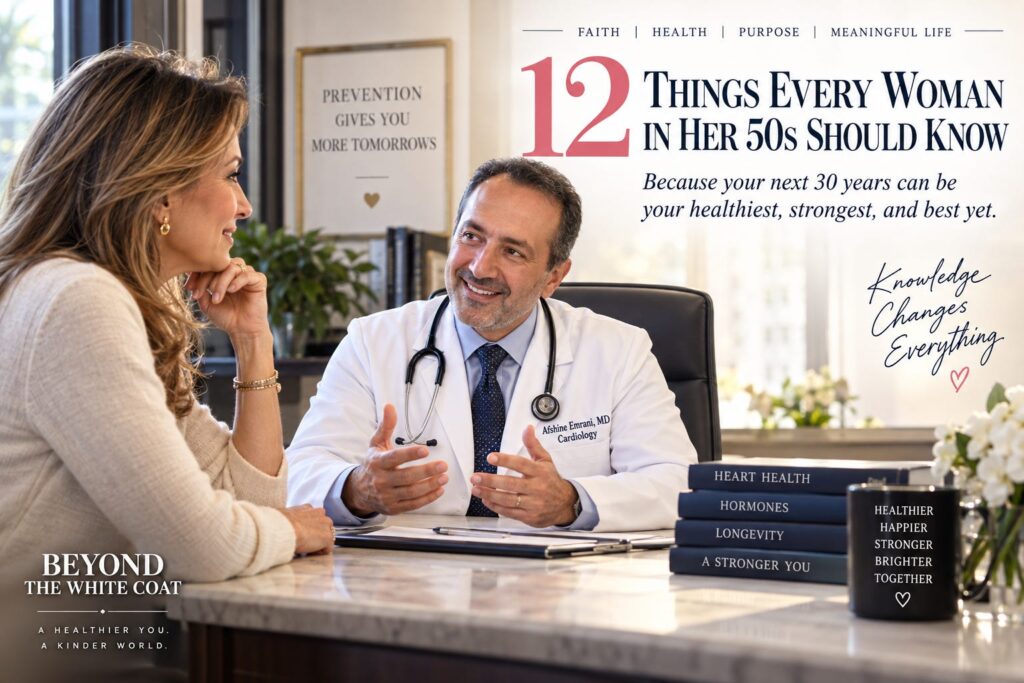
Twelve Things I Tell Women Before They Turn 60
Originally published on Substack.
She was 74, elegant, sharp, and furious.
Not at me. At the twenty years of doctors who had told her she was “fine for her age.” Her arteries were calcified. Her hip had fractured stepping off a curb. Her muscle was gone in the way that makes a woman suddenly need a hand to rise from a chair. She had done everything she was told.
She had simply been told very little.
I have practiced cardiology for more than twenty-five years, and I can trace almost every story like hers back to the same window: the decade between roughly 48 and 60, when the body is quietly renegotiating every contract it signed in youth, and when nearly every decision that matters is still yours to make.
Your 50s are not the beginning of the end. They are the last decade in which the levers are fully in your hands. This is what I would say if you were my sister, my wife, or my daughter, and I had one hour and no billing codes.
1. Menopause is a cardiovascular event
We file menopause under gynecology. Your arteries never got the memo. Estrogen has been quietly protecting your blood vessels since puberty. When it falls, LDL cholesterol rises, blood pressure climbs, fat migrates to the belly, and arteries stiffen — often within a few years. Heart disease kills more women than every cancer combined, and the curve bends upward right here.
Do this: Book a full cardiovascular risk assessment if you have not had one since menopause. Not “my numbers are fine.” A real assessment, with the tests in rule 3.
2. Ask about hormone therapy with 2026 eyes, not 2002 eyes
A generation of women was frightened off hormone therapy by a single study that was largely misread. The science has moved. For most healthy women with symptoms who begin within about ten years of menopause and before 60, the benefits generally outweigh the risks — and the FDA has now removed the black-box warnings that scared your mother’s doctors into silence. Hot flashes, broken sleep, brain fog, and vaginal changes are medical problems. They are not character flaws to be endured.
Do this: Have the conversation with someone who knows the current data. Hormone therapy is not for everyone. But “no” should be a decision, not a default.
3. Get the three numbers most women have never been given
-
Lipoprotein(a) — an inherited cholesterol particle that raises heart attack and stroke risk no matter how well you live. About one in five people carries it high. One blood test, once in your life.
-
ApoB — a truer count of the particles that actually build plaque than standard LDL.
-
Coronary calcium score — a five-minute CT scan that shows whether plaque has already begun. It ends the guessing.
Do this: Ask for all three by name. If your doctor has not heard of them, that is information too.
4. Your blood pressure is rising faster than a man’s — and each point costs you more
After 50, women’s blood pressure climbs more steeply than men’s, and the damage per point is greater. The target is under 130/80. “A little high for your age” is not a diagnosis. It is a shrug.
Do this: Buy a validated upper-arm cuff. Sit quietly, check it three mornings a week, and bring the log. A cuff is cheaper than a stroke.
5. Muscle is the organ of longevity, and you are losing it right now
From your 50s on, muscle disappears in a way that becomes frailty at 75. Muscle stores your blood sugar, anchors your bones, keeps you upright, and is the single best predictor of whether you will live independently.
Do this: Lift heavy enough that the last two repetitions are hard, two to three times a week. Walking is wonderful. Walking is not enough. And eat protein at every meal — roughly 1.2 to 1.6 grams per kilogram of body weight per day (unless you have kidney disease), which is far more than most women eat.
6. You may lose up to 20% of your bone in the years around menopause
Hip fracture after 65 carries a mortality that rivals many cancers. Bone loss is silent until the day it is not.
Do this: Ask for a DEXA scan now if you carry any risk factor — family history, early menopause, small frame, steroid use, smoking. Vitamin D, calcium from food, and resistance training are the foundation. Medication, when needed, is not a failure. It is a fence at the top of the cliff.
7. Sleep apnea in women does not look like sleep apnea
Men snore and gasp. Women wake at 3 a.m., feel wrung out by noon, get morning headaches, and are told it is anxiety or hormones. Untreated apnea drives blood pressure, atrial fibrillation, and weight gain.
Do this: If you are tired despite “enough” sleep, ask for a sleep study. Home tests are simple now.
8. Rethink the wine
I am sorry about this one. The nightly glass that protects your heart has not survived better science. Alcohol raises breast cancer risk at any amount, fractures sleep, worsens hot flashes, and provokes atrial fibrillation.
Do this: You do not have to quit. But drop the “it’s good for me” story. Choose it the way you choose dessert — with open eyes.
9. Your waist is a better number than your weight
Belly fat after menopause is not padding. It is an organ — metabolically active, pumping out inflammation and insulin resistance even when the scale barely moves.
Do this: Measure your waist. Over 35 inches is where risk climbs. Ask for a fasting insulin and an A1c, not just a glucose.
10. Know how a woman’s heart attack actually feels
Crushing chest pain is the man’s version. Women more often feel unusual fatigue, shortness of breath, nausea, jaw or back pain, or a sense that something is simply wrong. Women wait longer to call for help, and are more often sent home when they do.
Do this: If something feels new and wrong, go. Say these words: “I am concerned this is my heart.” Do not drive yourself.
11. Do not skip the screenings you think you have outgrown
Colonoscopy begins at 45 and continues. Mammography continues. Cervical screening usually continues to 65. If you smoked, ask about lung screening. Skin checks matter more with age, not less.
Do this: Write a one-page list with the date of your last screening of each kind. Most women are shocked by the gaps.
12. Loneliness is a cardiac risk factor — and so is purpose
Social isolation raises mortality about as much as smoking. Women in their 50s are so often caring for everyone and belonging to no one. Purpose — something that needs you in the morning — is not a soft variable. I see it in who comes back to my office and who does not.
Do this: Protect one weekly thing that is only yours and involves other people. Guard it like a prescription, because it is one.
The one-page version
Print this. Bring it to your next appointment.
-
Full cardiovascular risk assessment since menopause
-
Lp(a), ApoB, coronary calcium score
-
Blood pressure under 130/80, checked at home
-
Strength training 2–3x/week; protein at every meal
-
DEXA if any risk factor
-
Sleep study if tired despite sleeping
-
Waist under 35 inches; fasting insulin and A1c
-
Hormone therapy: a real conversation, not a reflex
-
Screenings up to date
-
One thing that is yours, weekly
Your mother’s generation was told to be quiet about menopause and grateful for whatever the doctor said. You do not have to inherit that silence.
The women who walk into my office at 80 with strong hearts and straight spines are not lucky. They made twelve small decisions thirty years earlier, mostly alone, mostly without permission.
This is your decade. Decide.
Blessings.
Afshine Ash Emrani, M.D., F.A.C.C.
Assistant Clinical Professor, UCLA
David Geffen School of Medicine
Join Our new website
Castle-Connolly Nationwide Top Doctor (Since 2008)
Los Angeles Magazine Super Doctor (Since 2010)
LA Style Magazine Top 100 Doctors in America (2024)
Subscribe to mynewsletter: substack.com/@afshineemrani
Explore my books: Amazon Author Profile
This essay is education, not personal medical advice. Please bring it to your own physician.