Writings
Why You Should take CREATINE!
Originally published on Substack.
The suitcase is the first tell. It used to come off the belt with one hand. Now you set it down, reset your grip, and pretend you were checking the tag.
The chair is next. You rock once before you stand, a small private negotiation nobody else sees.
Nothing dramatic has happened. No diagnosis. No fall. Just a body that has started spending muscle it is no longer replacing.
After the mid-forties, unused muscle tends to slip, on the order of 1% a year if life stays still. Strength goes faster than the tape measure. Balance follows. Most people answer with guilt and a gym membership that dies in March.
Then a randomized, double-blind trial from Texas A&M lands, and the internet does what it always does. Half of it screams miracle. The other half screams hype.
Both are wrong. Here is the version a clinician can stand behind.
What the researchers actually did
-
73 healthy, sedentary adults, ages 45 to 65, enrolled. 64 finished. Mean age about 55. 40 women, 24 men.
-
Participants chose whether to stay as they were or join a program: resistance and aerobic training three days a week plus a modest 300 to 500 calorie daily cut.
-
Inside each group, they were then randomized, double-blind, to creatine monohydrate or a maltodextrin placebo.
-
Dose: 10 grams a day (5 grams twice). Duration: 12 weeks.
-
Measured: DXA body composition, bench press and leg press strength, blood work, and a cognitive battery the authors themselves call exploratory.
Choosing the exercise arm is not the same as being randomized into it. The creatine-versus-placebo comparison inside each group is the clean part. Keep that in your pocket.
The headline: people who changed nothing still changed
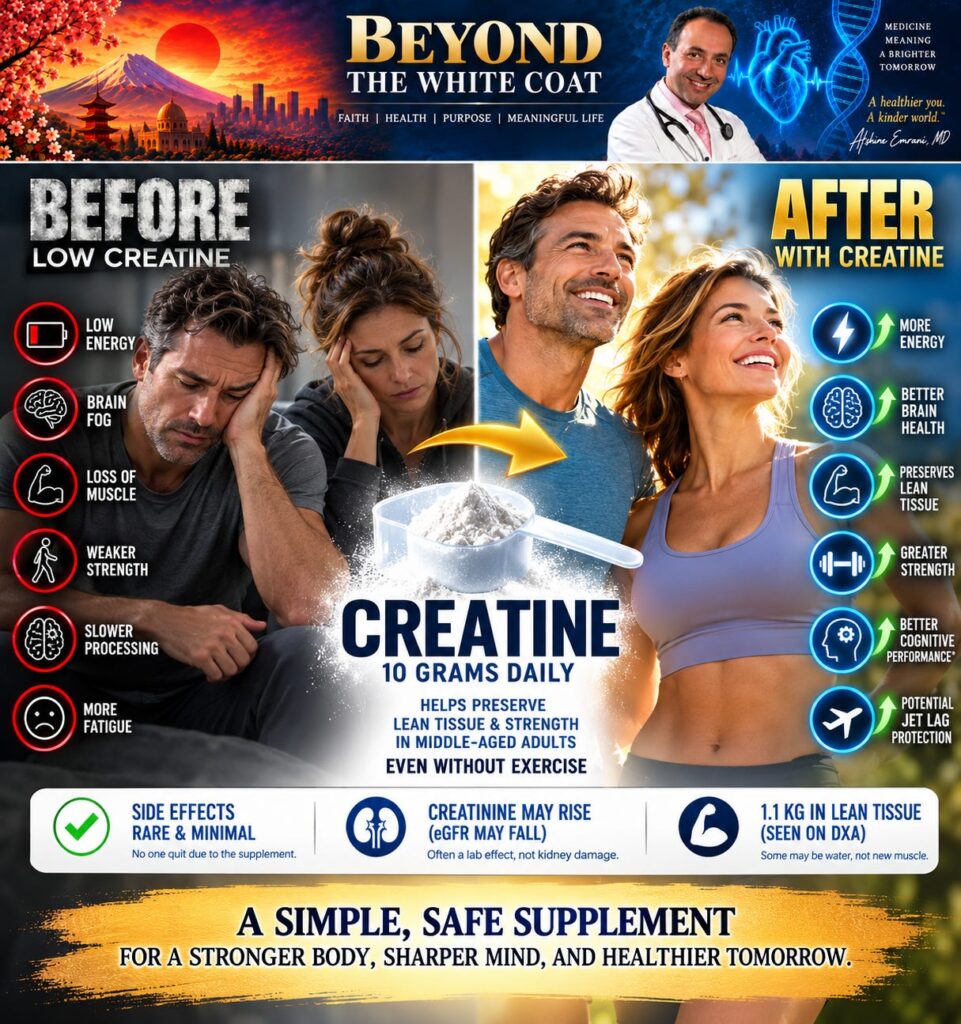
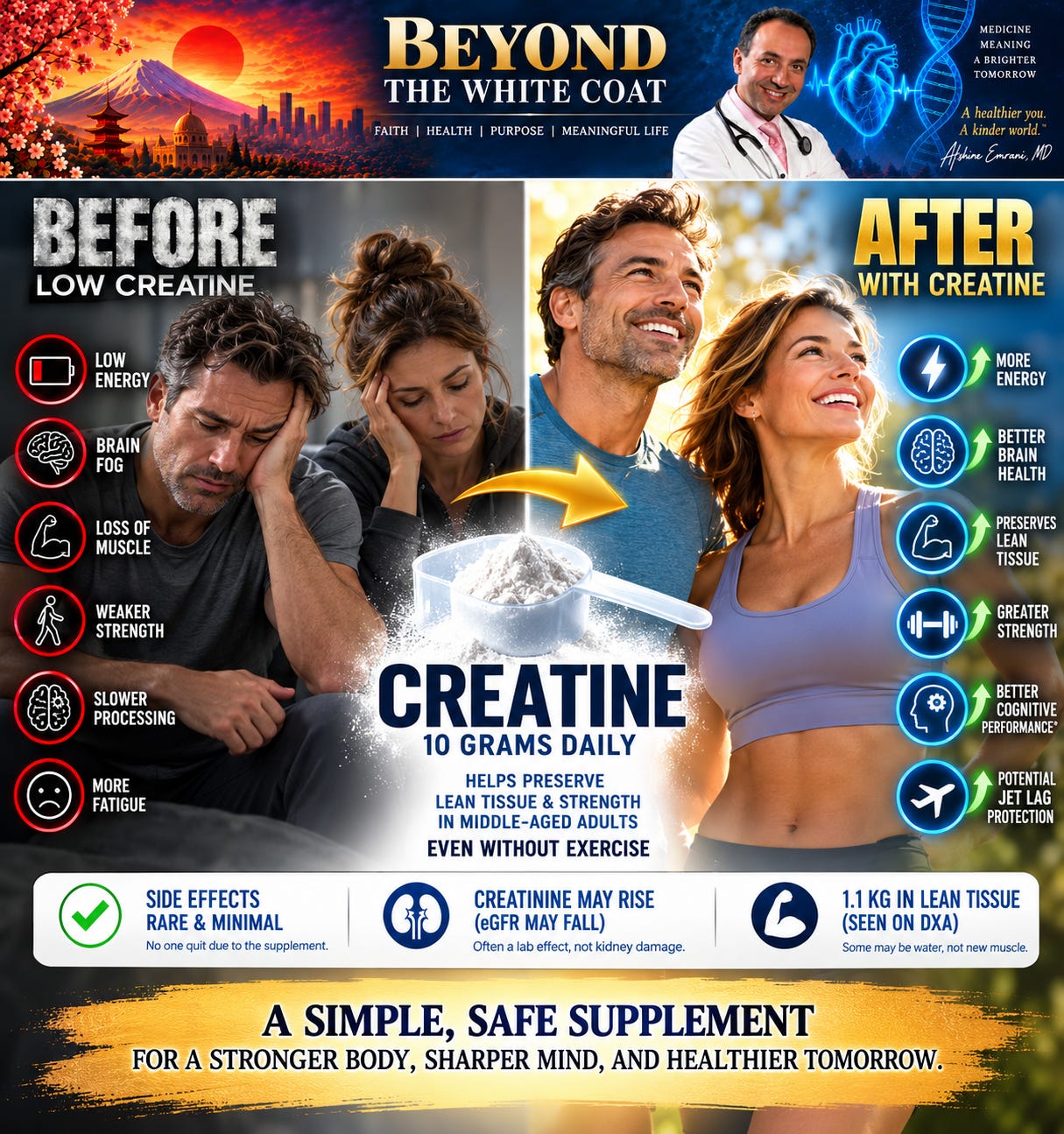
In the group that did not exercise and did not diet, creatine increased lean tissue by about 1.1 kg (roughly 2.4 pounds) at twelve weeks. The confidence interval ran from 0.2 to 2.0 kg. Real, and not enormous. Placebo did not do it.
They also got stronger on the bench press and leg press, and their muscular endurance improved. Nobody handed them a workout plan.
This is not permission to skip the gym. It is evidence that the machinery of muscle is still listening after 45, even in a body that has gone quiet.
The bigger story: creatine plus effort
Weight loss usually spends muscle along with fat. This is where creatine looked best.
-
Lean tissue: up about 1.27 kg (2.8 lb) at 12 weeks on creatine plus the program. At 6 weeks the gain was larger still, about 1.69 kg. Placebo exercisers barely moved.
-
Body fat: down about 3.2 points on creatine versus about 1.9 points on placebo.
-
Strength: leg press and bench press improved more with creatine than with identical training on placebo.
-
Aerobic capacity: no improvement. Creatine is a strength and power molecule, not a new set of lungs.
Same effort. A better return on the tissue that gets you out of the chair.
The brain: promising, but not proven
Creatine and cognition is the part going viral, and the part that needs the most care.
Some memory and processing measures moved. But several tests showed no improvement at all:
-
Stroop (attention and impulse control)
-
Corsi blocks (visual-spatial memory)
-
NeuroTracker (tracking multiple moving objects)
There may be a real effect. This study cannot tell us how broad or how reliable it is. The authors labeled the cognitive work exploratory, and I will not promote it to fact. A signal is how we decide what to study next. It is not a prescription.
The two asterisks I owe you
1. Some of that “lean tissue” is water. Creatine pulls fluid into muscle cells, and DXA counts that water as lean mass. So 2.4 pounds is not 2.4 pounds of pure new muscle. Anyone selling it that way is selling past the data.
Strength is the part water does not fake. If you can press more, and do it again, something functional changed. Function is what keeps a person in their own house.
2. The creatinine trap. Creatine breaks down into creatinine, the marker your doctor uses to estimate kidney function. In this trial serum creatinine rose about 6% to 8% in the non-exercise creatine group, and about 16% to 18% in the exercise groups. eGFR fell accordingly.
That is expected, and the authors specifically warned against reading it as kidney damage. But on a routine lab sheet, a normal kidney can look worse than it is. Tell whoever reads your labs before you start, not after the number scares you both.
On safety: side effects were rare and minimal, and nobody dropped out because of the supplement.
What this study does not say
-
It does not say creatine replaces lifting. It amplified it.
-
It does not say it is safe for every kidney, every pregnancy, or every medication list. These were healthy sedentary adults, not people in heart failure or on dialysis.
-
It does not say 10 grams is where you should begin tomorrow. That is what the trial used. Many clinicians start at 3 to 5 grams and adjust with the person in front of them. More is not automatically better.
-
It does not say the brain findings are settled. Replication first.
-
Sixty-four people finished. One trial, even a careful one, is a door, not a doctrine.
If you are going to try it
-
Call the office first if you have kidney disease, are pregnant, or have a long medication list. Say the word “creatine” out loud so the next creatinine is interpreted on purpose.
-
Buy plain creatine monohydrate. Skip the twelve-ingredient blends with a lightning bolt on the tub. Look for third-party testing (NSF or Informed Choice).
-
Take it at the same time, most days. Consistency is the intervention. The scoop is just the object.
-
Give the muscle a reason to stay. Two or three short sessions a week: a chair squat, a push-up, a band, a weight you can still own. Twenty honest minutes.
-
Eat protein at meals, about a palm, so the tissue has something to build with.
-
Test something you can feel at 12 weeks. How you stand up. How the suitcase comes off the belt.
Why I keep coming back to this
I have watched people wait for a dramatic injury before they believe their body is keeping score. Muscle does not announce itself on the way out. It leaves in the grip, the stair, the afternoon that feels heavier than it should.
A scoop of powder is not a pardon, and it is not a statin. It will not reverse a blocked artery. What this trial suggests, quietly, is that the account is still open. The body still takes small deposits.
Aging well is less luck than people think, and more a series of ordinary decisions made while standing up is still easy.
Start where you are. Let the small thing be the door, not the whole house.
Blessings, Ash
Quick Answers
Does creatine build muscle without exercise? In this Texas A&M trial, sedentary adults aged 45 to 65 taking 10g daily gained about 2.4 pounds of lean tissue in 12 weeks without working out, and their strength and endurance improved. Some of that lean tissue measurement is water, so it is not all new muscle.
Does creatine work better with exercise? Yes. With training and a modest calorie cut, creatine users gained more lean tissue, lost more body fat, and improved leg press and bench press more than placebo users doing the same program.
How much creatine should I take per day? The trial used 10g daily (5g twice). Many clinicians start at 3 to 5g. Talk with your doctor about what is right for you.
Is creatine bad for your kidneys? In healthy adults, creatine is among the most studied supplements, and the trial’s authors warned against reading the creatinine rise as kidney damage. But creatine raises serum creatinine, which can make a calculated eGFR look worse. Tell your clinician before your next blood draw, and do not start it without medical guidance if you have kidney disease.
Does creatine improve memory and brain function? Early signals, maybe. Some memory and processing measures moved, but attention, visual-spatial memory, and multiple-object tracking tests showed no improvement, and the authors called the cognitive work exploratory. Promising, not proven.
Will creatine make me gain weight? Possibly a little, partly from water drawn into muscle cells. That is expected and is not fat.
What is the best type of creatine? Plain creatine monohydrate, third-party tested (NSF or Informed Choice). Skip the blends.
Can I stop my other medications if I take creatine? No. Do not stop a diabetes drug, a statin, or a blood-pressure pill because of a sports-nutrition paper.
Blessings.
Afshine Ash Emrani, M.D., F.A.C.C.
Assistant Clinical Professor, UCLA
David Geffen School of Medicine
Join Our new website
Castle-Connolly Nationwide Top Doctor (Since 2008)
Los Angeles Magazine Super Doctors (every year since 2013)
LA Style Magazine Top 100 Doctors in America (2024)
Subscribe to mynewsletter: substack.com/@afshineemrani
Explore my books: Amazon Author Profile