Writings
Your body is on FIRE: Inflammation leads to chronic disease.
Originally published on Substack.
You wake up stiff. Your knees and hands take the first hour of the day to loosen. By mid-afternoon there’s a fog you can’t quite blink away. You’re not sick — your labs come back “normal,” your doctor says you’re fine.
But something is smoldering.
It is. I can tell you what it is, where it’s burning, and — this is the part almost no one talks about — why it flares worst in the morning and how to put it out. Most of the fix is free, and you can start tomorrow before breakfast.
Two kinds of fire
Inflammation isn’t the villain. It’s a rescue crew.
When you cut your finger or catch a virus, your body lights a fast, hot fire: swelling, redness, immune cells flooding the scene. The fire does its job, the injury heals, the fire goes out. That’s acute inflammation, and you’d die without it.
The problem is the other fire. The one that never goes out.
When inflammation fails to resolve, it drops down to a low, constant smolder — too quiet to feel, hot enough to do damage year after year. This is chronic inflammation, and it is the common root beneath most of the diseases we fear: heart disease, type 2 diabetes, many cancers, fatty liver, Alzheimer’s, and autoimmune conditions like rheumatoid arthritis and inflammatory bowel disease.
Here’s the key idea that changes everything: it’s all one fire. Your gut, your gums, your belly fat, your stress, your terrible sleep — they aren’t separate problems. They’re all feeding the same flame through the same wiring. Fix one, you turn down the whole system. Ignore them, and they amplify each other.
The smoke alarm that never resets
Inside your immune cells sits a molecular smoke alarm called the NLRP3 inflammasome.
Its job is to detect danger — bacterial fragments, cellular stress, damaged mitochondria — and sound the alarm by releasing inflammatory signals. In a healthy body, it blares when there’s a real fire and goes silent when the danger passes.
In a chronically inflamed body, it never fully resets. It stays primed — finger on the trigger, quietly leaking inflammatory signals into your bloodstream day and night. Those signals are what corrode your arteries, ache in your joints, and cloud your brain.
So the real question isn’t “how do I fight inflammation?” It’s: why did the alarm stop turning itself off?
The part no one told you: your body runs on a clock
Here’s where it gets remarkable.
You have a molecular night manager. Its name is REV-ERB, and one of its jobs is to walk through your immune cells on a schedule and tell that smoke alarm to stand down. It literally presses down on the genes that build the alarm. Alongside its partner BMAL1, it gates your inflammation to a daily rhythm — quieter at certain hours, allowed to rise at others.
This is why so many inflammatory conditions flare in the morning. That stiffness isn’t random. It’s the tail end of your body’s overnight immune schedule.
And here’s the catch. That night manager only clocks in if your body knows what time it is.
Late-night screens. A bedtime that drifts by hours. Midnight snacks. Shift work. Darkness in the morning and light at night. Every one of these tells your internal clock that time itself has become meaningless — and the night manager stops making his rounds. The alarm never gets the stand-down order. It stays primed. The fire keeps smoldering.
This isn’t theory. Shift workers — people whose clocks are chronically scrambled — carry measurably higher inflammation and higher rates of heart disease, autoimmune illness, and cognitive decline. Their bodies have lost track of what time it is, and their immune systems pay the bill.
A quick, honest word on the “miracle” pill
You may have seen biohackers online buying a research chemical called SR9009 — a drug that artificially switches on that night manager. In mice, it does impressive things: calms colitis, reduces liver scarring, quiets the inflamed brain.
Let me be direct, because this is where people get hurt. SR9009 has never completed a single human clinical trial. Its absorption in people is poor and poorly understood. It’s banned in competitive sport. It is a laboratory tool, not a medicine.
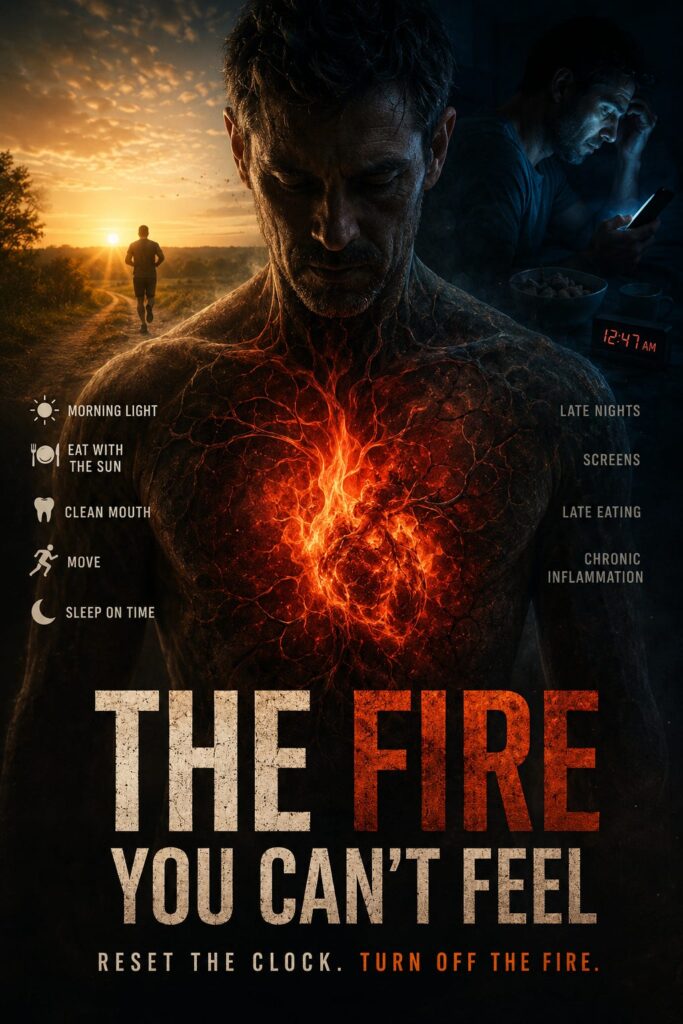
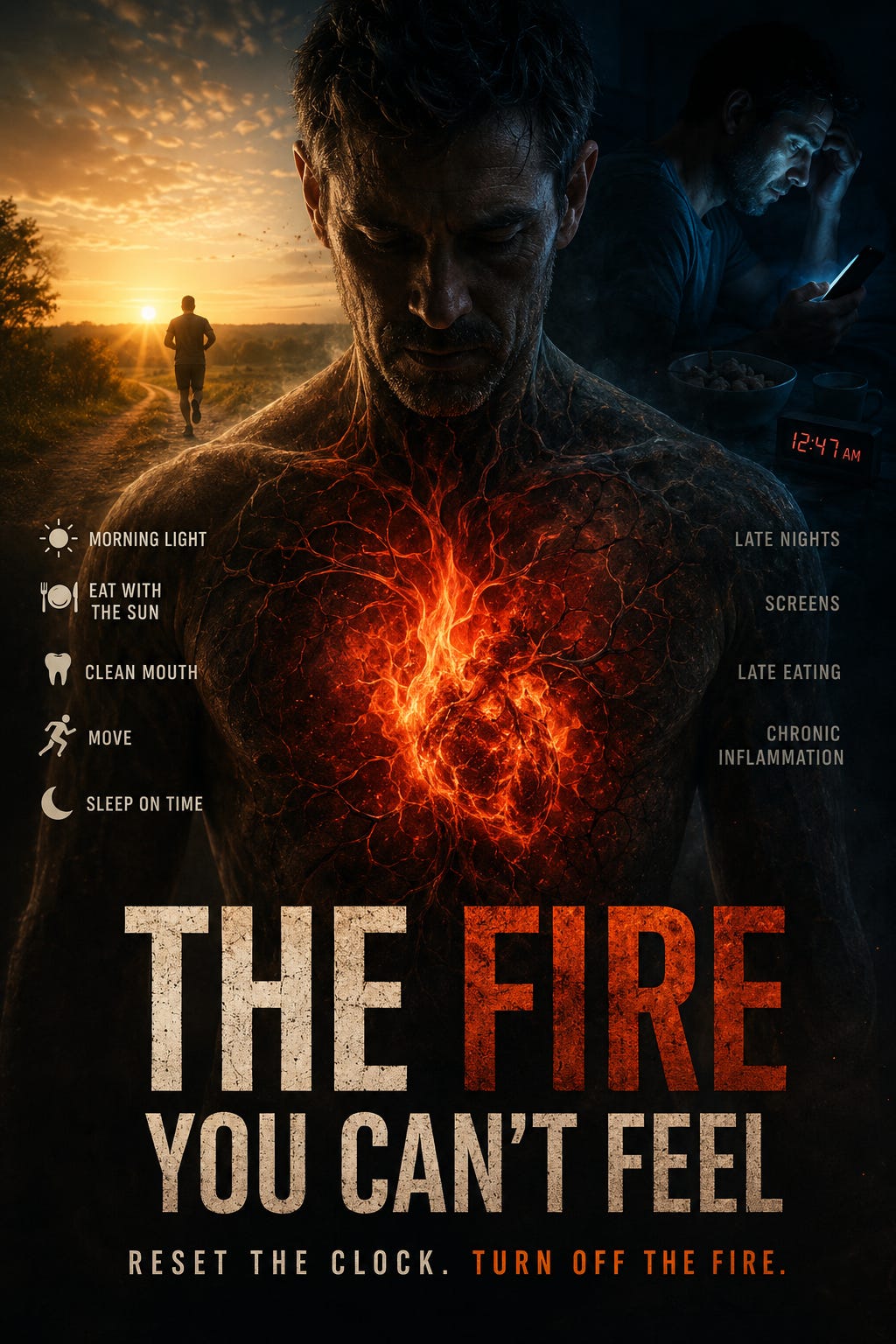
Meanwhile, the free version already lives in your day: morning sunlight, a steady bedtime, and meals eaten while the sun is up do the same job — switch on the night manager, reset the alarm — with decades of human evidence behind them and zero risk.
The people paying for the mouse drug are chasing what your morning walk gives away for free.
How to put out the fire
You interrupt this network in four places: the gut, the mouth, the cell, and the clock. Here’s the protocol I give my own patients.
1. Fix the clock first — it’s the cheapest and most overlooked. Get sunlight in your eyes within an hour of waking (outside, no sunglasses, even on a cloudy day). Keep a consistent 7–9 hour sleep window, same times weekdays and weekends. Dim your lights and screens after sunset. This single category re-hires your night manager.
2. Eat with the sun. Keep your food inside a daytime window — try to finish eating 2–3 hours before bed. Late-night eating confuses the same clock that controls your inflammation. When you eat matters nearly as much as what you eat.
3. Eat like the Mediterranean. Vegetables, berries, extra-virgin olive oil, fatty fish, nuts, legumes. Aim for 30+ grams of fiber a day — fiber feeds the gut bacteria that seal your intestinal lining and keep inflammatory triggers out of your blood. Cut the ultra-processed food, added sugar, and frequent alcohol; these tear that lining open.
4. Treat your mouth as part of your heart. Gum disease leaks bacteria straight into your bloodstream and feeds the exact same fire — and it measurably raises heart and diabetes risk. Brush twice daily, clean between your teeth every single day, and see your dentist every six months. This is cardiovascular medicine.
5. Move to make medicine. 150 minutes of moderate activity plus two strength sessions a week. Muscle releases anti-inflammatory signals when you use it — and exercise helps re-synchronize your clock.
6. Add only after the foundation is built. Once the above are in place, 1–2 g of EPA/DHA (fish oil) and vitamin D (if you’re deficient) are reasonable, evidence-supported adjuncts. They work with a healthy foundation, not instead of one.
The one thing to remember
You don’t need to be perfect. You need to be consistent.
Morning light. A reasonable eating window. Floss every night. The same bedtime. Do these, and you retrain the immune system that was built to protect you — so it stops mistaking your own body for the enemy.
The fire you can’t feel is real. But the switch that turns it off is already inside you.
It just needs to know what time it is.
Blessings.
Afshine Ash Emrani, M.D., F.A.C.C.
Assistant Clinical Professor, UCLA
David Geffen School of Medicine
Join Our new website
Castle-Connolly Nationwide Top Doctor (Since 2008)
Los Angeles Magazine Super Doctor (Since 2010)
LA Style Magazine Top 100 Doctors in America (2024)
Subscribe to mynewsletter: substack.com/@afshineemrani
Explore my books: Amazon Author Profile