Writings
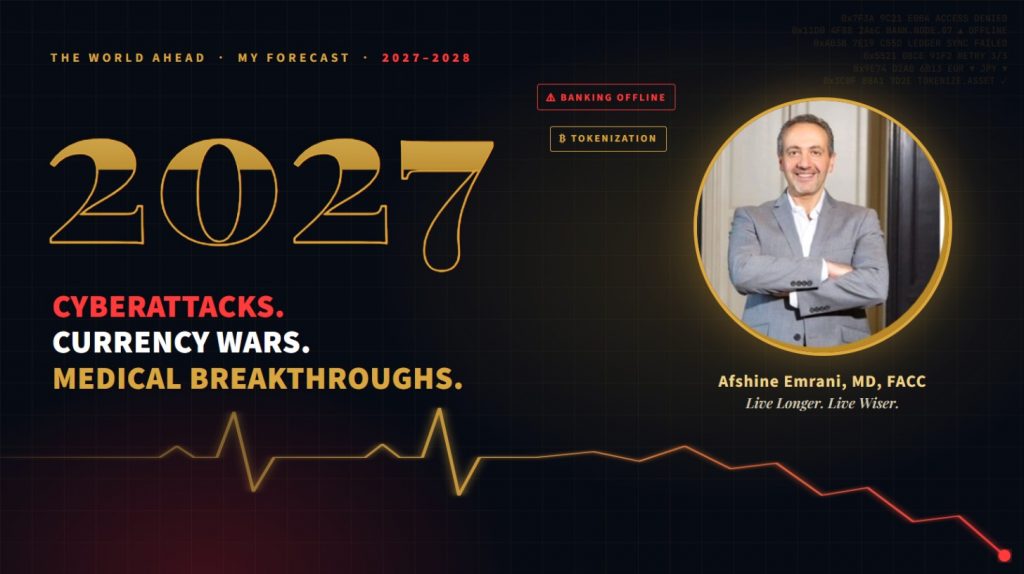
My 2027 Predictions: Cyberattacks, Currency Wars and the Medical Breakthroughs Coming Next
Originally published on Substack.
Most people read this cover as a war forecast. I read it as a cardiologist.
Every November, The Economist publishes The World Ahead, its forecast for the coming year. The 2027 cover, drawn by Cleon Peterson, is packed with missiles, tanks, robots, rockets, a circuit-board brain, a tower labeled TRUMP and a falling stock chart.
It also has syringes and medicine on it.
Most coverage of the cover focuses on war and politics. As a cardiologist, I paid attention to two other things: medicine and the computer systems that health care, banking and travel depend on.
Those are the two areas where I think 2027 will affect you most directly. Medicine will get better at catching disease early. The systems we rely on every day will become easier to break.
Here are my predictions.
Prediction 1: A cyberattack will shut down a service millions of people use
I’ve said for months that 2027 will be the year of cyberattacks. Here is the specific version.
My prediction: by December 31, 2027, at least one publicly confirmed cyberattack will shut down a service that ordinary people rely on, such as a bank, a hospital system, an airline or a phone network, for 24 hours or longer.
I don’t mean a data breach that gets a paragraph in the business section. I mean a full day when the service doesn’t work.
I suspect some hostile governments are already probing these systems for weaknesses. That is a suspicion, not a fact. For my prediction to count, the cause has to be publicly confirmed as a cyberattack. Blaming a specific government would require separate evidence.
Why does a cardiologist care about this?
Take the kind of patient I see every week: 71 years old, on a blood thinner, with a refill due today. The pharmacy can’t verify her prescription. My office can’t open her chart. Her bank card is declined.
The news will call it an IT outage. For her, it means a day without a medication that lowers her risk of stroke.
A lot of basic health care now depends on computer systems that patients never see. If those systems go down, care stops too.
What I recommend now: carry a printed list of your medications and doses. Keep a few extra days of supply when your insurance allows it. Write down your pharmacy’s phone number instead of relying on an app.
Prediction 2: The biggest medical gains will come from finding disease earlier
Most people will see the syringes on the cover and think of weight-loss drugs. The Economist lists that market as one of 2027’s major stories, and it will be. But I don’t think a single new drug is the most important change coming.
In nearly thirty years of practicing cardiology, the factor I’ve seen matter most is when we find the problem.
If we find a patient’s risk while they feel well, we have time to discuss options and act. If we find it after their first heart attack, we’re dealing with damage that has already happened.
My prediction: the most important medical progress in 2027 will come from better imaging, AI-assisted reading of scans and tests, and more targeted treatments that let doctors make decisions earlier, in the office instead of the emergency room.
I also predict that most of the health technology promoted next year won’t change patient care. Much of it will produce more data, longer reports and more worry, without changing treatment.
I’ll judge every new tool by one question: would it change what I do for the patient in front of me? If it doesn’t change when or how I treat someone, it isn’t useful to that patient.
A detailed report can look impressive. What matters is a result that changes the treatment plan while there is still time to act on it.
My other 2027 predictions, with dates and confidence levels
A prediction like “2027 will be a turbulent year” can’t be proven wrong, so it isn’t useful. Below are my other predictions, with timing and how confident I am in each. I’ll come back to them with you as the year goes on.
-
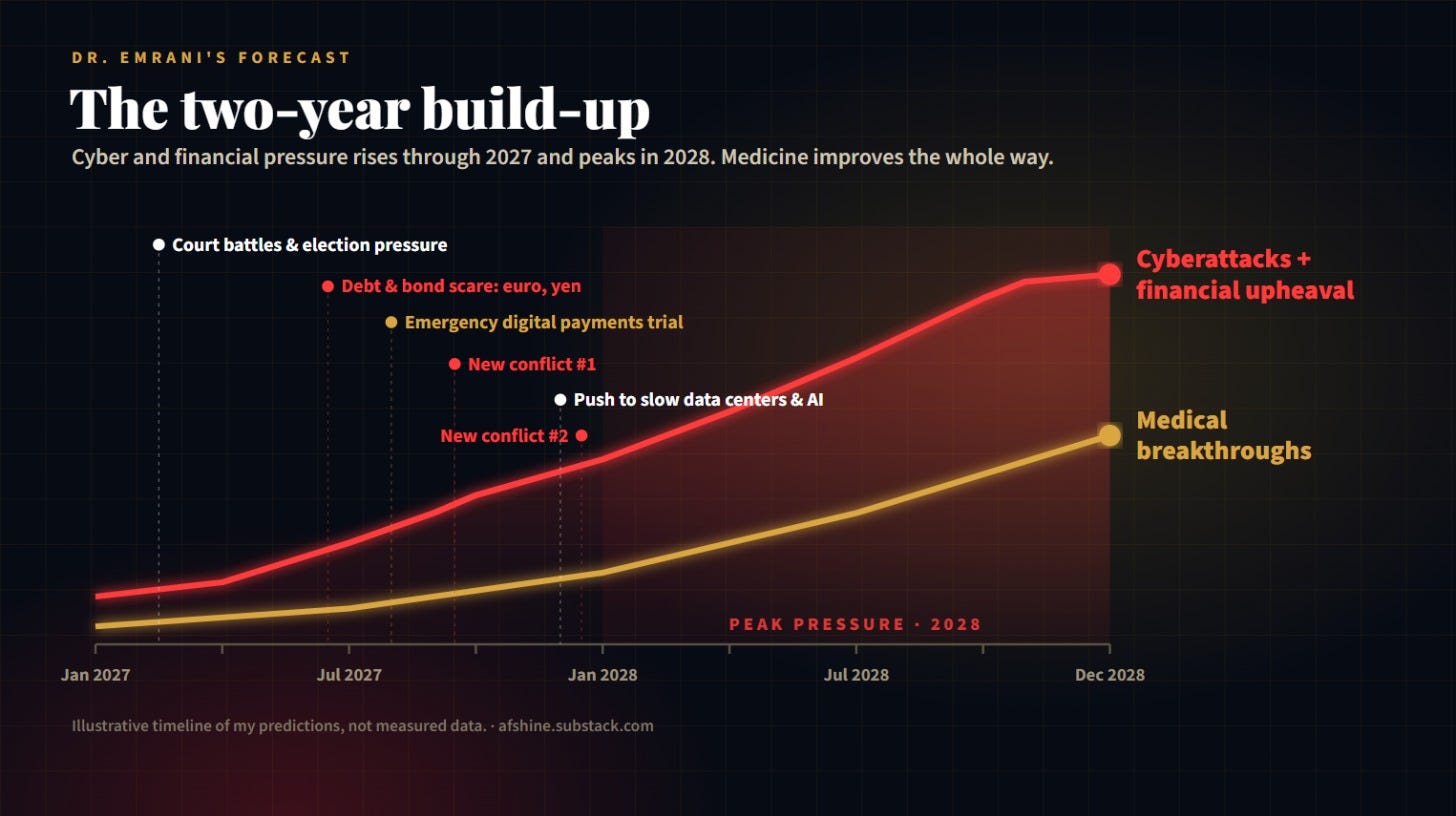
Debt and bonds (confidence: medium). A midyear scare over government debt or bond markets, with the euro and yen under the most pressure. A slowdown from June to September, followed by a return of inflation. Weakness in U.S. stocks and real estate.
-
Digital money and hacking (medium on the hacks, low on the payment system). A temporary or emergency digital payment system is tested somewhere between June and August. Hacks involving AI or cryptocurrency become a major news story.
-
War and energy (low on the exact months, high on oil disruption). Two new armed conflicts begin, one around September and one around December, with high conflict risk continuing into mid-2028. Iran-related disruption to oil and shipping continues into 2027.
-
Democracy and surveillance (medium). Pressure on elections and democratic institutions early in the year. China expands surveillance. Egypt plays a behind-the-scenes diplomatic role. Marine Le Pen’s party is a serious contender in France.
-
Tesla, SpaceX and space (low on a merger, medium on the space race). Serious discussion of combining Tesla and SpaceX, and early signs of a new space race, with the larger growth coming later in the decade.
-
Housing and society (high). More visible housing insecurity and homelessness, even as technology and finance do well. Much more public interest in prediction markets.
The low-confidence predictions are the riskiest ones to publish. I include them anyway, because a specific prediction tells you more than a vague one.
Several of these predictions are connected. A debt scare, a new payment system, AI-driven hacking and an energy shock would all put pressure on the same computer and financial systems described in Prediction 1. I read the cover as one main warning, not ten separate ones: technology is advancing quickly, and the systems it runs on are becoming more vulnerable.
What I see coming in 2027 and 2028
Beyond the cover, here is my own view of where things are heading.
-
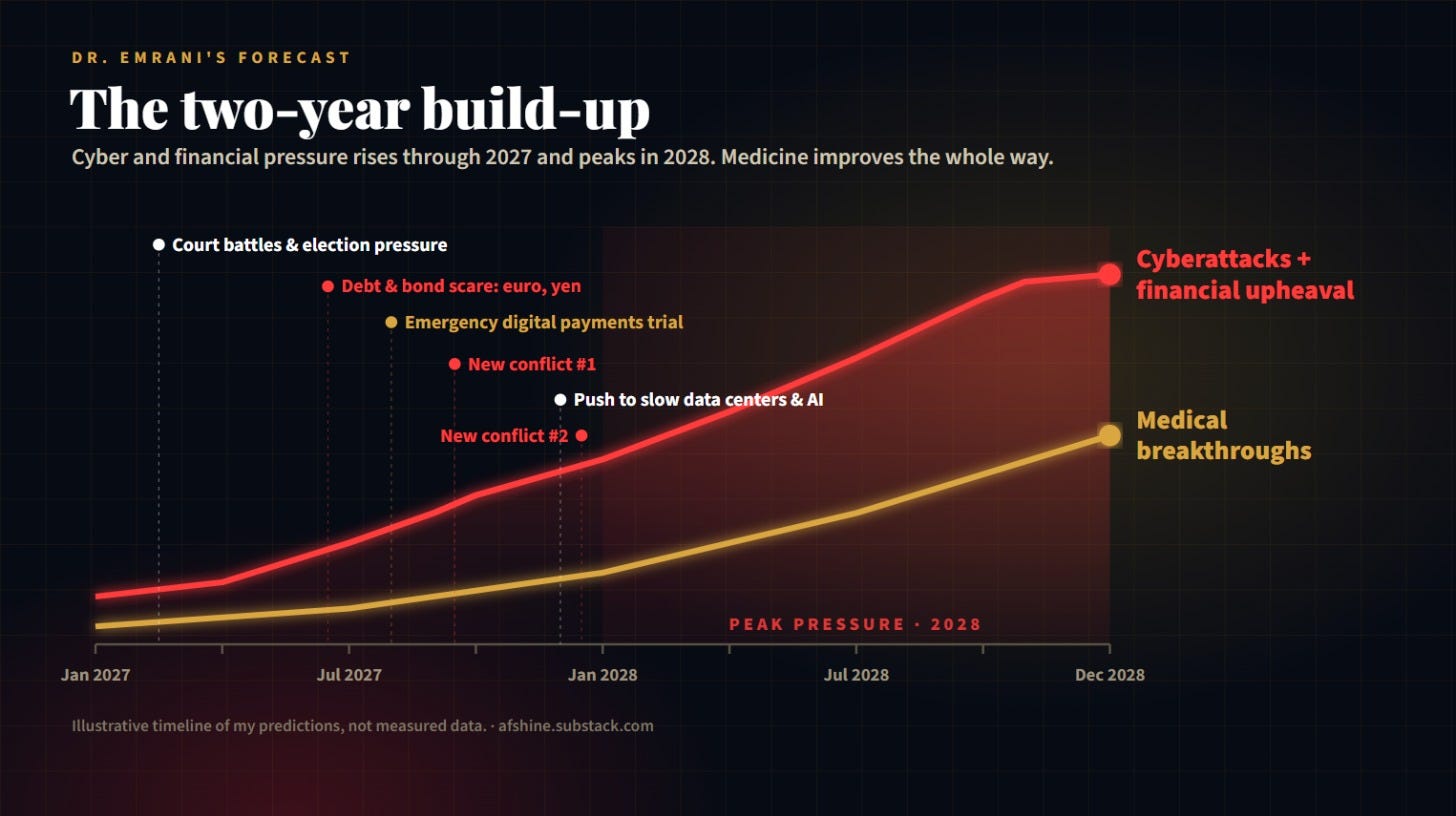
Trump and his family will face many court battles in 2027. I expect legal fights to take up a large share of the political news next year.
-
Democrats will move to slow down data centers and AI by the end of 2027. Expect pushback over power use, local opposition to new data centers, and calls for more regulation.
-
We are already in two kinds of war, and neither is nuclear. One is a money and currency war. The other is a cyber war. The currency war will push governments toward digital currencies. The cyber war will include attacks aimed at banks and other financial systems, which I believe will come mostly from Iran and China.
-
This will build through 2027 and peak in 2028. I expect the next two years to bring serious cyberattacks and financial upheaval.
-
The same two years will also bring major medical breakthroughs. The tools I described in Prediction 2 will start changing how and when we treat disease.
Where I see the biggest investment opportunities
Over the next two years, I believe the strongest areas for investment will be:
-
Biosciences and medicine, driven by earlier diagnosis, AI-assisted testing and more targeted treatments.
-
The infrastructure for tokenizing assets, meaning systems that turn real-world assets like property, bonds or funds into digital tokens. I believe that build-out will drive the next major expansion of crypto.
Why I make predictions
To those of you who follow me: I make predictions often. I don’t do it to say “I told you so” later. I do it to test whether my reading of the times, and of where the world is heading, is accurate.
I’d like to hear how you see it. What do you think 2027 will bring? Post your view in the comments, whether you agree with me or not.
If you know someone who has never thought about what happens to their prescriptions or their bank account during an outage, send them this post.
Coming next week for paid members: a more detailed analysis of these predictions. If you want it, upgrade to a paid subscription before then.
Blessings,
Ash
Dr. Afshine Emrani, M.D., F.A.C.C. · Assistant Clinical Professor, UCLA David Geffen School of Medicine · Live Longer. Live Wiser.
These are personal forecasts, not investment, legal or medical advice. Talk to your own doctor before changing any medication.
This article is general education, not medical advice, and does not create a doctor-patient relationship. Talk with your own doctor before starting, stopping or changing any medicine, supplement, hormone or peptide. Emergency? Call 911.