
Writings
Is it POTS? Your Heart Races When You Stand Up…
Originally published on Substack.
More young women are walking into my office asking to be worked up for POTS than for almost anything else right now. Some have been dismissed for years and are desperate to be taken seriously. Others read about it online, recognized their own racing heart and fatigue, and want to know if that’s the name for what’s wrong.
Both groups deserve a straight answer. So let me give you the one I wish every patient walked in already knowing — because the truth about POTS is genuinely two things at once, and you need both halves.
It is real, badly under-recognized, and physically debilitating for the people who have it. And it is also over-attributed — a label increasingly stretched over symptoms that sometimes have a different, and often more fixable, cause. Understanding the difference is how you get actual help instead of a wrong turn.
What POTS actually is
POTS stands for Postural Orthostatic Tachycardia Syndrome, and once you understand the physiology, the whole thing makes sense.
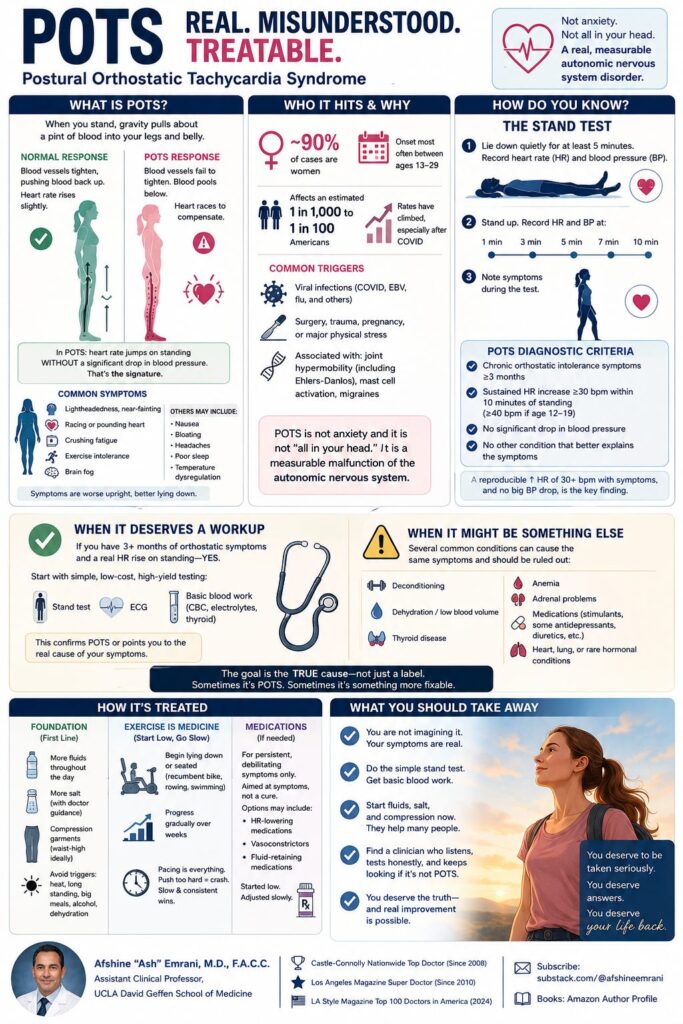
Every time you stand up, gravity pulls roughly a pint of your blood downward into your legs and belly. In a healthy body, the autonomic nervous system — the automatic controller of heart rate, blood pressure, and blood vessel tone — reacts in seconds: it tightens the blood vessels in your lower body to push blood back up, and nudges your heart rate up a little to keep your brain supplied.
In POTS, that first step fails. The blood vessels don’t clamp down the way they should, so blood keeps pooling below. To compensate and keep blood reaching your brain, your heart does the only thing left to it: it races. Not a little — a lot. And critically, your blood pressure usually does not crash. That combination — a heart pounding hard on standing, without a big blood-pressure drop — is the signature of POTS.
That’s why the symptoms are what they are: lightheadedness and near-fainting when upright, a racing or pounding heart, crushing fatigue, exercise intolerance, and the “brain fog” that makes it hard to think clearly. Many patients also have nausea, bloating, headaches, poor sleep, and trouble regulating temperature. It can touch nearly every system in the body — even though the heart, gut, and nerves usually look structurally normal on standard tests. That normalcy is exactly why so many patients get told nothing is wrong, when something very much is.
Why it exploded — and who it hits
POTS overwhelmingly affects women — about 90% of cases — with onset most often between ages 13 and 29. It’s estimated to affect somewhere between 1 in 1,000 and 1 in 100 Americans, and that number has almost certainly climbed.
The reason is infection. In a large share of cases, POTS begins within about three months of a viral illness — and COVID changed everything here. Long COVID drove a real, documented surge; by some estimates, nearly a third of people with severe long COVID meet the criteria for POTS. Epstein-Barr, influenza, and other infections can trigger it too, as can major physical stressors like surgery, trauma, or pregnancy. It also travels with certain other conditions — joint hypermobility (including Ehlers-Danlos syndrome), mast cell issues, and migraines.
I want to say one thing as plainly as I can, because too many women have been told the opposite: POTS is not anxiety, and it is not “all in your head.” It is a measurable malfunction of the autonomic nervous system. Living with an uncontrollable racing heart and bone-deep fatigue certainly causes stress — but that stress is the consequence, not the cause. The average patient waits around two years for a diagnosis, often after being brushed off repeatedly. That delay is a failure of medicine, not of the patient.
So how do you actually know if you have it?
Here is the part that answers the question I get most — and it’s more objective and more reassuring than most people expect. POTS is not a vague feeling. It has clear, measurable diagnostic criteria, and the core test is simple enough to start at home.
The four things that define it:
First, chronic symptoms of orthostatic intolerance — worse when upright, better when lying down — lasting at least three months. Second, a sustained heart-rate rise of at least 30 beats per minute within ten minutes of standing (or at least 40 bpm if you’re between 12 and 19). Third, no significant drop in blood pressure when you stand — if your pressure crashes, that’s a different condition. And fourth, no other cause that better explains it.
The practical version, the “stand test,” is something any clinic can do and you can even trial yourself: lie down quietly for at least five minutes and record your heart rate and blood pressure. Then stand, and record both again at intervals for up to ten minutes, noting how you feel. A reproducible jump of 30-plus beats per minute with real symptoms — and no big pressure drop — is the finding that matters.
When it deserves a workup — and when the answer is somewhere else
This is where honesty matters most, and where I try to help my patients rather than just label them.
A racing heart when you stand up is a real symptom. But it is not automatically POTS. Several common, often more treatable things produce the exact same feeling, and a good doctor rules them out before settling on POTS:
Simple deconditioning — a loss of cardiovascular fitness after illness or a long stretch of inactivity — can cause a big heart-rate jump on standing that mimics POTS closely. Dehydration and low blood volume do it too. So do thyroid disease, anemia, adrenal problems, and certain medications — stimulants, some antidepressants, diuretics. Occasionally a genuine heart, lung, or rare hormonal condition is hiding underneath.
So the honest answer to “does this deserve a workup” is: if you have three-plus months of orthostatic symptoms and a real heart-rate rise on standing, yes — get the simple stand test, an ECG, and basic blood work (blood count, electrolytes, thyroid). That’s low-cost, low-risk, and it either confirms POTS or, just as valuably, points you toward the thing that’s actually causing your symptoms. What you don’t need, in most cases, is an immediate cascade of expensive specialist testing — tilt-table studies, Holter monitors, echocardiograms are for atypical or complex cases, not the starting point.
The goal isn’t to collect a fashionable diagnosis. It’s to find the true reason your body feels the way it does. Sometimes that’s POTS. Sometimes it’s something else entirely — and finding that is the win, because it may be more fixable than POTS is.
When — and how — it’s treated
Here’s the encouraging part: for most people who truly have POTS, the first and most effective treatments aren’t drugs at all. They deserve to be tried first, and many patients improve substantially on them alone.
The foundation is expanding your blood volume: more fluids across the day, and — this surprises people — significantly more salt, because salt helps your body hold onto that fluid and fill the tank the pooling keeps draining. This is done with a doctor’s guidance and individualized, since it’s not right for everyone (especially with high blood pressure or kidney issues). Next, lower-body compression garments — ideally waist-high — physically stop the blood from pooling. Avoiding triggers helps: heat, prolonged standing, big heavy meals, alcohol, dehydration.
And then the one that’s hardest but matters most: structured, gradual exercise — started lying down or seated (a recumbent bike, rowing, swimming) to take gravity out of the equation, then slowly progressed over weeks. Formal programs exist for exactly this. The catch, and it’s important: pacing is everything. Pushing too hard, especially if you have overlapping post-viral fatigue, can trigger a crash that sets you back. Slow and consistent beats aggressive and inconsistent, every time.
Medications come in only when these measures aren’t enough to let you function — and they’re aimed at symptoms, not a cure. Options a specialist may use include drugs to slow the racing heart, drugs to tighten blood vessels, or drugs to help retain fluid. Started low, adjusted slowly. No pill cures POTS; the honest goal is to restore your life, measured by what you can do — not by chasing a perfect heart-rate number.
What I want you to take from this
If you’re one of the women wondering whether this is you: you are not imagining your symptoms, and you’re right to want answers. Do the simple stand test. Get the basic bloodwork. Start the fluids, salt, and compression now, while you seek care — they’re safe, and they help many people before any diagnosis is even confirmed. And find a clinician who takes you seriously enough to do the honest workup: to confirm POTS if it’s there, and to keep looking if it isn’t.
Because being taken seriously cuts both ways. It means never being dismissed with “it’s just anxiety.” And it also means not being handed a label that stops the search before the real cause is found. You deserve the truth about your own body — and for most people, with the right approach, real improvement is genuinely possible.
I write clear, honest explanations of the conditions my patients actually struggle with — the science, the nuance, and the practical steps, without hype or dismissal. If you want medicine explained straight, come join me.
Blessings,
Afshine “Ash” Emrani, M.D., F.A.C.C. Assistant Clinical Professor, UCLA David Geffen School of Medicine
🏅 Castle-Connolly Nationwide Top Doctor (Since 2008) 🌟 Los Angeles Magazine Super Doctor (Since 2010) 🇺🇸 LA Style Magazine Top 100 Doctors in America (2024)
📬 Subscribe: substack.com/@afshineemrani 📚 Books: Amazon Author Profil