Writings
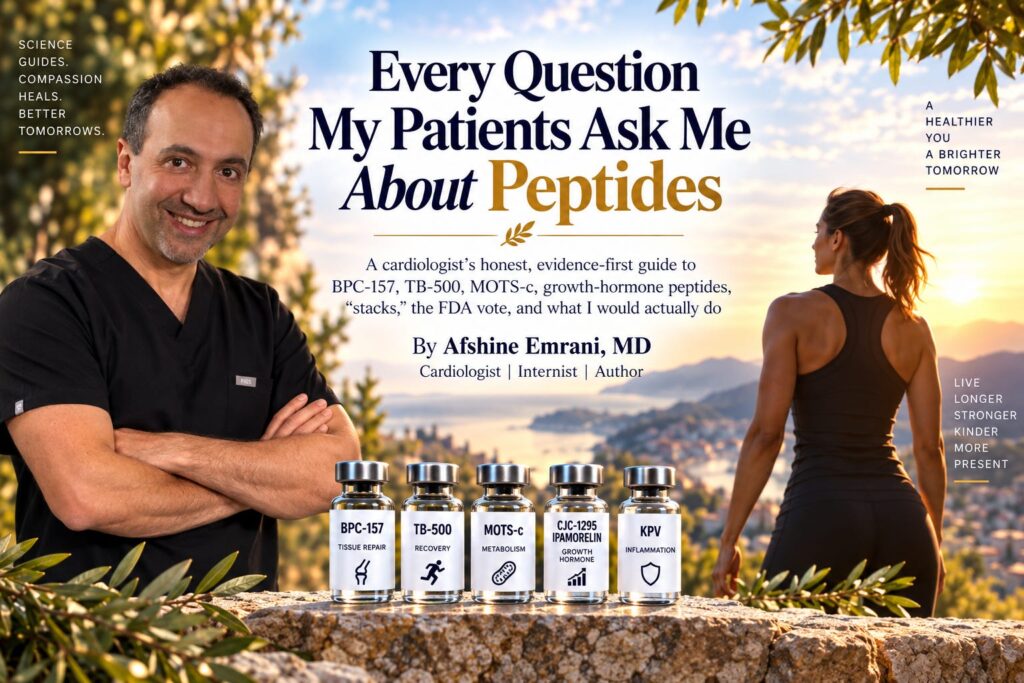
Every Question My Patients Ask Me About Peptides
Originally published on Substack.
Almost every day now, someone in my office asks me about peptides.
A retired attorney with a torn rotator cuff. A 34-year-old marathoner. A mother whose 16-year-old son has been watching videos about “optimizing” his jawline. A patient on a statin who wants to know if BPC-157 will heal his gut. A CEO who has already ordered three vials from a website and wants me to “just check the dosing.”
I have been collecting their questions for two years. This article answers all of them.
I want to be clear about where I stand before we begin, because you will hear two loud voices online and I belong to neither of them.
One voice says peptides are a miracle the medical establishment is hiding from you. The other says they are dangerous nonsense for gullible people.
Both are wrong.
Peptides are one of the most exciting frontiers in medicine. Some of the most important drugs of the last decade are peptides. And many of the specific molecules being sold on Instagram have almost no human evidence behind them, are manufactured with no oversight, and are being injected by teenagers.
All of those things are true at the same time. My job is to help you hold them together.
If you only have sixty seconds, here is the whole article:
“Peptide” is a chemistry word, not a safety rating. Insulin and Ozempic are peptides. So is an unregulated powder from a “research” website. They are not the same category.
BPC-157, TB-500, MOTS-c, KPV, Semax, and Epitalon have real animal data and almost no human data. Not one has a completed randomized trial.
The July 2026 FDA committee vote was about compounding, was non-binding, and was opposed by FDA’s own scientists. It was not an approval.
Independent testing of gray-market peptides finds that roughly half fail basic quality checks. The purity certificate on the website does not detect bacterial endotoxin.
The growth-hormone peptides (CJC-1295, ipamorelin) actually work—which is why chronic use worries me most.
No research peptide for teenagers, in pregnancy, or with a cancer history. Full stop.
If you are going to use one anyway, do it with a physician, a licensed pharmacy, a batch-specific certificate, one agent at a time, and a stop date.
I am not against peptides. I am waiting for the evidence to catch up with the sales pitch.
Everything below is the why.
Let’s go question by question.
PART ONE: THE BASICS
“What exactly is a peptide?”
A peptide is a short chain of amino acids—the same building blocks that make up proteins. The usual convention is that anything under roughly 50 amino acids is called a peptide; anything longer is a protein.
Your body makes thousands of them. Insulin is a peptide. Oxytocin is a peptide. The hormone that tells your stomach you are hungry (ghrelin) is a peptide. The signals that tell your pancreas to release insulin after a meal (GLP-1, GIP) are peptides.
So peptides are not exotic. They are the language your cells already speak.
That is exactly what makes them promising—and exactly why they deserve respect. When you inject a peptide, you are sending a message into a signaling system that evolved over millions of years. Sometimes that message is precisely what a body needs. Sometimes it is a message the body was never meant to receive at that dose, at that time, in that combination.
“If my body already makes them, aren’t they natural and therefore safe?”
This is the single most common misconception I hear, and I want to answer it carefully.
Insulin is natural. Give a healthy person too much and they will die within hours.
Growth hormone is natural. Chronic excess causes acromegaly, diabetes, cardiomyopathy, and colon polyps.
“Natural” tells you where a molecule came from. It tells you nothing about what happens when you take an unnatural amount, by an unnatural route, for an unnatural duration.
And here is the part people miss: most of the popular peptides are not actually the natural molecule at all. BPC-157 is a synthetic fragment that does not exist in that form in your body. TB-500 is a synthetic fragment of a larger protein. CJC-1295 is a chemically modified version of a hormone-releasing factor, engineered to last far longer than the original. These are drugs. Calling them “natural” is marketing.
“Are all peptides experimental?”
No—and this distinction is the key to the entire conversation.
There are two completely different worlds that share one word.
World One: FDA-approved peptide medicines. Insulin. Semaglutide (Ozempic, Wegovy). Tirzepatide (Mounjaro, Zepbound). Liraglutide. Teriparatide for osteoporosis. Tesamorelin for HIV-related belly fat. Bremelanotide (Vyleesi) for low libido in premenopausal women. Octreotide. Leuprolide. Dozens more. These have gone through phase 1, 2, and 3 trials in thousands of humans. We know the dose, the side effects, who should never take them, and what happens over years. I prescribe several of these regularly.
World Two: unapproved “research” peptides. BPC-157, TB-500, MOTS-c, KPV, Semax, Epitalon, GHK-Cu, CJC-1295, ipamorelin, Melanotan II, and the “stacks” that combine them. These are sold online with the label “for research use only, not for human consumption”—a legal fig leaf that everyone involved understands is fiction. Most have never completed a single randomized controlled trial in humans. Some have never been given to more than a handful of people in any published study.
When someone tells you “peptides work,” they are usually pointing at World One to sell you something from World Two.
Do not let anyone do that to you.
PART TWO: THE SPECIFIC ONES YOU ASK ABOUT
I will go through the peptides I am asked about most, and I will tell you plainly what the human evidence looks like as of September 2026.
“What about BPC-157? Everyone says it heals everything.”
BPC-157 (”Body Protection Compound”) is a synthetic 15-amino-acid peptide derived from a protein found in gastric juice. It is the undisputed celebrity of the peptide world.
The animal data is real and it is impressive. Over three decades, more than a hundred preclinical studies—mostly from a single research group in Croatia, mostly in rats—have shown accelerated healing of tendons, ligaments, muscle, bone, gut lining, and blood vessels. It appears to promote new blood-vessel growth (angiogenesis), modulate nitric oxide signaling, and dampen certain inflammatory pathways.
The human data is almost nonexistent. A 2026 review of the human literature found three published studies with fewer than 30 participants combined: a small retrospective series in knee pain, a small study in interstitial cystitis, and a two-person intravenous safety pilot. None was a randomized controlled trial. A 2025 systematic review of the orthopedic sports-medicine literature screened hundreds of papers and found exactly one human study that met inclusion criteria.
Read that again. One. For the most hyped healing peptide on earth.
There is no validated human dose. There is no long-term safety data. There is no head-to-head comparison against physical therapy, PRP, or simply waiting.
One more detail that matters more than it sounds. When FDA reviewers looked for human evidence supporting the use that was actually nominated—ulcerative colitis—the best they found was a decades-old conference abstract that was never published as a peer-reviewed trial, and it used an oral route. The subcutaneous injections that wellness clinics sell for tendons and shoulders have no supporting human data at all. That is a meaningful distinction: BPC-157 comes from gastric juice and is unusually acid-stable, so a gut-directed oral story is at least mechanistically coherent. Injecting it next to your rotator cuff and expecting the MRI to change is a rodent extrapolation.
My honest summary: BPC-157 is a genuinely interesting molecule with a preclinical story that deserves proper human trials. It is not yet a medicine. Anyone who tells you “the research is clear” is describing rat research.
“TB-500? I heard it’s for tendons.”
TB-500 is a synthetic fragment of thymosin beta-4, a naturally occurring protein involved in cell migration and wound repair.
Here is a nuance the internet skips: thymosin beta-4 itself has actually been tested in humans—in trials for wound healing and dry eye, with mixed and mostly modest results. TB-500, the fragment being sold online, has essentially no published human trials of its own. FDA reviewers preparing for the 2026 committee meeting reported finding no direct human administration studies of TB-500 at all. People assume the fragment does what the full protein does. That is an assumption, not a finding.
And a practical warning: “TB-500” is not one standardized molecule. Different vendors sell different sequences and lengths under the same name. You may not be getting the same substance your friend got, let alone the one in any study.
TB-500 is also explicitly banned by the World Anti-Doping Agency. If you are a competitive athlete, this one can end your career.
“MOTS-c for longevity and metabolism?”
MOTS-c is fascinating to me as a cardiologist, and I will tell you why honestly.
It is a small peptide encoded not in the nucleus but in your mitochondrial DNA—one of a newly discovered class of “mitochondrial-derived peptides.” In animal models it behaves like an exercise mimetic: it improves insulin sensitivity, protects against diet-induced obesity, and rises in the blood after exercise. Levels appear to decline with age.
If you were going to design a peptide to study for metabolic aging, it would look something like MOTS-c.
But the human record is thin. A pharmaceutical analog of MOTS-c was studied in a small early-phase trial for fatty liver disease and obesity, with a signal but no follow-through into large trials. The MOTS-c being sold online has no completed efficacy trial in humans, no established dose, and no long-term safety record. The FDA advisory committee recommended it for compounding in July 2026 by a 7–5 vote with two abstentions—narrower than any of the others, which tells you how the experts felt about the evidence.
Interesting biology. Not yet medicine.
“CJC-1295 and ipamorelin? My trainer says they boost growth hormone naturally.”
This category deserves special attention because it is the one where I worry most about long-term harm.
CJC-1295 is a modified version of growth-hormone-releasing hormone (GHRH), engineered to stay in the body for days instead of minutes. Ipamorelin mimics ghrelin and triggers growth hormone release through a separate pathway. Together, they raise growth hormone and IGF-1.
Three things you need to know:
First, they do work—in the narrow sense. Small human pharmacokinetic studies confirm that CJC-1295 raises growth hormone and IGF-1 levels for days. This is not a placebo.
Second, that is precisely the problem. Chronically elevated growth hormone and IGF-1 are not a free lunch. In the disease of growth hormone excess, we see insulin resistance, fluid retention, joint pain, carpal tunnel, enlargement of the heart, and an increased incidence of certain cancers. IGF-1 is a growth signal. It does not ask whether the cell it is stimulating is a muscle fiber or a tumor.
Third, the development history is not reassuring. CJC-1295’s pharmaceutical development was halted after a death occurred during an early trial. Ipamorelin was studied by a drug company for post-surgical bowel recovery and failed. Neither is FDA-approved. Both are on FDA’s list of substances it has said may present significant safety risks in compounding.
I have watched people in their forties inject these for years with no physician monitoring IGF-1, glucose, or the heart. That is not longevity medicine. That is an uncontrolled experiment with a growth signal.
“What about sermorelin and tesamorelin? Aren’t those approved?”
Partly—and this is an honest, useful distinction.
Tesamorelin (Egrifta) is FDA-approved, but for one specific indication: excess abdominal fat in people with HIV. It has real trial data behind it. Using it in healthy people for “body composition” is off-label, and the safety data in that population is limited.
Sermorelin was once an FDA-approved diagnostic and pediatric growth-hormone-deficiency drug. The branded product was discontinued years ago for commercial reasons, not safety. It remains legally compoundable with a prescription. It is the most conservative of the growth-hormone peptides because it is short-acting and works through the body’s own feedback loops—but “most conservative” is not the same as “proven for anti-aging.” There are no long-term trials of sermorelin for healthy-aging outcomes.
“GHK-Cu, the copper peptide?”
GHK-Cu is a naturally occurring tripeptide bound to copper. There is modest, reasonably credible evidence that topical GHK-Cu improves skin appearance in cosmetic formulations. That is a low-risk, low-stakes use, and I have no objection to it.
Injectable GHK-Cu, promoted online for “systemic regeneration,” is a different matter. There are no human trials of injected GHK-Cu for those claims. Copper is also not a trivial element to inject.
“PT-141 and Melanotan for libido and tanning?”
PT-141 is bremelanotide, which is FDA-approved under the name Vyleesi for low sexual desire in premenopausal women. That approval matters: we know its dose and side-effect profile.
Here is the cardiology point you will not hear from an online vendor: bremelanotide raises blood pressure—transiently but measurably—after each dose. The label specifically warns against use in people with uncontrolled hypertension or known cardiovascular disease. If you have a heart condition and someone is selling you PT-141 without checking your blood pressure, they are not practicing medicine.
Melanotan II, its cousin sold for tanning, is not approved anywhere. It has been associated with nausea, spontaneous erections, and, more seriously, case reports of new or changing moles and concern about melanoma risk. I would not touch it.
“Semax, Epitalon, KPV—the ones the FDA committee also voted on?”
Briefly:
Semax is a Russian-developed peptide marketed for cognition and stroke recovery. There are Russian clinical studies, but very few meet Western methodological standards, and it has never been through FDA-grade trials.
Epitalon is promoted as a telomerase activator for anti-aging. The human evidence is a small number of older Russian studies with methodological limitations. There is no modern randomized trial.
KPV is a three-amino-acid fragment of a melanocyte-stimulating hormone with anti-inflammatory effects in animal models of colitis. FDA reviewers reported they could not find human exposure data for KPV by any route.
A note on Epitalon: “telomerase activation” is sold as a fountain of youth. Telomerase is also the enzyme most cancers switch on to become immortal. That does not mean Epitalon causes cancer—nobody knows—but it means the marketing slogan and the biology are pointing in uncomfortable directions.
All three were recommended for compounding by the advisory committee in July 2026, by narrow margins (Semax 8–5, Epitalon 7–5). The one peptide the committee rejected, emideltide (DSIP), was actually the one with the most human data—it was just contradictory. Read that however you like. None of these is FDA-approved. None has a validated dose.
“What about the ‘research’ versions of Ozempic, Mounjaro, and retatrutide people buy online?”
This is where the two worlds collide, and where I get most worried.
Semaglutide and tirzepatide are FDA-approved medicines with enormous trial data. When you fill a prescription at a pharmacy, you are getting the real thing.
The vials of “semaglutide” or “tirzepatide” sold by research-chemical websites are not the same product. They are made by unknown manufacturers, with no guarantee of identity, dose, sterility, or purity. Dosing errors with these products have sent people to emergency rooms.
Retatrutide is a different story again: it is an investigational triple-agonist drug that is still in clinical trials and is not approved for anyone. The “retatrutide” sold online is not the drug being studied. It is a molecule someone claims is retatrutide.
If you want a GLP-1 medicine, get it from a licensed pharmacy with a physician who monitors you. This is one area where I have no hesitation prescribing—when it is the real drug.
“Collagen peptides in my coffee—are those the same thing?”
No, and this is a useful contrast.
Oral collagen peptides are hydrolyzed collagen protein that you swallow. Your digestive system breaks most of it into amino acids and small fragments, the same as any protein. There are several randomized trials suggesting modest improvements in skin elasticity and joint comfort. The risk is essentially nil. Take them if you like. Just do not confuse a protein powder with an injectable drug.
PART THREE: THE EVIDENCE QUESTION
“If it works in animals, why wouldn’t it work in people?”
Because medicine has been humbled by exactly this assumption over and over.
Roughly nine out of ten drugs that look promising in animals fail in human trials—for lack of effect, for unexpected toxicity, or both. Rat tendons are not human tendons. Rat lifespans are two years, not eighty. A dose that heals a rat’s Achilles may do nothing in a human, or may do something we did not anticipate.
A 2026 sports-medicine review of “emerging peptide supplements” found that about two-thirds of the published literature was in animal models, that the human studies were small and poorly controlled, and that the claimed benefits for recovery and performance were unsubstantiated.
This does not make the animal science worthless. It makes it a hypothesis. Hypotheses are where curiosity begins. They are not where prescriptions should begin.
“What would actual proof look like?”
I want to give you a mental checklist so that the next time someone says “the studies show,” you can ask the right questions.
Real evidence looks like this:
-
Humans, not rodents.
-
Randomized and placebo-controlled—so we know the improvement was not just time, expectation, or the physical therapy you were also doing.
-
Enough people to matter—hundreds, and eventually thousands—so rare harms have a chance to show up.
-
Clinically meaningful outcomes, not just blood tests. Did the tendon actually heal faster on imaging? Did you return to sport sooner? Did anything bad happen?
-
Long enough follow-up to see what happens after a year, and five years.
-
Pharmaceutical-grade product so we know what was actually injected.
-
Independent replication by researchers who did not invent the molecule.
For BPC-157, TB-500, MOTS-c, KPV, Semax, and Epitalon, not one of these boxes is fully checked.
“But no company will ever fund those trials because the peptides can’t be patented. Isn’t that unfair?”
This is the strongest argument the peptide advocates make, and I want to give it its due, because it is partly right.
Our drug-approval system is built around patents. A company spends hundreds of millions on trials because it will have exclusive rights to sell the drug afterward. A decades-old molecule with expired or nonexistent patents attracts no such investment. So genuinely promising compounds can sit in “preclinical limbo” for thirty years—not because they failed, but because nobody had a financial reason to test them.
That is a real flaw in how we develop medicines, and it deserves fixing—through public funding, academic trials, and regulatory pathways designed for off-patent molecules.
But here is what it does not mean: it does not mean the molecule works. “Nobody has tested it” and “it has been proven” are not the same sentence. The absence of a trial is a reason to demand one, not a reason to skip it.
PART FOUR: WHAT IS ACTUALLY IN THE VIAL
“I buy from a reputable site with lab tests. Isn’t that safe enough?”
This is the question I most want you to read slowly, because it is the risk almost no one talks about.
When you inject a research peptide, you are not injecting a molecular diagram. You are injecting a manufactured product from an unregulated factory, usually overseas, shipped to a reseller, reconstituted in your kitchen.
An independent analysis published in 2026 examined more than 6,400 samples of gray-market research peptides—including BPC-157, TB-500, CJC-1295, ipamorelin, semaglutide, and tirzepatide. Depending on which quality standard was applied, between roughly 42% and 71% of samples failed basic quality criteria for identity, purity, or measured content. A meaningful fraction contained measurable bacterial endotoxin.
Let me explain endotoxin, because it is the part even sophisticated buyers miss. Endotoxins are fragments of the outer wall of certain bacteria. They remain after the bacteria die. They survive sterile filtration. They are invisible to the standard purity test (HPLC) that vendors post on their websites. A vial can be “99% pure” and still deliver an inflammatory toxin straight into your tissue.
The FDA’s specific concerns about compounded BPC-157 were not about the molecule’s mechanism. They were about immunogenicity—the possibility that impurities and aggregated peptide provoke an immune reaction—and about the inability to confirm that what is in the vial is what the label says. Reviewers noted inconsistent naming (free base versus acetate salt, which have different impurity profiles), weak impurity control on the certificates of analysis that were submitted, and, in at least one nominator’s certificate, no endotoxin test at all.
And the adverse-event system is not completely empty. FDA’s reporting database contained three cases tied to compounded injectable BPC-157, including one patient who developed diffuse darkening of the skin and gums after using a “research purposes only” BPC-157/TB-500 blend. Three cases is a small number. It is also three more than the “zero side effects” claim you will read online—and it comes from a system that almost no gray-market user ever reports to.
So when a patient tells me, “My friend has taken it for six months and feels great,” I believe him. I also know that neither he nor his friend has any idea what was actually in those six months of injections.
“What questions should I ask a vendor or clinic?”
If you are going to do this regardless of my advice—and some of you will—at least ask:
-
Is this from a licensed 503A or 503B pharmacy in the United States, or from a “research” website?
-
Is there a batch-specific certificate of analysis showing identity (mass spectrometry), purity (HPLC), and endotoxin (LAL assay)? Purity alone is not enough.
-
Was the certificate produced by an independent lab, or by the seller?
-
Which exact sequence and salt form am I getting? (”BPC-157” can mean free base or acetate; “TB-500” can mean several different fragments.) If they cannot answer, they do not know what they are selling.
-
Who is the prescribing physician, and will they monitor me?
If the answers are “research website,” “purity only,” “the vendor,” and “there isn’t one”—you are not a patient. You are a test subject in a study no one is running.
PART FIVE: THE FDA VOTE, EXPLAINED
“The FDA just approved BPC-157, right? I saw it on Instagram.”
No. Here is what actually happened, because the confusion is causing real harm.
In 2023, the FDA placed BPC-157 and several other peptides in a category of substances it said may present significant safety risks, effectively barring compounding pharmacies from making them. That is why they moved to the gray market.
On July 23–24, 2026, the FDA’s Pharmacy Compounding Advisory Committee met to reconsider seven of them. FDA’s own scientists reviewed the evidence and recommended against adding any of the seven. The committee—an outside advisory body—disagreed. It voted, by narrow margins, to recommend BPC-157, KPV, and TB-500 (8–6, one abstention), MOTS-c (7–5, two abstentions), and then Semax and Epitalon. It rejected only emideltide.
Now the critical part:
The vote is non-binding. The FDA has not acted on it. Even if the FDA accepts the recommendations, it must go through formal rulemaking—a proposed rule, public comment, and a final rule—before any pharmacy can legally compound these substances. That process typically takes a year or more.
The vote is about compounding, not approval. Being placed on a compounding list means a pharmacy may prepare the substance with a prescription. It does not mean the substance has been shown to work. It does not mean it has been shown to be safe. It does not create a dose, an indication, or a warning label. Compounded drugs are not FDA-approved drugs.
The vote was contested on the record. The committee had been substantially reconstituted before the meeting. Several members who voted yes had disclosed ties to longevity clinics or telehealth companies that sell or plan to sell these very products. Several who voted no said explicitly that they worried a listing would create a false impression of vetting. The FDA’s own staff opposed all seven. Reporters in the room described an audible gasp when the first tally was read, because advisory committees almost never overrule the agency’s scientists—and this one did it six times in two days.
I am not accusing anyone of bad faith. I am saying that when the people evaluating a product are drawn from the industry that sells it, the result deserves the same skepticism we would apply if a pharmaceutical company had staffed its own review panel. Skepticism that only points in one direction is not skepticism. It is marketing.
A piece of history worth remembering. In the early 1960s, thalidomide was approved across Europe for morning sickness. It never reached the American market because a single FDA reviewer, Frances Kelsey, refused to be rushed and kept asking for the safety data that did not exist. Thousands of children elsewhere were born with severe limb malformations. The slow, frustrating, evidence-first process that people now want to bypass for peptides is the process that was built out of that catastrophe. It exists because “everyone is already taking it and feels fine” has been wrong before, at terrible cost.
So: regulatory movement is not clinical proof. A committee is not a clinical trial. And “the FDA approved BPC-157” is simply false.
“Isn’t compounding safer than the gray market, though? At least there’s a doctor and a pharmacy.”
Yes—and this is the best argument the yes voters made, and I think it is partly correct.
A licensed compounding pharmacy using an FDA-registered ingredient supplier, dispensing on a physician’s prescription, is a meaningfully better supply chain than a bodega in Queens or a website in Shenzhen. Sterility, identity, and dose become more reliable. That is real harm reduction.
But notice what it does not fix: it does not tell us whether the molecule works, at what dose, for whom, or for how long. A perfectly manufactured vial of a drug with no efficacy data is a perfectly manufactured experiment.
Both things can be true. Compounding may reduce contamination risk. It does not create evidence.
PART SIX: THE RISKS
“What are the actual side effects?”
For the FDA-approved peptides, I can hand you a label. For the research peptides, the honest answer has three layers.
Layer one: what we have seen. Injection-site reactions. Nausea. Headache. Fatigue. Water retention and joint aches with the growth-hormone peptides. Blood pressure elevation with PT-141. Rare reports of allergic reactions.
Layer two: what we can predict from mechanism.
-
Angiogenesis. BPC-157 and TB-500 promote new blood-vessel growth. That is wonderful for a healing tendon. It is exactly what a tumor needs to grow. No study has established that this risk is real in humans—and no study has established that it is not. If you have a personal or family history of cancer, this is not a theoretical footnote.
-
Growth signaling. Sustained IGF-1 elevation from CJC-1295, ipamorelin, and similar compounds is associated in the medical literature with insulin resistance and with increased risk of certain cancers.
-
Cardiovascular effects. Growth hormone excess enlarges the heart. Melanocortin agonists raise blood pressure. Some peptides affect heart rate and vascular tone in ways that have only been characterized in animals. As a cardiologist, I take these seriously precisely because they are unstudied in the people most likely to be harmed.
-
Immunogenicity. Your immune system may develop antibodies to a foreign peptide or its impurities. In the worst case, those antibodies cross-react with the natural hormone the peptide imitates.
Layer three: what nobody knows. What happens after five years of continuous use? After ten? What happens when three of these are combined? What happens in someone with kidney disease, or on immunosuppressants, or with a history of clotting?
Nobody knows. And “nobody knows” is not the same as “nothing happens.”
“Has anyone actually been hurt?”
The truthful answer is that we would not know, because there is no system for finding out.
Approved drugs have mandatory adverse-event reporting. Gray-market peptides have none. If a 40-year-old develops a blood clot or a tumor two years into a “Wolverine stack,” there is no mechanism by which that gets connected to the vials in his refrigerator.
What we do have are scattered signals: emergency visits from dosing errors with gray-market GLP-1 vials; case reports of mole changes with Melanotan; and, in the late summer of 2026, media reports from Australia of a young man left with permanent heart damage after a heart attack that clinicians linked to an unapproved injectable peptide. One case does not prove causation. But it should end the fantasy that these products are harmless because no one has published a harm.
Absence of evidence, in a system with no way to collect evidence, is not evidence of safety.
PART SEVEN: SPECIAL SITUATIONS
“My teenager wants to try peptides. Is that ever okay?”
Here I will be as clear as I know how to be.
Outside of an established pediatric medical indication or a legitimate clinical trial, healthy children and adolescents should not be using experimental peptides. Full stop.
Children are not small adults. Their growth plates, endocrine systems, brains, and reproductive systems are still being built. The growth-hormone peptides act directly on the pathways that govern that construction. We do not have five-year safety data in adults; we have zero-year safety data in children.
And this is not hypothetical. In August 2026, Pediatrics, the journal of the American Academy of Pediatrics, published a clinical piece describing an adolescent arriving at an appointment asking about the side effects of injectable peptides and “mewing”—part of an online movement called “looksmaxxing” that assigns numerical scores to teenagers’ faces and bodies and then sells them the fix. The Lancet Child & Adolescent Health has called unregulated peptide use among young people an emerging public-health issue. Reporters have interviewed teenagers who started injecting at fifteen and sixteen because an algorithm told them their normal adolescent body was a deficiency.
If you are a parent: ask. Ask specifically. Ask what videos they watch, what accounts they follow, whether friends are “on peptides.” Teenagers will rarely volunteer it, and pediatricians rarely think to ask.
A sixteen-year-old does not need a peptide stack. He needs sleep, protein, a barbell, patience, and adults who tell him the truth about the internet.
“I’m a competitive athlete.”
Then the risk-benefit math is simple, and it is not in your favor.
The World Anti-Doping Agency’s 2026 Prohibited List bans BPC-157 (as a non-approved substance) and TB-500, CJC-1295, ipamorelin, sermorelin, and the other growth-hormone secretagogues (as peptide hormones and releasing factors), at all times, in and out of competition. Many college and professional bodies follow WADA. A positive test for a recovery peptide with no proven human benefit can end a career.
“I have a history of cancer.”
Then I would not use any peptide that promotes angiogenesis or IGF-1 signaling outside of a trial. The theoretical risk is not proven. It is also not disproven, and you are the person for whom the downside is largest.
“I’m pregnant or trying to conceive.”
There is no safety data in pregnancy for any of the research peptides. None. This should be self-explanatory.
“I’m one of your cardiac patients. Can I use BPC-157 for my shoulder?”
This is the question I actually get, so let me answer it the way I do in the office.
If you have coronary disease, heart failure, arrhythmia, or uncontrolled blood pressure, you are on medications that we chose carefully and that we monitor. Adding an unregulated injectable with vascular effects that have been characterized only in rodents, from a vial whose contents I cannot verify, is not a risk I can quantify for you—and if I cannot quantify it, I cannot recommend it.
What I can do is treat the shoulder properly: imaging, physical therapy, an orthopedic opinion, and, when indicated, treatments with actual human evidence. That is not me being conservative. That is me being your doctor.
PART EIGHT: “I’M GOING TO DO IT ANYWAY”
“Doctor, I respect what you’re saying, but I’ve decided. What’s the safest way?”
I appreciate the honesty, and I would rather you hear this from me than from a vendor.
First, before any of this: do the unglamorous things that already move tissue. Progressive loading, tendon-specific rehab, sleep, adequate protein, and patience. If a peptide is real, it should beat that baseline in a blinded trial—not merely accompany it while you do the rehab anyway and then take the credit.
If you still use an unapproved peptide, here is how to reduce—not eliminate—the risk:
-
Involve a physician who will actually monitor you—not one who signs a telehealth form in ninety seconds. Baseline labs at minimum: CBC, comprehensive metabolic panel (kidney and liver), fasting glucose and A1c, hs-CRP, IGF-1 if you are using a growth-hormone peptide, and a blood-pressure check. Repeat them at six to eight weeks. If it is a specific injury, get real imaging first—otherwise you are scoring the peptide against a calendar, and time heals most tendons on its own.
-
Source from a licensed U.S. pharmacy if any legal pathway exists. Avoid “research use only” websites entirely.
-
Demand a batch-specific, independent certificate of analysis covering identity, purity, and endotoxin.
-
Use one agent, not a stack. If something goes wrong—or right—you need to know which molecule did it.
-
Set a goal and a stop date before you start. “Eight weeks for the shoulder, then reassess.” Indefinite use is where unknown risks accumulate.
-
Tell every doctor you see. Especially before surgery, before any new prescription, and especially if you have a cardiac history. We cannot protect you from an interaction we do not know about.
-
Stop immediately and seek care for chest pain, shortness of breath, palpitations, new swelling, a changing mole, a new lump, new darkening of skin or gums, a rash that comes back when you restart, or any reaction at the injection site that spreads or persists. A reaction that reappears on rechallenge is the body telling you it recognizes a foreign substance.
-
No minors. Ever.
This is harm reduction, not endorsement. I would rather you be safer inside a decision I disagree with than unsafe because I refused to talk to you.
PART NINE: MY SCORECARD
Patients ask me to just tell them where things stand. Here is my honest, one-glance summary as of September 2026. This reflects human evidence and product reliability—not hype, and not my hopes.
I prescribe these today, for their approved indications, with monitoring:
-
Insulin, GLP-1 and GIP/GLP-1 agonists (semaglutide, tirzepatide, liraglutide), teriparatide, octreotide, leuprolide, and other FDA-approved peptide medicines—from a licensed pharmacy.
-
Bremelanotide (Vyleesi)—with blood-pressure screening.
-
Tesamorelin—for its approved HIV indication.
Low stakes, reasonable to use if you want:
-
Oral collagen peptides.
-
Topical GHK-Cu in skincare.
Compoundable with a prescription; legitimate but limited evidence; I use rarely and only with monitoring:
-
Sermorelin—short-acting, works through natural feedback, but no long-term anti-aging outcome data.
Promising biology, human evidence not yet adequate, product supply unreliable; I do not prescribe outside a trial:
-
BPC-157
-
TB-500
-
MOTS-c
-
KPV, Semax, Epitalon
Mechanistic reasons for real concern; I actively discourage:
-
CJC-1295, ipamorelin, and other long-acting growth-hormone secretagogues used for “optimization.”
-
Melanotan II.
-
Any “stack” (Wolverine, GLOW, KLOW, and their successors).
-
Gray-market versions of semaglutide, tirzepatide, and retatrutide.
Absolutely not, under any framing:
-
Any research peptide in a healthy child or adolescent.
-
Any research peptide in pregnancy.
-
Any peptide from an unverified source in a patient with active or recent cancer.
PART TEN: WHAT WOULD CHANGE MY MIND
“So you’re just against peptides.”
No. I am against pretending we know things we do not yet know.
I want BPC-157 studied in a real randomized trial of Achilles tendinopathy. I want MOTS-c tested against a placebo in prediabetic adults with hard metabolic endpoints. I want a national adverse-event registry for compounded peptides. I want public funding for trials of off-patent molecules so that promising biology is not stranded by economics.
Show me the trial. Show me the outcomes, not just the biomarkers. Show me the adverse events. Show me what happens at year five. Show me independent replication. Show me a pharmaceutical-grade product.
When the evidence gets there, my prescribing will get there too. I have changed my mind on many things in twenty-five years of medicine, and I expect to change it on some of these.
But I will change it because the science moved—not because the marketing did.
THE LARGER POINT
There is a strange double standard at work right now.
When a drug comes from a pharmaceutical company, my patients—rightly—ask about trials, side effects, and long-term data. When the same class of molecule comes from a longevity clinic wrapped in words like “regenerative,” “natural,” and “biohacking,” suddenly a testimonial is enough.
Your body does not know who sold you the drug. It does not know whether the vial said “Pfizer” or “research use only.” It responds to what is actually in the syringe—the molecule, the dose, the impurities, and the years.
I am pro-innovation. I am pro-longevity. I am pro-patient autonomy. And I am pro-evidence, because evidence is the only thing that has ever reliably told us which promises were real.
Some of the peptides in this article will become important medicines. I hope to prescribe them. Until then, I would rather be a little late to a trend than a little early to its consequences.
The syringe can wait. The science is worth waiting for.
TAKE THIS TO YOUR DOCTOR
Screenshot this section. Bring it to your appointment—with me or with anyone.
Before I take any peptide, I want to know:
☐ Is this FDA-approved, compounded by a licensed U.S. pharmacy, or from a “research” website? ☐ What is the exact molecule, sequence, and salt form? ☐ Is there a batch-specific certificate of analysis from an independent lab covering identity, purity, and endotoxin? ☐ Is there any completed randomized human trial for the use I want it for? ☐ What is the proposed dose, and where did that number come from? ☐ How long will I use it, and what is the stop date? ☐ What baseline labs and imaging do I need first? ☐ Do I have a personal or family cancer history, or any condition that makes growth or vascular signaling risky? ☐ Am I on heart medications, blood thinners, or anything that could interact? ☐ Am I a tested athlete? ☐ Is there an approved treatment that does the same thing? ☐ Who do I call if something goes wrong?
If you can’t get a clear answer to most of these, you don’t have a treatment plan. You have a purchase.
GLOSSARY (the words vendors use to sound like doctors)
Peptide — A short chain of amino acids. A chemistry category, not a safety category.
Preclinical — Studied in cells or animals, not humans. Where hypotheses start.
Randomized controlled trial (RCT) — Humans randomly assigned to treatment or placebo, so we know the drug—not time, expectation, or rehab—caused the result. The gold standard. None of the popular research peptides has completed one.
503A pharmacy — A state-licensed compounding pharmacy that makes patient-specific prescriptions. Compounded drugs are not FDA-approved drugs.
Bulks List — The list of raw ingredients 503A pharmacies are legally allowed to compound from. Being recommended for it (what happened in July 2026) is not the same as being on it, and being on it is not approval.
Category 2 — FDA’s designation, since 2023, for substances it says may present significant safety risks in compounding. BPC-157 and its peers are still there today.
Certificate of analysis (COA) — A lab report on a specific batch. Ask whether it is independent, batch-specific, and includes endotoxin. A purity-only COA from the seller is nearly meaningless.
HPLC — The standard purity test. It measures how much of the sample is the intended molecule. It cannot detect endotoxin.
Endotoxin — Fragments of bacterial cell walls left behind by unclean manufacturing. Survives filtration. Invisible to HPLC. Causes fever and inflammation when injected. Tested with a separate assay (LAL).
Angiogenesis — Growth of new blood vessels. Great for healing. Also how tumors feed themselves.
IGF-1 — Insulin-like growth factor 1, the downstream signal of growth hormone. Raised by CJC-1295, ipamorelin, and sermorelin. A growth signal that does not distinguish muscle from tumor.
Immunogenicity — The tendency of a substance to provoke an immune response, including antibodies. A central FDA concern for injected peptides with poor impurity control.
Off-label — Prescribing an approved drug for a use it was not approved for. Legal and often appropriate. Not the same as prescribing an unapproved drug.
“Research use only” — A label that lets a seller ship an injectable without being a pharmacy. Everyone involved knows what it is actually for.
Stack — Two or more peptides sold together under a brand name. No human trial exists for any of them in combination.
YOUR QUESTIONS
This article exists because you asked. If there is a question I missed—about a specific peptide, a specific situation, or something a clinic told you—leave it in the comments or send it to me. I will update this piece as the evidence changes, and I will say so when it does.
That is the deal: you keep asking, and I keep telling you the truth as best the science allows.
Blessings, Ash
Afshine Emrani, MD Cardiologist | Internist | Author
Selected sources
-
U.S. Food and Drug Administration. FDA Briefing Document, Pharmacy Compounding Advisory Committee, July 23–24, 2026 (BPC-157 free base and acetate; KPV; TB-500; MOTS-c; emideltide; Semax; Epitalon), including FAERS case summaries and chemistry/characterization review.
-
Health Affairs Forefront. FDA Advisory Committee’s Vote May Open a Drug-Compounding Back Door for Unapproved Peptides. August 2026.
-
Pediatrics (American Academy of Pediatrics). From Mewing to Peptides: Looksmaxxing as an Emerging Pediatric Concern. August 2026.
-
The Lancet Child & Adolescent Health. Responding to injectable synthetic peptide use among young people: priorities for clinicians and public health. 2026.
-
American Journal of Sports Medicine. Systematic review of BPC-157 in orthopaedic sports medicine, 2025; and Injectable Peptide Therapy: A Primer for Orthopaedic and Sports Medicine Physicians, 2026.
-
Lee E, Burgess A. Safety of Intravenous Infusion of BPC157 in Humans: A Pilot Study. 2025.
-
Evaluation of Research Grade Peptides (preprint analysis of 6,441 gray-market peptide samples). 2026.
-
World Anti-Doping Agency. 2026 Prohibited List.
-
FDA. Certain Bulk Drug Substances for Use in Compounding That May Present Significant Safety Risks (2023), including immunogenicity concerns regarding BPC-157.