Writings
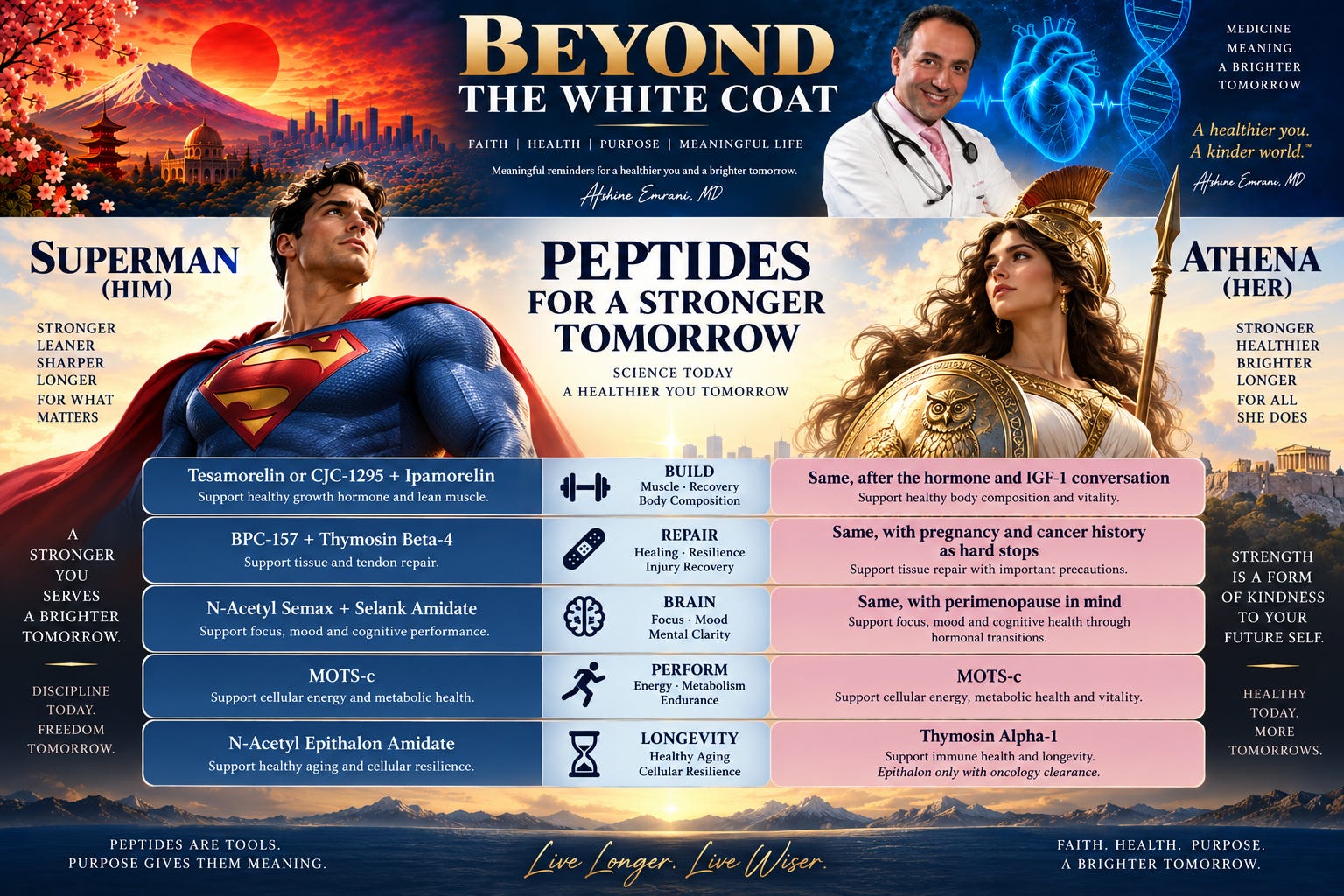
The best peptide stack for a man and the best peptide stack for a woman after 50.
Originally published on Substack.
When I published the Superman Stack, I said every one of those five areas matters just as much for women. I still believe that.
But I got a hundred versions of the same question: “Okay, but what would YOU build for her?”
Fair. A woman at 54 is not a smaller man at 54. She is in a different hormonal world, with different injury patterns, a different cancer-risk conversation, and a different set of things she’s trying to protect. Handing her a copy-paste of my stack is lazy, and she deserves better.
So here are two stacks, each built for the best realistic outcome in its own body.
The one rule hasn’t changed: no two picks can do the same job.
The one new rule: every pick gets an honest evidence grade, so you can see exactly how much weight each one can bear.
Education only. None of this is a medical plan, and nothing here tells you to inject anything. Everything below belongs in a conversation with a physician who has seen your labs.
Before any peptide: the 95%
Peptides are the top slice of the pyramid. Without the base, they’re expensive decoration.
-
Strength training 2 to 3 times a week, heavy enough to matter
-
Protein at every meal
-
Sleep you protect like a flight you can’t miss
-
Zone 2 cardio plus a little hard work at the top end
-
Labs: ApoB, Lp(a), A1c, fasting glucose, IGF-1, thyroid, and a coronary calcium score if your age and risk say so
Men add: total and free testosterone, estradiol, hematocrit, PSA.
Women add: where she is in the menopause transition (FSH, estradiol, symptoms), ferritin, an up-to-date mammogram and cervical screening, and a pregnancy test if there’s any chance.
If your testosterone is low or your menopause symptoms are wrecking you, fix that first. Hormone replacement is a bigger lever than any peptide on this list, and it changes how the rest of the stack behaves. That’s a conversation for a clinician who does this every day.
A Few Words You’ll See a Lot
Peptide: a short chain of amino acids, the building blocks of protein. Your body makes many of its own and uses them as messengers.
Receptor: a docking spot on a cell. The right chemical attaches, and the cell gets told to do something.
Randomized, placebo-controlled trial: people are split by chance into a real group and a placebo group, and the results are compared. It’s one of the strongest tests we have.
Angiogenesis: growth of new blood vessels. Wonderful for healing a tendon. Unwelcome when a tumor is the one recruiting them. Hold onto this word.
How to read the evidence grades
-
Strong for its indication: a real human randomized trial exists, but often in a specific patient group.
-
Moderate: some human data, some gaps.
-
Early: mostly animal and lab work, with limited human data.
A high grade means “we know more,” not “it’s right for you.”
THE SUPERMAN STACK
Built for a man at 50+
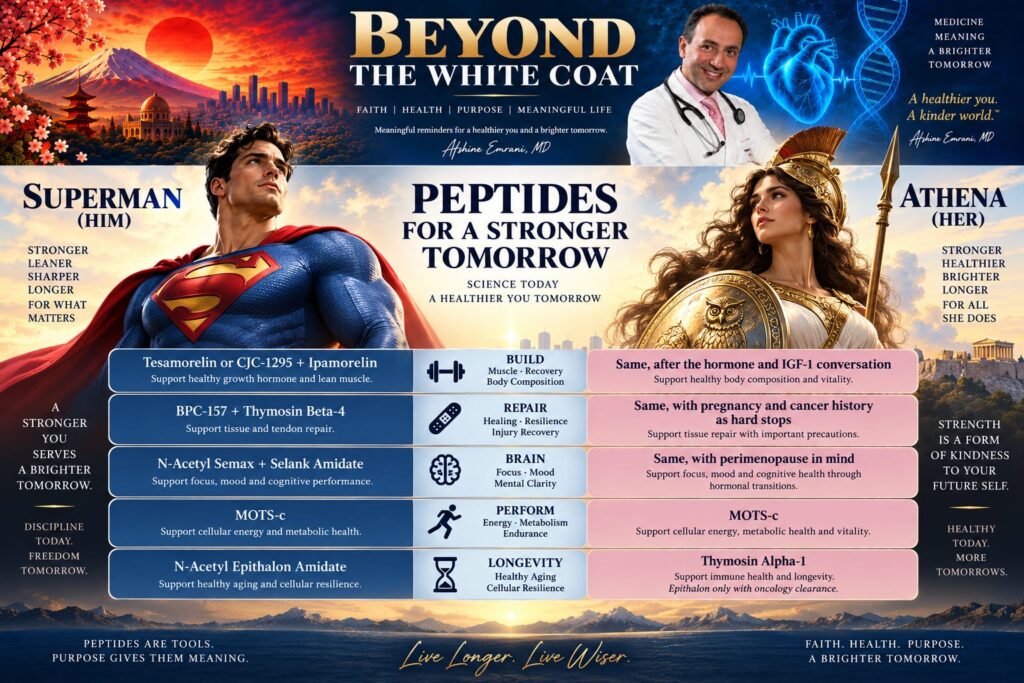
#1 Build: Tesamorelin (or CJC-1295 + Ipamorelin)
Evidence: Strong for its indication (tesamorelin), early (the combination).
Growth hormone comes from the pituitary, a small gland at the base of the brain. It tells your liver to make IGF-1, which carries out much of the work. Both fall with age, which is part of why muscle gets harder to hold and belly fat gets easier to gain.
Tesamorelin is the pick if the target is visceral fat, the deep fat packed around your organs. It’s FDA-approved (Egrifta) for reducing that fat in adults with HIV lipodystrophy, and the trials used 2 mg injected daily. That’s a specific population, so treat it as the best-studied option rather than a guarantee. CJC-1295 + Ipamorelin is the alternative, and the evidence isn’t equal. A 2006 study showed CJC-1295 raised growth hormone and IGF-1 in healthy adults, but nobody has shown the combination shrinks visceral fat the way tesamorelin did.
Pick one. Tesamorelin and CJC-1295 push on the same GHRH signal, so stacking them just doubles up.
What I’d watch in a man: blood sugar, fluid retention, joint or nerve symptoms, IGF-1 staying in range, and PSA staying on the calendar.
Community protocol (not a recommendation): 250 mcg each of CJC-1295 and Ipamorelin at night, 5 days on and 2 off, for 10 to 12 weeks. Never tested as a combination in a clinical trial.
#2 Repair: BPC-157 + full-length Thymosin Beta-4 (TB-500)
Evidence: Early (BPC-157 is animal-heavy), moderate for Thymosin Beta-4 in wound repair.
Tendons and ligaments have a thin blood supply, which is why they heal slowly and why a sore shoulder at 54 can linger for months. BPC-157 has a large body of animal research and only a handful of small human pilots. Thymosin Beta-4 has a randomized, placebo-controlled trial in 73 people with leg ulcers, where one of the strengths tested seemed to speed healing. That’s wound repair, not proof an injection fixes a tendon.
I want the full-length, 43-amino-acid molecule, because the name TB-500 doesn’t always mean the same material from one source to the next.
Community protocol (not a recommendation): 400 mcg BPC-157 daily and 5 mg TB-500 twice a week, a few days apart.
#3 Brain: N-Acetyl Semax Amidate + N-Acetyl Selank Amidate
Evidence: Moderate for the originals (mostly Russian data), early for the capped versions.
Both are used as medicines in Russia. Neither is FDA-approved in the US. A 2006 rat study found Semax raised BDNF, a protein that helps brain cells survive and connect, in the hippocampus. A 2008 study of 62 people compared Selank to medazepam, a Valium-family drug, and Selank eased anxiety with less fatigue. A brain-scan study of 52 healthy people found both peptides shifted activity involving the amygdala.
The capped versions protect the chain from being chewed up as fast. The studies above used the originals, and nobody has compared them head to head.
Community protocol (not a recommendation): 250 mcg of each once daily, subcutaneous. No trial has tested that for the modified versions.
#4 Perform: MOTS-c
Evidence: Early. Strong biology, mostly mouse data.
Your own mitochondria make MOTS-c from their own DNA. It switches on AMPK, the cell’s energy sensor. In mice it protected against weight gain and insulin resistance, and it improved physical performance at every age tested, including very old mice. In people, exercise raises your own MOTS-c. What we don’t have is a controlled trial showing that injecting it does the same in healthy humans.
Community protocol (not a recommendation): 5 mg three times a week on non-consecutive days. The reasoning is that MOTS-c is released in bursts with exercise, and the old mice that got stronger were dosed three times a week, not daily.
#5 Longevity: N-Acetyl Epithalon Amidate
Evidence: Early. Cell-dish research only.
Epithalon is a four-amino-acid synthetic peptide from the work of Vladimir Khavinson. In 2003 his group reported it switched on telomerase and lengthened telomeres in human cells in a dish, and a 2025 team at Brunel University London saw something similar in normal cells. The same Brunel work found breast cancer cells also lengthened their telomeres, through a different route, and the paper later carried a correction for errors in some figures. It does not show Epithalon helps anyone live longer.
If you want the slot filled with the option that has the most human clinical history, Thymosin Alpha-1 is the swap (see the women’s stack below).
Community protocol (not a recommendation): 1 to 2 mg daily, subcutaneous. The famous 10 mg figure came from a mix-up with Epithalamin, the crude pineal extract.
THE ATHENA STACK
Built for a woman at 50+
Four of the five jobs stay the same. The fifth changes, and the reason matters.
#1 Build: Tesamorelin (or CJC-1295 + Ipamorelin), after the hormone conversation
Evidence: Strong for its indication, but the trials enrolled mostly men.
As estrogen falls, women lose muscle faster and shift fat toward the middle. The goal is the same as his, but the road has three extra signs:
-
Estrogen route matters. Oral estrogen lowers circulating IGF-1. Transdermal estrogen mostly doesn’t. If she’s on hormone therapy, that changes the growth hormone math, so settle it first.
-
Thinner data. Women were a minority in the key trials, so we know less about what a given dose does to her body composition.
-
Hormone-sensitive cancer history. Anyone with a personal or strong family history of breast cancer should talk to her oncologist before touching anything that raises IGF-1.
Community protocol (not a recommendation): Same published numbers as the men’s section. No sex-specific protocol exists, and a smaller body is a dosing conversation for her prescriber.
#2 Repair: BPC-157 + full-length Thymosin Beta-4
Evidence: Early for BPC-157, moderate for Thymosin Beta-4 in wound repair.
This is not a “men’s category.” Women suffer ACL tears several times more often than men, and tendon quality changes as estrogen drops. My daughter’s ACL recovery is the reason I think about this so much.
Two hard stops:
-
Pregnancy or breastfeeding: no safety data. Treat it as an absolute no, and have a plan if pregnancy is possible.
-
Active or recent cancer: both peptides are studied for promoting new blood vessel growth. That’s a reason to pause and ask her oncologist.
Community protocol (not a recommendation): 400 mcg BPC-157 daily and 5 mg TB-500 twice a week.
#3 Brain: N-Acetyl Semax Amidate + N-Acetyl Selank Amidate
Evidence: Moderate for the originals, early for the capped versions.
For many women this may be the most valuable category. Anxiety disorders are more common in women, and perimenopause brings brain fog, mood swings, and fragmented sleep that many describe as the hardest part of the transition. To be straight with you: none of the Semax or Selank research was designed around menopause. I’m connecting dots, not citing a trial. And significant anxiety or depression is a conversation with her doctor first, not a vial.
Community protocol (not a recommendation): 250 mcg of each once daily, subcutaneous.
#4 Perform: MOTS-c
Evidence: Early, but with the most interesting female-specific signal on the list.
A mouse study using a menopause model (ovariectomized mice) found MOTS-c helped protect against the fat gain and insulin resistance that follow estrogen loss. That’s an animal study and not proof in women, but it points straight at what midlife women struggle with most.
Community protocol (not a recommendation): 5 mg three times a week on non-consecutive days.
#5 Longevity: Thymosin Alpha-1 (the swap)
Evidence: Moderate, with far more human clinical history than most compounds on this list.
Here’s why the slot changes. The Epithalon research that excites me is cell-dish work, and the same Brunel study found breast cancer cells lengthened their telomeres too. For a woman, that’s exactly the type of signal that should make you slow down. I would not put it in her default stack.
Thymosin Alpha-1 is an immune peptide that has been used as a medicine in a number of countries outside the US, and the immune system is the biggest area this whole framework otherwise leaves uncovered. It better fits the goal of aging well while carrying less of a cancer-biology question mark. It’s also not a longevity drug in the telomere sense, and I’m not claiming it extends lifespan.
Optional extra: Epithalon only after a clean screening history and an oncology green light.
Common protocol (not a recommendation): The dose used where it’s approved abroad is 1.6 mg subcutaneously twice a week. That comes from approved use in specific conditions, not from a longevity trial.
If I could only start two
Don’t launch five at once. You won’t know what’s doing what, and you won’t know what’s hurting you.
For him: Build + Repair. Muscle, fat, and recovery are the most visible and best-studied wins.
For her: Build (after the hormone conversation) + Brain. Body composition and the fog-and-sleep problem are the two things midlife women tell me wreck their quality of life.
Add one new compound at a time, a few weeks apart, with labs in between.
Three warnings
1. Most of this is not FDA-approved, and the regulatory picture for several of these has been moving. Check where each one stands today.
2. Quality is the whole game. “Research use only” vials vary wildly. A peptide is only as good as what’s actually in the vial.
3. Don’t do this alone. Find a physician who will look at your labs, your history, and your medication list.
The ones that almost made it
SS-31 (elamipretide): goes straight to the mitochondria and has an FDA-approved version (Forzinity) for Barth syndrome, a rare genetic disease. That doesn’t make it an anti-aging drug for healthy people, and MOTS-c already covers the slot.
FOXO4-DRI: designed to help clear senescent “zombie” cells. Promising in a 2017 mouse study, but no human trials.
Humanin: another mitochondrial peptide that overlaps with MOTS-c.
NAD+: not technically a peptide. It’s central to energy and DNA repair, but it didn’t add a new category.
Why I built it this way
I’m not trying to be 25 again. I want 70 to look different from what most people picture, for him and for her.
But “equally important” never meant “identical.” The best advice for a woman starts with her biology, not a smaller version of mine.
If I made this list again in five years, it could look completely different. The research keeps moving, and I’ll tell you when it does.
If this was useful, send it to the man and the woman in your life who keep asking. And tell me in the comments: which stack are you building?
This article is for education only and is not medical advice. Talk to your own physician before starting, stopping, or changing anything.
Blessings.
Afshine Ash Emrani, M.D., F.A.C.C.
Assistant Clinical Professor, UCLA
David Geffen School of Medicine
Join Our new website
Castle-Connolly Nationwide Top Doctor (Since 2008)
Los Angeles Magazine Super Doctors (every year since 2013)
LA Style Magazine Top 100 Doctors in America (2024)
Subscribe to mynewsletter: substack.com/@afshineemrani
Explore my books: Amazon Author Profile