Writings
What the FDA Just Said About Testosterone for Women — And What It Didn’t

Originally published on Substack.
She sat across from me and said it without looking up: “I still love him. I just don’t want him.” Not pain. Not anger. A quiet absence where desire used to live. She had already tried the podcasts, the supplements, the friend who swore testosterone “gave her her life back.” She wanted a physician who would tell her the truth without selling her a miracle.
This week, the FDA held a public workshop on testosterone use in menopausal women. That matters. There is still no FDA-approved testosterone product formulated for women in the United States, even as off-label prescribing and compounding rise, and even as social media promises energy, muscle, mood, sleep, and sharper thinking. Regulators asked for better evidence. Patients asked to be taken seriously. Both requests can be true at once.
Here is what the strongest science actually supports.
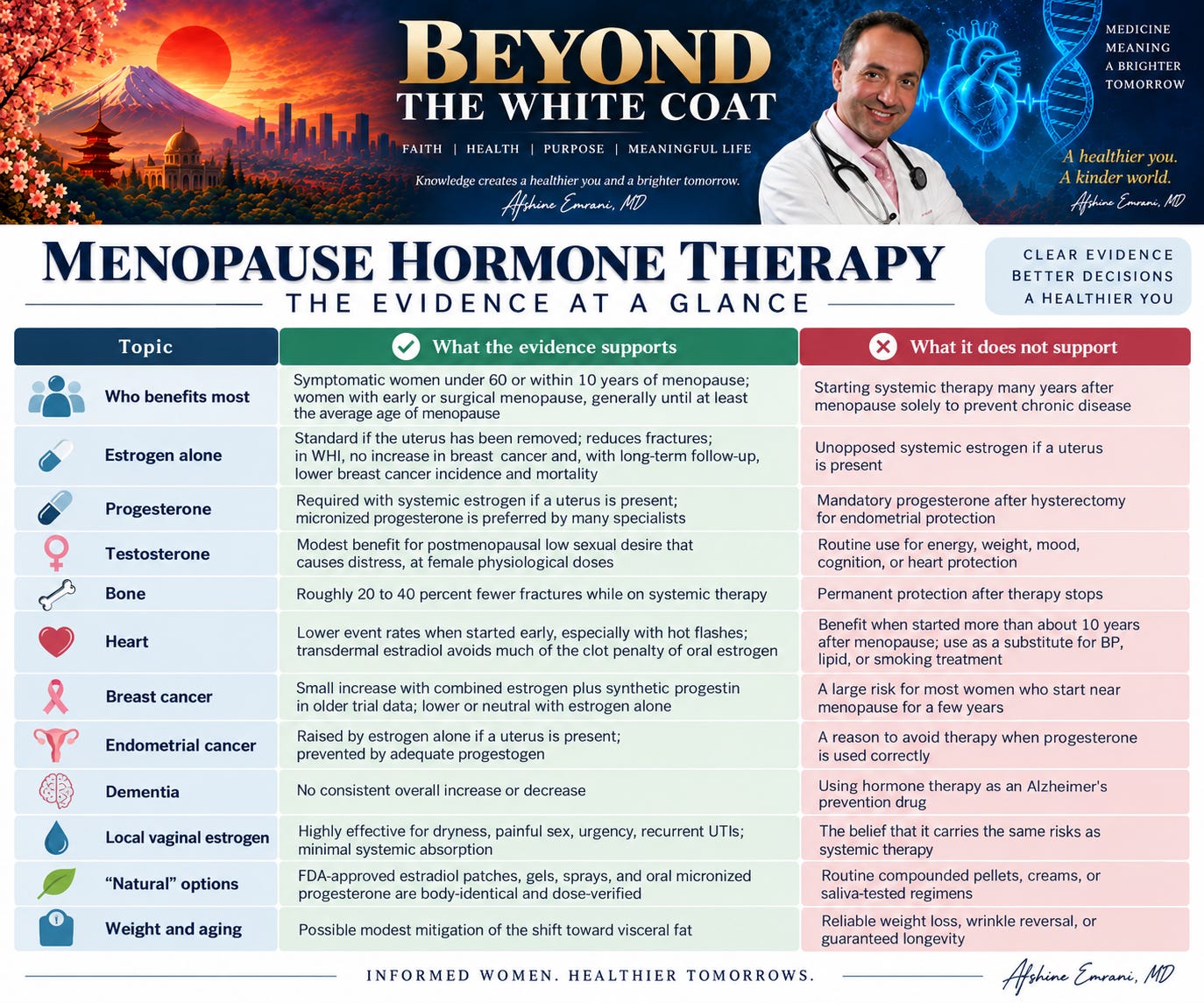
In 2019, a Global Consensus Position Statement — endorsed by the Endocrine Society, the International Menopause Society, ISSWSH, and others — concluded that the only evidence-based indication for testosterone in women is postmenopausal hypoactive sexual desire disorder (HSDD) after a careful biopsychosocial assessment. In randomized trials using physiologic doses, testosterone produced a modest but real benefit: roughly one additional satisfying sexual event per month on average, with improvements in desire, arousal, orgasm, and sexual distress. That is not nothing. For a woman who has felt erased in her own body, it can be meaningful.
What the same consensus does not support is equally important.
Available data show no effect on general wellbeing. Evidence is insufficient for cognition or delaying cognitive decline. Physiologic-dose testosterone has not been shown to improve lean mass, fat mass, muscle strength, or bone density in the studies reviewed. Oral testosterone worsens lipids and is not recommended. Long-term cardiovascular and breast-cancer safety remain incompletely defined; trials excluded higher-risk women and rarely extended beyond two years. Association with desire is established. Claims about longevity, personality upgrades, and “optimization” are still speculative.
As a cardiologist, I hear the marketing before I see the patient. Desire is physiology and relationship and sleep and grief and blood pressure medication and the slow renegotiation of a decades-long marriage. A hormone can help some women. It cannot carry the whole story.
If you are considering testosterone — or your spouse is asking about it — treat it like medicine, not folklore:
① Name the problem accurately. HSDD is distress from low desire that is not explained only by relationship conflict, depression, pain, or medication. A low lab number alone does not make the diagnosis; no testosterone cutoff separates women with and without sexual dysfunction.
② Fix the reversible first. Sleep apnea, uncontrolled hypertension, alcohol, SSRIs, relationship rupture, untreated vaginal dryness, and exhaustion all blunt desire. Hormones work best when the rest of the system is not on fire.
③ If a trial is appropriate, insist on physiologic dosing and monitoring. Transdermal formulations that keep levels in the premenopausal female range are preferred; pellets, injections, and compounded products that drive levels supra-physiologic are not. Baseline total testosterone, recheck in 3–6 weeks, clinical follow-up, and stop by six months if there is no clear benefit.
④ Protect the heart while you protect intimacy. Prefer non-oral routes. Avoid oral testosterone because of adverse lipid effects. If you have established heart disease, prior stroke or clot, hormone-sensitive breast cancer, or uncontrolled risk factors, this is a specialist conversation — not a wellness purchase.
⑤ Bring your partner into the room, not just the prescription. Medicine can restore capacity. Only the two of you can restore meaning.
Desire is not vanity. It is aliveness. But aliveness is more than a serum level. The women I respect most in this season of life do not chase every new hormone story. They ask a harder question: What in me still wants — and what have I quietly abandoned?
A good life after fifty is not built by optimizing every molecule. It is built by refusing to disappear.
The Takeaway
• Established: Physiologic-dose testosterone can modestly improve desire and sexual function in carefully selected postmenopausal women with HSDD.
• Not established: Benefits for mood, energy, cognition, muscle, bone, or longevity at physiologic doses.
• Prefer transdermal physiologic dosing with lab monitoring; avoid oral testosterone and supra-physiologic pellets/injections.
• Screen for sleep, meds, pain, mood, and relationship factors before any hormone trial.
• Stop by six months if benefit is unclear — and never outsource your marriage to a vial.