Writings
The Cure Has a Boarding Pass: Designer Cancer Cures!
Originally published on Substack.
Michael Walters was twenty-five and out of doors.
He had non-Hodgkin lymphoma, and New Zealand had given him what medicine gives you: chemotherapy, then radiation, then immunotherapy, in the order the protocols prescribe. The cancer had read the protocols too. It kept growing. A hospital across the Tasman in Melbourne offered one more door — CAR-T therapy, a treatment that re-engineers a person’s own immune cells to hunt their specific cancer — and quoted him as much as six hundred thousand US dollars to walk through it.
That is not a price. For most families, that is a sentence pronounced in accounting language.
So he did the thing that would have sounded like desperation, or delusion, a decade ago. He got on a plane to Shanghai.
On August 18, he learned that his cancer was in complete remission.
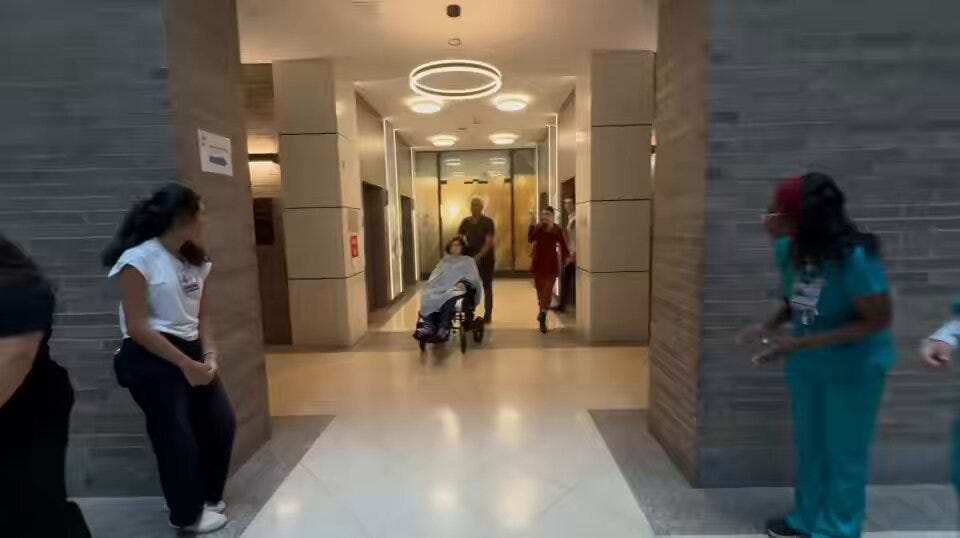
He was not alone on that route. Around the same time, a 59-year-old New Zealand business executive named Josh Bronkhorst arrived in the same city with stomach cancer that his doctors at home were running out of ways to fight; the next round of chemotherapy, he was told, had roughly a fifteen percent chance of doing much. He received cell therapy at a private international hospital, watched the fluid that had been accumulating in his body stop, and flew home.
I am a cardiologist. I have spent twenty-five years in rooms where the honest answer was “there is nothing more we can do,” and I have written some version of that sentence more times than I want to count. So I understand exactly what these two men felt when the drainage tube came out and the plane pointed home. It feels like a miracle.
But I want to be careful with that word, because the most important thing about these stories is that they are not miracles at all.
They are a market forming.
The miracle, and why it isn’t one
Let me stay with the wonder for a moment, because it is real and it deserves to be felt before it is analyzed.
For most of the history of medicine, cancer treatment has been a form of controlled poisoning. Chemotherapy kills fast-dividing cells and hopes the cancer dies before the patient does. Radiation burns. Surgery cuts. These are blunt instruments used with enormous skill, and they have saved millions of lives, and they are still, for the great majority of patients, the standard of care.
CAR-T is a different kind of thing entirely. You draw a patient’s own T-cells — the immune system’s assassins — and you insert a gene that teaches them to recognize a single molecular fingerprint on the surface of that patient’s cancer. You grow those edited cells into an army of millions. You infuse them back. And then, unlike a drug that clears the body in hours, the cells stay. They circulate. They hunt. A living drug, manufactured from the patient and returned to the patient, that keeps working after the infusion bag is empty.
When it works in blood cancers like Walters’s lymphoma, it can work the way nothing before it worked: not “managed,” not “in retreat,” but gone.
That is the miracle. Here is why it is not one: it is manufacturing. And manufacturing can be industrialized, priced, scheduled, franchised, and shipped. The moment a cure becomes a product, it stops being a gift of fate and becomes a question of supply chains and margins. That is not cynicism. That is the most important sentence in this essay, because everything that follows — the hope and the warning both — flows from it.
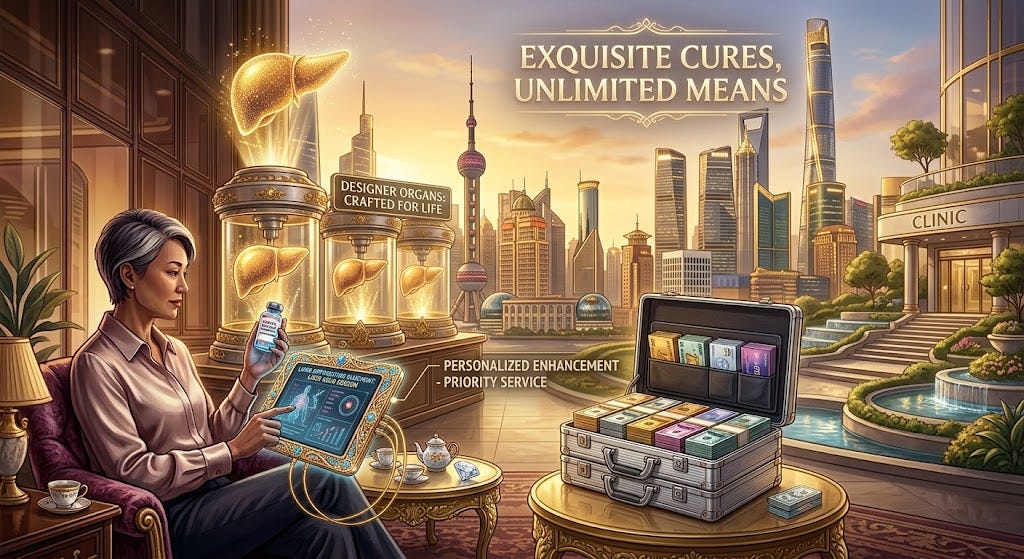
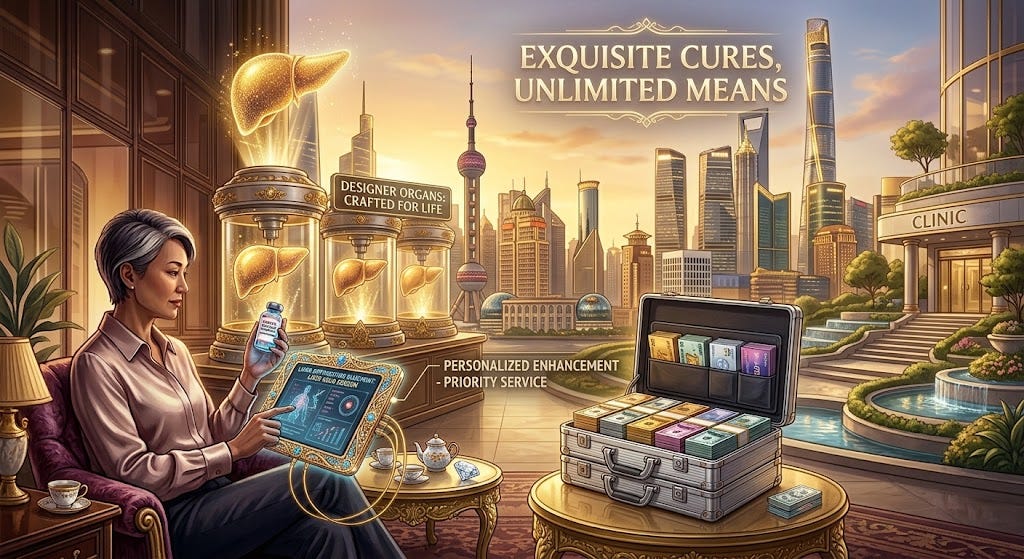
Cancer treatment is quietly splitting into two industries. The old industry sells protocols: chemo, radiation, off-the-shelf drugs, the same regimen for everyone with the same diagnosis. The new industry sells design: a one-patient factory that reads your particular tumor and builds a particular weapon against it. China is the first country to industrialize the second one at scale. And patients from the wealthy world are already buying the plane ticket.
The science: from a living drug to a designed one
To see where this goes, you have to see that CAR-T is only the first mass-produced version of a much larger idea. Call it designer oncology. It has three layers, and all three are already real.
The first layer is cell therapy — your own cells, custom-armed. This is CAR-T. The United States invented it; the science was born in American and European labs. But China has approved nine CAR-T products, more than any other nation on earth, and in June 2026 it crossed a line the field had been staring at for a decade. Its regulator approved the world’s first commercial CAR-T therapy for a solid tumor — CARsgen’s product, brand-named Kelimei, for advanced stomach and gastroesophageal cancers that carry a specific marker called Claudin18.2.
I want to be precise here, because the precision is the point. This is a narrow approval: one biomarker, one family of cancers, patients who have already failed at least two prior treatments. It is not “China cured solid tumors.” Solid tumors remain brutally hard — the cancer cells hide, they mutate, they build walls the engineered cells struggle to cross. But for ten years, “CAR-T doesn’t work on solid tumors” was a load-bearing wall in oncology. That wall just cracked. The West still has no commercial equivalent.
The second layer is the personalized mRNA cancer vaccine — and it just had its landmark moment, so let me tell you exactly what happened rather than what a headline might imply. In August 2026, Moderna and Merck reported a Phase 3 win for their individualized vaccine, intismeran autogene. In patients whose high-risk melanoma had been surgically removed, the vaccine — added on top of the standard immunotherapy Keytruda — reduced the risk of recurrence and spread compared to Keytruda alone.
Read that twice, because it is easy to garble. This is not a vaccine beating immunotherapy. It is a vaccine plus immunotherapy beating immunotherapy by itself. But even stated at that honest, narrower strength, it is historic: the first time a one-patient mRNA cancer vaccine has succeeded in a late-stage, randomized trial. You sequence the tumor, identify the unique mutations that make it that person’s cancer and no one else’s, and print a shot that teaches the immune system to remember and hunt exactly those mutations.
The third layer is the quiet one, and it may be the most commercially durable: tumor sequencing and residual-disease tracking. Every custom cell therapy and every custom vaccine begins with reading a genome. And after treatment, monitoring whether a few microscopic cancer cells are still hiding — minimal residual disease — turns follow-up from a one-off scan into an ongoing subscription. The recurring layer beneath everything.
Stack those three layers in a single city with same-week manufacturing, and you no longer have a hospital. You have a cancer foundry.
The business model almost nobody is naming yet
Shanghai is the prototype foundry. The international private hospitals there — SinoUnited, Jiahui, and their peers — are not cowboy operations running back-alley experiments on foreigners. That is the lazy assumption, and it is wrong. They are selling approved products wrapped in concierge logistics: the medical visa, the English-speaking hematologist trained at a US or European center, the cardiologists and neurologists standing by for the violent side effects these living drugs can cause, the birthday cake on the ward, the flight home booked for the day the drainage tube comes out. That is not charity. That is product design. And underneath it, a business model is assembling that deserves to be named plainly.
One: the living-drug factory. Cell therapy is not pharmacy; it is manufacturing. The competitive moat is not the molecule — everyone roughly knows the science — it is cycle time, the interval between drawing a patient’s cells and returning them. China built the factories next to the beds, which is why a Shanghai lab can turn cells around in days while Western vein-to-vein timelines can still run into weeks. This is not a detail. For an aggressive cancer, weeks is the difference between a candidate and a funeral. And it is precisely why AstraZeneca announced in March 2026 that it would build its own end-to-end cell therapy hub in Shanghai — the first multinational drugmaker to do so — as part of a fifteen-billion-dollar commitment to China through 2030. Speed is the asset everyone is buying.
Two: destination bundles, not procedures. The old model prices a procedure. The foundry model prices an entire episode as a single invoice: cell collection, engineering, an ICU-capable hospital stay, a toxicity team, visa, hotel, translator, and a follow-up packet for the oncologist back home. One city, one price, one coordinator. That is how you sell a $180,000 product to a family that just heard “$600,000 or hospice” — you make the terrifying thing legible.
Three: the dual market. Domestic Chinese volume crushes the unit cost. Foreign self-pay patients capture the margin. Same laboratory, two entirely different price architectures pointed at two entirely different populations. It is a playbook China has run in manufacturing for forty years, now applied to living human cells.
Four: platform, not pill. The valuable company of 2030 is not “a CAR-T.” It is the platform that sequences the tumor, designs the receptor and the vaccine, manufactures in seventy-two hours, infuses, monitors residual disease for years, and re-doses when the cancer evolves. In that architecture the sequencing-and-monitoring layer may quietly out-earn the dramatic one-shot cell product, because it recurs. Every patient becomes both a customer and a dataset — and every dataset trains the design of the next patient’s cure.
Five: regulatory speed as a feature, with a warning stamped on it. China can approve faster than the FDA or the EMA. That is why the first solid-tumor CAR-T exists in 2026 and not 2031. It is also why a patient must insist on the commercial, approved-product pathway rather than the experimental ward. The wider system has already seen transparency fights and trial deaths. The entire destination-cure market works only if the buyer can tell approved therapy from adventure — and a frightened family, googling at 3 a.m., is not well equipped to tell the difference.
Which brings me to the part of this that I refuse to skip.
The warning label
The stories that travel across the world are the stories of the people it worked for. Michael Walters flew home in remission and told a reporter about it. The people who spent their savings, flew to a foreign city, received the same class of treatment, and died anyway — they do not trend. They do not get the article. This is survivorship bias operating at the scale of human hope, and it is the most dangerous force in this entire story.
One anecdote in remission is not an outcome. A dazzling response rate from a small, early-phase trial is not a promise to the next patient, whose age and disease burden and tumor biology may be nothing like the trial’s. A cure that exists is not the same as a cure that will work for you. These are not pedantic distinctions. They are the difference between an informed decision and an expensive tragedy.
I say this as someone who wants this technology to win. Precisely because I want it to win, I want it described accurately — because the fastest way to discredit a real revolution is to oversell it to desperate people.
The timeline
It helps to see how fast this has actually moved, because the acceleration is the story:
-
December 2022 — Moderna and Merck’s mRNA cancer vaccine posts its first Phase 2b signal in melanoma: the first efficacy for an mRNA cancer treatment in a randomized trial.
-
July 2025 — the science underpinning industrial-scale ECG and cell-therapy screening matures; China’s CAR-T ecosystem shifts from experimental to clinically dominant.
-
January 2026 — AstraZeneca pledges $15 billion to China through 2030, flagging cell therapy as a priority.
-
March 19, 2026 — AstraZeneca announces an end-to-end CAR-T manufacturing and R&D hub in Shanghai, the first multinational to attempt it.
-
June 22, 2026 — China approves the world’s first commercial CAR-T for a solid tumor.
-
August 2026 — Moderna and Merck report the first-ever Phase 3 win for a personalized mRNA cancer vaccine; and, in the same month, a 25-year-old from New Zealand learns his lymphoma is gone after buying his cure in Shanghai.
Four years from “promising signal” to “patients boarding planes.” That is not the pace of medicine. That is the pace of an industry.
Project it forward and the shape is clear. In the version that keeps compounding, you do not “go to China for cancer.” You fly to a design city. Day one, your tumor is sequenced. Day four, your custom cell construct and your personal list of neoantigens are locked. Day ten, the living drug goes in. Month two, a personalized mRNA booster. For years afterward, blood tests that hunt a single leftover cancer cell in a million. Cancer stops being a nationality problem — “what does my country’s system cover?” — and becomes a logistics problem — “which foundry can print my immune system this month?”
What personalized medicine that money can buy will actually do
Here is where I have to be honest about the phrase in the title, because it cuts both ways, and the pretty version of this essay would only tell you one side.
The first thing this does is stratify. A cure with a price tag and a boarding pass is, by definition, first available to the people who can pay for the tag and the pass. For a while — maybe a long while — the two industries will map onto two classes of patient. The solvent will buy design. Everyone else will get the protocol. A single-payer national health system, built on the premise that everyone gets roughly the same standard of care, was never designed for a world in which the standard of care can be privately out-purchased in another hemisphere within the week. When a wealthy patient can simply exit the queue and buy the newer thing, the social contract of medicine develops a quiet leak. That is the uncomfortable truth, and pretending otherwise would insult your intelligence.
But the second thing this does is the reason I am not writing a eulogy. Industrialization, historically, is the thing that eventually makes the expensive cheap. Today’s $180,000 luxury SKU, sold to the desperate rich, is exactly the product whose manufacturing curve gets bent by volume — and China’s dual market is, whatever else you think of it, a volume machine. The technologies that begin as the exclusive privilege of the few have a long habit of becoming the boring standard of the many: the mobile phone, the sequenced genome, the very immunotherapy these vaccines are now built on top of. If the foundry model bends the cost curve the way manufacturing usually does, the same forces that stratify medicine this decade could democratize it the next. Both futures are live. Which one we get is not a scientific question. It is a political and moral one, and it is still open.
And the third thing it does is subtler and, to me, the most profound. It changes what a cure is. For all of human history, the answer to serious illness was fundamentally passive: you presented your body to medicine and medicine did what it could to your body. Designer oncology inverts that. Your body becomes the raw material and the blueprint both. The disease is read, and a bespoke answer is written and manufactured to order. Medicine stops being something done to you and becomes something built from you. That is a genuinely new relationship between a person and their own mortality, and we have not begun to reckon with what it means to live inside it.
A 25-year-old put the whole thing more simply than I can. Ten or fifteen years ago, he said, this option would not have existed.
It exists now. It is personal, it is portable, and the industry assembling around it is not really “medical tourism.” It is destination cures — designer immune systems, printed on demand and sold as a trip.
The patients have already bought the ticket. The only question left is who builds the airport, who is allowed through the gate — and whether, a decade from now, we look back on this summer as the moment medicine became more miraculous, more unequal, or somehow both at once.
I think it will be both. And I think our job — as doctors, as patients, as a society deciding what it will pay for and for whom — is to make sure the miracle outruns the inequality. That race has already started. The starting gun went off in Shanghai, in August, in a young man’s bloodwork that came back clean.
Blessings.
Afshine Ash Emrani, M.D., F.A.C.C.
Assistant Clinical Professor, UCLA
David Geffen School of Medicine
Join Our new website
Castle-Connolly Nationwide Top Doctor (Since 2008)
Los Angeles Magazine Super Doctor (Since 2010)
LA Style Magazine Top 100 Doctors in America (2024)
Subscribe to mynewsletter: substack.com/@afshineemrani
Explore my books: Amazon Author Profile
Sources and further reading in the notes. If you found this useful, subscribe — I write about where medicine, technology, and being human collide.