Writings
“WE HAVE A CURE. DON’T WORRY!”
Originally published on Substack.
There is a sentence they don’t teach you to say in medical school, and it is the hardest one you will ever speak. You learn it at a bedside, usually late, usually with a family gathered in a room that is too small and too bright. There’s nothing more we can do.
I have said it more times than I can count. As a cardiologist, I have spent my life at the border between what medicine can reach and what it cannot, and for most of my career that border has felt fixed — a coastline, not a frontier. We managed. We slowed things down. We bought time and called it victory, because often time was the only currency we had.
I am writing to you today because that border has begun to move. Not in a press release. Not in a promise. In three human beings whose stories broke in the last twelve months, and whom I cannot stop thinking about.
The first is a baby.
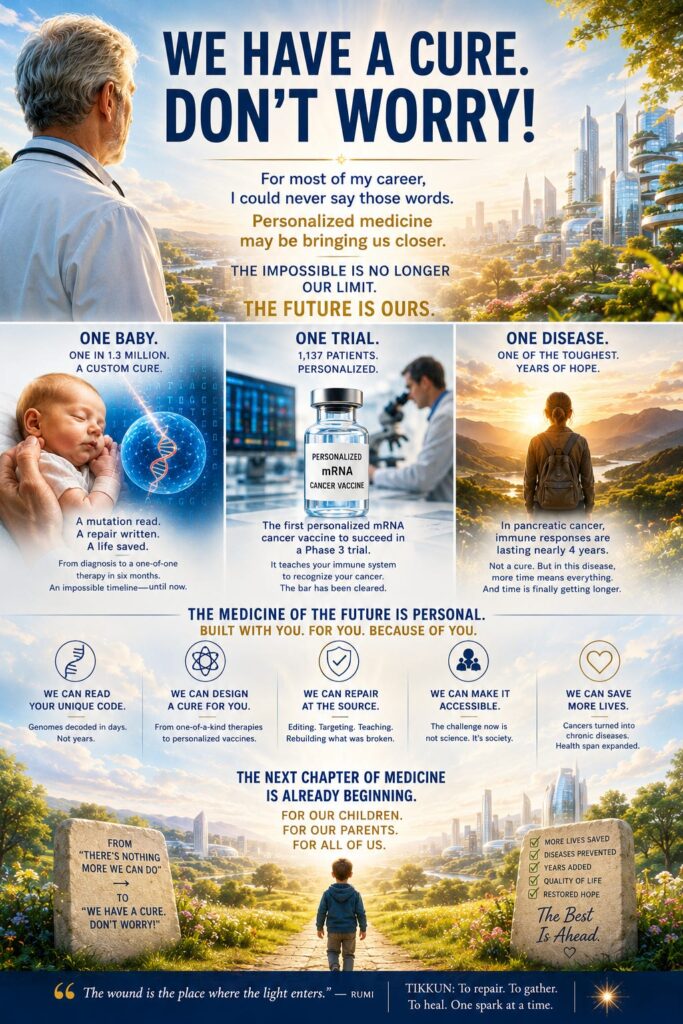
He was born with a mutation so rare it appears in roughly one child in 1.3 million. His body could not clear ammonia, so it built up in his blood like a slow tide, the kind that damages the brain and, in about half of these infants, ends their lives in the first week. He was too small for the transplant that might have saved him. No drug existed for what he had. In the old grammar of medicine, he was the sentence itself: nothing more we can do.
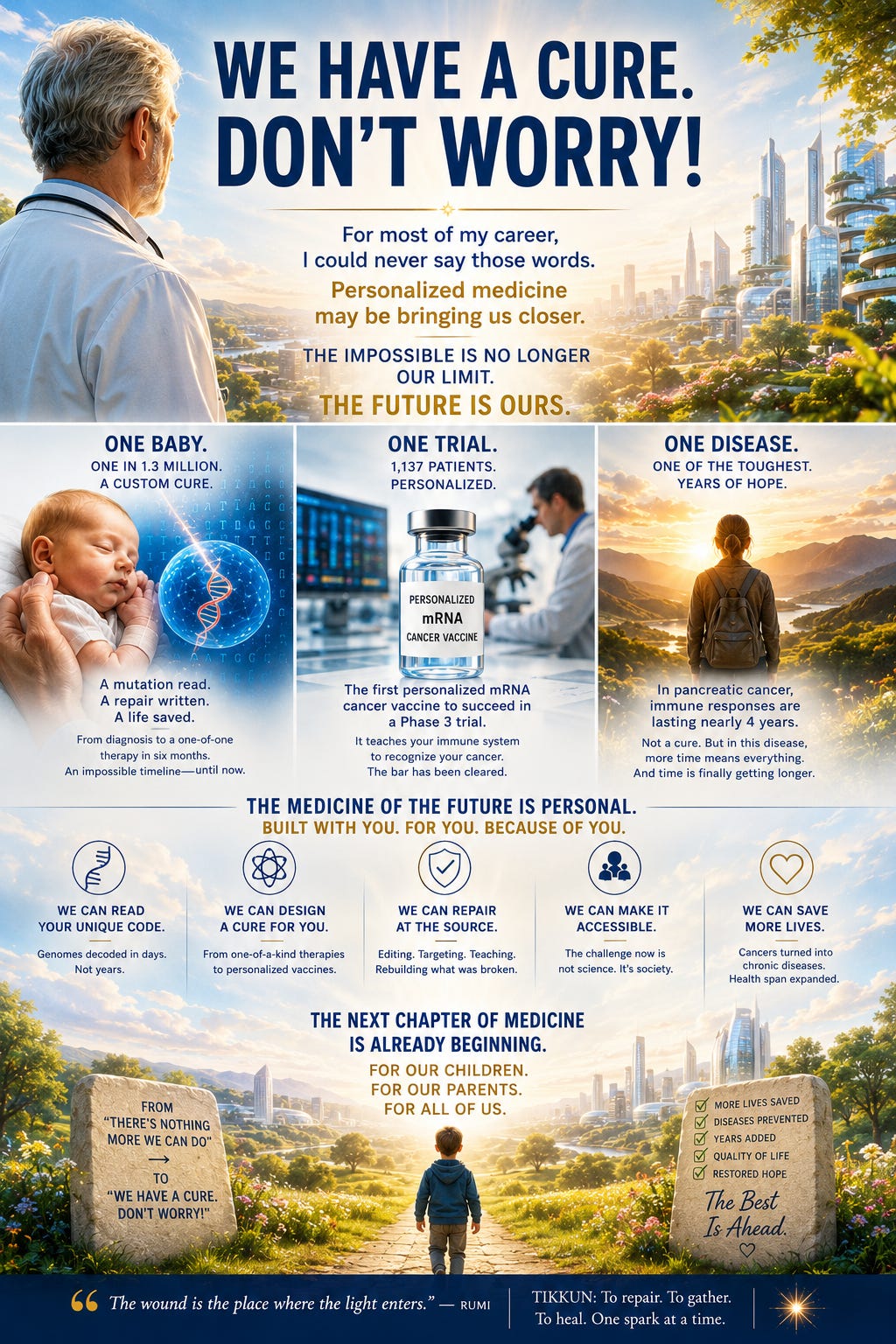
So a team refused the sentence and wrote him a new one. They read his exact mutation — his, no one else’s — and designed a CRISPR editor built for him alone, wrapped it in a lipid particle, and delivered it into his liver cells to correct the error at its source. From diagnosis to a custom-made, one-of-one therapy took about six months. He went home. His lethal disease is now a survivable one.
I want you to sit with the strangeness of that. Not a drug for a million people. A drug for one. His genome, his specific fracture, his specific repair — designed and delivered before his first birthday. The trial that grew out of his case is now opening to other children with other fatal metabolic mutations. Medicine has always been mass-produced. This was tailored.
The second is a number that just became a milestone.
Last week, for the first time, a personalized mRNA cancer vaccine succeeded in a Phase 3 trial — the large, randomized, gold-standard kind that separates hope from hype. Eleven hundred and thirty-seven melanoma patients, their cancers surgically removed, at high risk of return. The vaccine is not one shot for everyone; it is printed from each patient’s own tumor, a wanted poster handed to their immune system describing the specific enemy it must hunt.
Added to standard immunotherapy, it meaningfully cut the risk of the cancer coming back or spreading, compared to immunotherapy alone. It is not yet approved; the companies are now taking it to regulators. But understand what happened: the idea that we could teach a person’s own immune system to recognize their own cancer — an idea that has been almost working for a decade — finally cleared the bar that matters.
The third is a word we almost never get to use.
In pancreatic cancer, one of the cruelest diagnoses I know, an earlier personalized vaccine has produced immune responses still standing nearly four years after treatment in some patients. Early. Small. Not a cure. But in that disease, years is a word we rarely say out loud, and here it was, said plainly.
Notice what these three have in common. Each one is personalized — built from the patient’s own body rather than pulled from a shelf. And the step that used to make personalization impossible, the years of design, is collapsing toward months as our tools learn to read the language of biology and write back to it. That is the real revolution. Not a single miracle drug, but a shift in what kind of thing a treatment is.
Now let me be a physician with you, and not a hype man — because the internet is full of the latter this month, and you deserve better.
This is the beginning. It is not the finish line. One baby. One trial. A handful of patients in pancreatic cancer. The timelines are years, not months. Cancer is not “solved,” and anyone who tells you it will be by some specific date on the calendar is selling you something — a subscription, a stock, a fantasy. I have held too many hands to traffic in false springtime. The honest word is not cured. The honest word is possible — and possible was not on the table a decade ago.
But the direction is unmistakable. The tools to read a mutation and write a correction are no longer theoretical. They are in the laboratories, and now, for the first time, in living bodies. The question has quietly changed from can we? to how fast, how safely, and for whom? — which is a moral question, not a scientific one, and those are the ones worth staying awake for.
I keep returning to an old idea from the tradition I was raised in. The Kabbalists taught that at the beginning, the vessels meant to hold the Divine light shattered, and the sparks scattered into everything, and the work of a human life — tikkun — is to gather them, to mend what is broken, one fragment at a time. I used to read that as metaphor. Lately I read it as a job description. A single child, a single mutation, a single vessel repaired at its exact point of fracture. Rumi said the wound is the place where the light enters. Perhaps it is also, now, the place where we finally learn to let it back in.
I have spent my life on the wrong side of there’s nothing more we can do. I do not know the day that sentence finally dies. But I have watched it begin to, and I do not think most people understand how enormous that is. The impossible is quietly becoming a scheduling problem.
That is not a small thing to witness. It may be the largest thing our generation gets to see.
Blessings.
Afshine Ash Emrani, M.D., F.A.C.C.
Assistant Clinical Professor, UCLA
David Geffen School of Medicine
Join Our new website
Castle-Connolly Nationwide Top Doctor (Since 2008)
Los Angeles Magazine Super Doctor (Since 2010)
LA Style Magazine Top 100 Doctors in America (2024)
Subscribe to mynewsletter: substack.com/@afshineemrani
Explore my books: Amazon Author Profile