Writings
The Menopause Hormone Therapy Handbook: Everything to Know Before You Meet Your Gynecologist
Originally published on Substack.
Why this guide
Most women arrive at the hormone therapy conversation with fragments: a headline from 2002, a podcast claim about pellets, a friend’s story, a social media post promising to reverse aging. Then they get fifteen minutes with a clinician.
Fifteen minutes is enough for a good decision only if you arrive prepared.
This handbook draws on the October 2026 Science review by Laura Gravelsins, Liisa Galea, and colleagues, the companion perspective on the postmenopausal ovary, the Women’s Health Initiative (WHI) and later trials, and current guidance from menopause and endocrine societies. It translates them into the questions you actually need answered:
-
Do I need estrogen alone, or estrogen plus progesterone?
-
Do I need testosterone?
-
Will this cause cancer?
-
What will it do for my heart, bones, brain, sleep, and sex life, and what will it not do?
-
What should I ask, and what should I bring?
Read it once through. Then use the checklists near the end as your script for the appointment.
Menopause in numbers
Menopause is the permanent end of menstrual cycles, after the ovarian follicle supply can no longer sustain them. It is confirmed after 12 consecutive months without a period.
-
Average age: 51.
-
How women get there: about three-quarters naturally; about 10 percent after both ovaries are removed; a smaller share after chemotherapy or medical suppression; and about 10 percent early (before 45) or prematurely (before 40).
-
Share of life: roughly 40 percent of the average female lifespan.
-
Symptoms: as many as 72 have been catalogued, with women often experiencing about seven at once.
-
Hot flashes and night sweats: about 80 percent of women in the transition, and still roughly one-third of women in their late 60s and 70s.
-
Duration: the average symptomatic stretch is about 7.4 years, and for many women it is considerably longer.
-
Other common symptoms: brain fog, broken sleep, mood changes, joint aches, vaginal dryness, urinary urgency, and recurrent urinary infections.
Severe or prolonged symptoms, and especially early or surgical menopause, track with faster aging signals across multiple organs and higher later risk of fracture, cardiovascular disease, and cognitive decline.
That is why “you’re about the right age” is not a complete assessment. The details of your menopause (how it happened, when, how severe) belong at the center of the conversation.
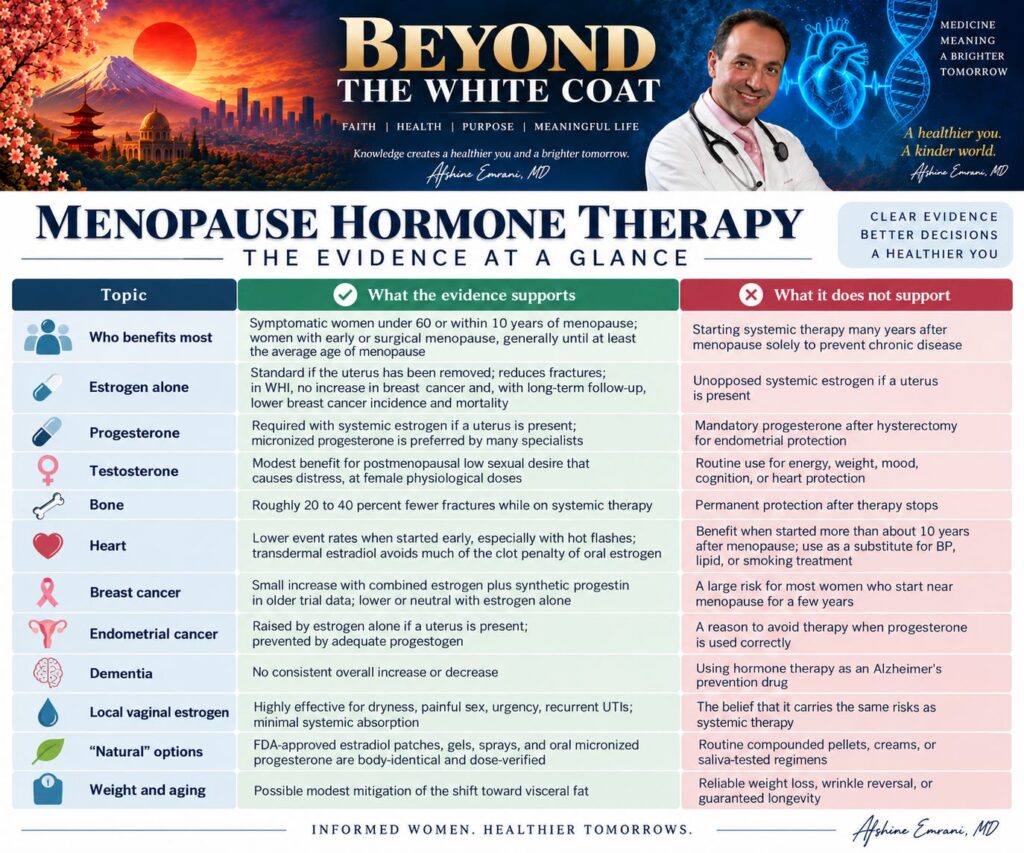
The summary table: points that change decisions
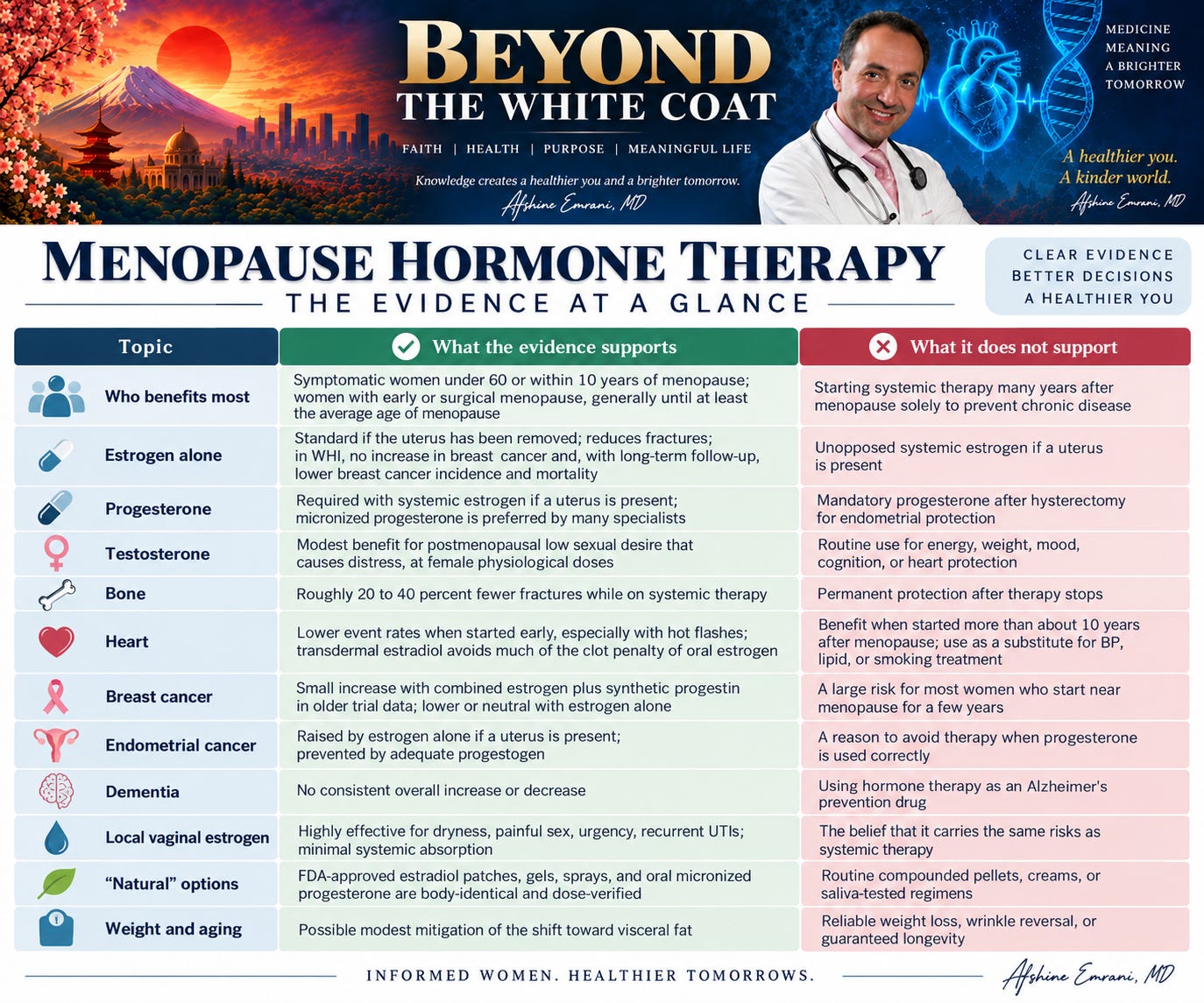
What is actually happening in your body
Estrogen and progesterone receptors are found in the brain, blood vessels, heart, liver, bone, muscle, gut, skin, immune cells, and reproductive tissue. This is not a hormone that only affects the uterus and hot flashes.
When estradiol and progesterone fall and follicle-stimulating hormone rises:
-
Blood vessels become less elastic.
-
Blood pressure and LDL cholesterol tend to rise.
-
Visceral fat and low-grade inflammation increase.
-
Sleep fragments.
-
Bone density declines, most rapidly in the first years after the final period.
-
Vaginal and urinary tissues thin.
-
Mood and cognitive symptoms appear in a large subset of women.
Menopause itself, independent of chronological age, is linked to accelerated aging clocks in multiple organs.
Differences you should know about. Black and South Asian women tend to reach menopause earlier. Black women more often report severe hot flashes and, in the data discussed in the review, less often receive hormone prescriptions. If that describes you, say so at the visit. It changes your baseline picture.
The postmenopausal ovary is not dead tissue. After menopause it is smaller and stroma-dominant, but it still secretes mainly testosterone and smaller amounts of other steroids. It also develops inflammatory and senescent features that may contribute to whole-body “inflammaging.” Surgical removal before natural menopause clearly harms bone, heart, and brain outcomes through abrupt hormone loss. Removal after natural menopause is a different question with thinner evidence. The remaining ovarian androgens still support bone and libido, so removal is not an anti-aging shortcut.
Estrogen-only therapy: who it is for and what to expect
Estrogen-only systemic therapy is the standard choice for women who no longer have a uterus. With no uterine lining left to protect, progesterone is not required for that purpose.
Common side effects
These usually appear in the first weeks or at a dose higher than you need:
-
Breast tenderness
-
Mild nausea
-
Headache
-
Bloating and fluid retention
They often settle with a lower dose, time, or a switch in route.
Route matters
-
Oral estrogen passes through the liver first, raises clotting-factor production, and carries a higher risk of venous thromboembolism (VTE) and, in some data, ischemic stroke. Gallbladder disease risk is also higher.
-
Transdermal estradiol (patch, gel, or spray) largely avoids that first-pass effect and is the preferred route for most women, particularly those with higher clot risk, migraine, obesity, elevated triglycerides, or cardiovascular risk factors.
Typical starting doses for transdermal estradiol are low (a patch delivering roughly 0.025 to 0.05 mg per day is a common range), titrated to the lowest dose that controls symptoms. Your clinician sets the actual dose.
What the trials showed
In the WHI estrogen-alone arm, women who had already had a hysterectomy received conjugated equine estrogen. They did not have more breast cancer. With longer follow-up they had fewer breast cancers and lower breast cancer mortality. Fractures fell. Cardiovascular results depended heavily on age and years since menopause: more favorable near the transition, neutral to unfavorable when started many years later.
When estrogen alone is the wrong choice
If you still have a uterus, unopposed systemic estrogen raises the risk of endometrial hyperplasia and endometrial cancer. You need a progestogen. Always.
Any postmenopausal bleeding needs evaluation, even if you are on therapy and even if you believe your uterus is absent.
Do you need progesterone?
If you have a uterus and take systemic estrogen: yes. The progestogen’s job is to keep the uterine lining from thickening under estrogen stimulation.
If you have had a hysterectomy: no, not for endometrial protection. Some women without a uterus try progesterone for sleep or mood. That use is optional and less well proven.
If you use only low-dose vaginal estrogen: no. Systemic absorption is minimal.
Micronized progesterone vs. synthetic progestins
Micronized progesterone is identical to the progesterone your ovaries made. Many specialists prefer it because:
-
It has a more favorable metabolic and lipid profile than medroxyprogesterone acetate (MPA), the progestin used in the original WHI combination arm.
-
Its metabolite, allopregnanolone, acts on brain receptors that can promote sleep, so it is commonly taken at bedtime.
-
Observational data suggest a lower breast cancer signal than MPA, although long, head-to-head randomized comparisons are limited.
Schedules
-
Continuous (daily): usually leads to no scheduled bleeding after an adjustment period. Often used once you are well past menopause.
-
Cyclic (part of the month): produces a monthly withdrawal bleed. Often used in the early transition.
A commonly used oral micronized progesterone dose is 100 mg nightly for continuous use or 200 mg for 12 to 14 days a month for cyclic use. Your clinician decides.
Side effects: sleepiness, bloating, mood change, breast tenderness. Dose and timing adjustments usually help. An intrauterine system containing levonorgestrel is another way to protect the lining for women who prefer it.
Testosterone in women: what is real and what is marketing
Testosterone is a normal female hormone. The ovaries and adrenal glands make it. After menopause the ovarian stroma and adrenals continue to contribute, and levels fall further if both ovaries are removed.
It is not a routine third hormone you add because you started estrogen. It is also one of the most oversold treatments in this field.
The one evidence-based indication
Hypoactive sexual desire disorder (HSDD) in postmenopausal women: low sexual desire that causes personal distress, after other contributors have been addressed. Randomized trials of transdermal testosterone dosed to keep blood levels within the premenopausal female range show modest improvements in desire, arousal, and the number of satisfying sexual events. A 2019 Global Consensus Position Statement endorsed by major menopause and endocrine societies supports this narrow use.
Before testosterone, your clinician should look at:
-
Pain with sex or vaginal dryness (treat with vaginal estrogen first)
-
Depression, anxiety, and sleep deprivation
-
Medications, including SSRIs and some blood pressure drugs
-
Relationship and life stressors
-
Whether systemic estrogen is adequate
What testosterone does not have solid evidence for
Energy, weight loss, muscle, mood, cognition, or heart protection. Those claims outrun the data at physiological female doses. It also does not replace estrogen for hot flashes or bone protection.
Practical realities
-
No FDA-approved testosterone product is labeled for women in the United States. Treatment is therefore off-label, often using a fraction of a male-labeled gel or cream, or a compounded preparation.
-
Target: blood levels in the female range, not male levels. Baseline testing, a recheck a few months after starting, and periodic monitoring are the standard.
-
Expected side effects at correct doses: mainly acne or mild increases in facial or body hair.
-
Signs of excess that should prompt a dose reduction or stop: voice deepening, scalp hair loss, clitoral enlargement, marked irritability. Some of these changes can be permanent.
-
Pellets: frequently drive testosterone and sometimes estradiol well above physiological female ranges, are difficult to reverse, and are not recommended for routine care by major societies.
-
Premenopausal women: testosterone is not recommended outside research settings.
-
Trial length: a time-limited trial (often around three to six months) with a clear endpoint is reasonable. If there is no meaningful benefit, stop.
The bottom line: if low desire is your main concern, ask whether a measured, time-limited trial is appropriate. If hot flashes, sleep, or bones are your problem, testosterone is not the first answer.
Will it cause cancer?
The honest answer depends on the regimen, not on the word “hormones.”
Breast cancer
-
Combined estrogen plus a synthetic progestin (WHI): a small increase in diagnoses, on the order of about one extra case per 1,000 women per year in that trial population.
-
Micronized progesterone: looks more favorable than MPA in observational studies. Long randomized head-to-head data are limited.
-
Estrogen alone after hysterectomy: associated with lower breast cancer risk in WHI.
-
What moves your baseline risk more than a few years of appropriately timed therapy: family history, breast density, alcohol intake, obesity, and inactivity.
-
After hormone-receptor-positive breast cancer: systemic therapy is generally avoided. Local vaginal estrogen is sometimes considered, case by case, with your oncologist.
Keep up your screening. Mammography on schedule matters whether or not you take hormones.
Endometrial cancer
Estrogen alone with a uterus present increases risk. Adding an adequate progestogen brings the risk back to baseline or below. This is why progesterone is non-negotiable when the uterus is present.
Ovarian cancer
Any increase is small in absolute terms and, by itself, is not a reason for most symptomatic women to avoid therapy. Data are mixed and confounded by formulation and duration.
Colorectal cancer
Some older data suggested lower risk with combined therapy. That is not a reason to start.
The FDA label change
In 2025 the FDA removed the broad boxed warnings that had lumped cardiovascular disease, breast cancer, and probable dementia together as though they applied uniformly to every woman and every product. The endometrial cancer warning remains for systemic estrogen-alone products. Labels now emphasize starting systemic therapy for bothersome symptoms before age 60 or within 10 years of menopause, when the balance is most favorable.
What hormone therapy will actually do for you
Hot flashes, night sweats, sleep, and mood
Systemic estrogen is the most effective treatment available for vasomotor symptoms. Sleep and daytime concentration often improve as the flashes improve. Mood volatility that travels with sleep loss and flashes often eases as well.
Genitourinary symptoms
Low-dose vaginal estrogen (or other local vaginal hormone therapy) is highly effective for dryness, pain with sex, urgency, and recurrent urinary tract infections. It can be used long-term, and it does not require progesterone.
Bone
Systemic therapy reduces fracture risk by roughly 20 to 40 percent and increases bone density at the spine and hip while you take it. Protection is dose-related and fades after you stop, so duration is a planned decision, not a lifetime lock-in. It is an approved option for osteoporosis prevention in suitable women. If you have osteoporosis or high fracture risk, ask about bone-specific medications too.
Heart and blood vessels
Timing dominates the story.
-
Started within about 10 years of menopause or before age 60, particularly in women with vasomotor symptoms, therapy is associated in trial subgroups and in newer analyses with fewer cardiovascular events. One 2026 target-trial emulation found about a 22 percent lower risk of fatal and nonfatal events.
-
Started more than 10 years after menopause, that benefit is not seen and risk may rise.
-
Route matters: transdermal estradiol avoids the clotting penalty of oral estrogen.
-
Hormone therapy is not heart disease prevention in a patch. It does not replace blood pressure control, statins when indicated, glucose management, or smoking cessation.
If you have cardiovascular risk factors, ask for a real cardiovascular risk assessment before or alongside the hormone decision: blood pressure, lipids including LDL and lipoprotein(a), glucose or A1c, family history, and, where appropriate, discussion of coronary artery calcium scoring. Menopause is a high-yield moment to find out where your risk stands.
Brain and memory
Hormone therapy is not a dementia-prevention drug. Large reviews show no consistent overall increase or decrease in dementia risk. Some signals are neutral to favorable when symptomatic women start near the transition, and the genetic variant APOE ε4 may modify response, but late starts do not show the same pattern and APOE testing is not a routine prescribing tool. Relief of hot flashes and better sleep can themselves improve daytime concentration and “brain fog.”
Other effects
-
Genitourinary tissue health: strongly supported.
-
Possible modest mitigation of the shift toward visceral fat: supported to a limited degree.
-
Partial reversal of some menopause-linked inflammatory and immune changes: early evidence.
-
The postmenopausal ovary: hormone therapy does not “turn it back on,” but it replaces the estradiol signal whose absence accelerates bone, vascular, and symptomatic aging.
What it will not do
It will not reliably cause weight loss, erase wrinkles, or guarantee a longer life. Observational signals of lower mortality with earlier use exist. They are not a promise for any individual woman.
Who should be cautious or avoid systemic hormone therapy
Tell your clinician if any of these apply. Some are absolute reasons to avoid systemic therapy; others call for a more careful route, dose, or specialist input.
-
Current or past hormone-receptor-positive breast cancer
-
Undiagnosed vaginal bleeding
-
Known or suspected estrogen-dependent cancer
-
Prior venous thromboembolism or known clotting disorder
-
Prior stroke or heart attack, or active coronary disease
-
Active liver disease
-
Migraine with aura (transdermal estradiol is often preferred; discuss individually)
-
Very high triglycerides
-
Strong family history of breast cancer or early clotting events
Having one of these does not always end the conversation. It changes the conversation.
Body-identical vs. compounded: what “natural” really means
FDA-approved body-identical hormones (estradiol patches, gels, and sprays; oral micronized progesterone; vaginal estradiol) are molecularly identical to the hormones your ovaries made and are manufactured and tested to a stated dose. They are the regulated “natural” standard.
Compounded creams, capsules, and pellets are mixed to order. They are not FDA-approved as finished drugs and have documented dose variability and little long-term safety data. ACOG, the Endocrine Society, and the Menopause Society advise against routine compounded therapy when an approved product exists. Saliva hormone testing to guide dosing is not validated.
Phytoestrogen supplements (soy isoflavones, red clover, and similar) are weak and are not equivalent therapy for moderate to severe symptoms.
If hormones are not right for you
Non-hormonal options with evidence for hot flashes include:
-
Fezolinetant, a neurokinin 3 receptor antagonist. It carries a liver-injury warning, so baseline and follow-up liver tests are part of safe use.
-
Elinzanetant, a newer dual neurokinin antagonist, recently approved. Ask your clinician about current availability and fit.
-
SSRIs or SNRIs, such as paroxetine at low dose or venlafaxine. Paroxetine interacts with tamoxifen, which matters for breast cancer survivors.
-
Gabapentin, particularly helpful for night sweats.
-
Cognitive behavioral therapy and clinical hypnosis, which have credible evidence for reducing how bothersome flashes feel.
Non-hormonal drugs do not protect bone the way estrogen does. If bone health is a concern, it needs its own plan.
Your pre-visit preparation checklist
Bring or write down:
-
The date of your last period, or the date of your surgery if you had a hysterectomy or oophorectomy.
-
Whether you still have a uterus and ovaries. This single fact decides whether you need progesterone.
-
Your worst symptoms and how they affect sleep, work, relationships, and sex. Rate each from 0 to 10.
-
Your personal and family history of breast cancer, ovarian cancer, blood clots, stroke, heart attack, migraine with aura, osteoporosis, and liver disease.
-
All medications and supplements, including over-the-counter products and anything compounded.
-
Recent test results: blood pressure, cholesterol, A1c, mammogram date, bone density if you have had one.
-
Alcohol, tobacco, and activity levels. They change your risk calculation more than most people expect.
-
Your goals. Are you after symptom relief, bone protection, sexual function, or all three? Say it first.
What to ask your doctor
Print this list. Take it with you.
Eligibility and timing
-
Given my age and the years since my last period, am I in the window where systemic therapy has the best balance of benefit and risk?
-
Does my type of menopause (early, premature, or surgical) change how long I should consider treatment?
Choice of regimen 3. Would you use transdermal estradiol (patch, gel, or spray) rather than an oral estrogen, and at what starting dose? 4. Do I still have a uterus? If yes, which progestogen and which schedule (continuous or cyclic) do you recommend? If no, why would I need progesterone? 5. Are my symptoms mainly local? Would low-dose vaginal estrogen alone be enough?
Risk 6. What is my personal absolute risk of breast cancer and of blood clots over the next five years, and how does this specific regimen change it? 7. Given my blood pressure, cholesterol, and family history, what is my cardiovascular risk, and do I need further testing? 8. Does my breast density or family history change your recommendation?
Testosterone 9. I have low desire that bothers me. Is a measured testosterone trial appropriate, or is something else (pain, mood, sleep, medication) driving it? 10. If we try testosterone, what product, what dose, what blood level are we aiming for, and when do we stop if it does not help?
Quality and safety 11. Should I use an FDA-approved product rather than a compounded one? If you recommend compounding, why? 12. Do I need a baseline mammogram, bone density scan, or lipid panel before we start?
Duration and follow-up 13. How long do we try this, and when do we reassess symptoms, blood pressure, and (if used) testosterone level? 14. What side effects should make me call you, and what bleeding pattern means I should be seen sooner? 15. Who manages refills?
If hormones are not right for me 16. Which non-hormonal option (fezolinetant, elinzanetant, an SSRI or SNRI, gabapentin, CBT) fits me best, and what should I know about its risks? 17. How will we protect my bones and heart without estrogen?
Red flags: call before your next appointment
Whether or not you take hormones, these need prompt evaluation:
-
Any bleeding after menopause
-
New chest pain or pressure
-
Shortness of breath
-
Leg swelling, pain, or warmth, especially on one side
-
Sudden severe headache, vision change, or weakness
-
A new breast lump, nipple discharge, or skin change
What a good visit looks like
The useful outcome of this appointment is not a yes or no to “HRT” in the abstract.
It is a matched decision:
-
Molecule: which hormone
-
Route: patch, gel, spray, or pill
-
Dose: the lowest that controls your symptoms
-
Progesterone: if you have a uterus
-
Testosterone: only if low desire is the target and other causes have been addressed
-
Local vaginal estrogen: if genitourinary symptoms are part of the picture
-
A review date: so the decision is revisited, not forgotten
-
A fallback: a clear non-hormonal plan if the first choice does not suit you
Or, if the answer is no, a clear plan for bone, heart, and symptom protection without hormones.
Your uterus status, your timing, your symptoms, and your personal risks decide the answer. Not your friend’s experience, not an influencer’s protocol, and not a headline from 2002.
You deserve to walk in prepared. Now you are.
Blessings.
Afshine Ash Emrani, M.D., F.A.C.C.
Assistant Clinical Professor, UCLA
David Geffen School of Medicine
Join Our new website
Castle-Connolly Nationwide Top Doctor (Since 2008)
Los Angeles Magazine Super Doctors (every year since 2013)
LA Style Magazine Top 100 Doctors in America (2024)
Subscribe to mynewsletter: substack.com/@afshineemrani
Explore my books: Amazon Author Profile