Writings
What Actually Hurts People in a 90-Day Blackout (It Isn’t Hunger)
Originally published on Substack.
Everyone’s talking about it this week: what if the power went out for 90 days?
The prepper lists all start the same way, with buckets of rice, cases of water and a generator. That’s fine. But as a doctor, I can tell you what actually puts people in the ER after a disaster. Usually it isn’t hunger.
It’s carbon monoxide from a stove run indoors. It’s a prescription that ran out on Day 30. It’s dirty water, a bad can of food, a fall in the dark, a heat wave with no air conditioning. And it’s fear.
After the 1994 Northridge earthquake here in Los Angeles, researchers went through the county coroner’s records. On the day of the quake, sudden cardiac deaths jumped from an average of about 4.6 a day to 24. Most of those people weren’t hit by anything. Their hearts gave out from the shock.
So here’s the plan I’d want every family I care about to have, in the order you should actually do it. Save it now. Then send it to the one person in your family who would never make this list on their own.
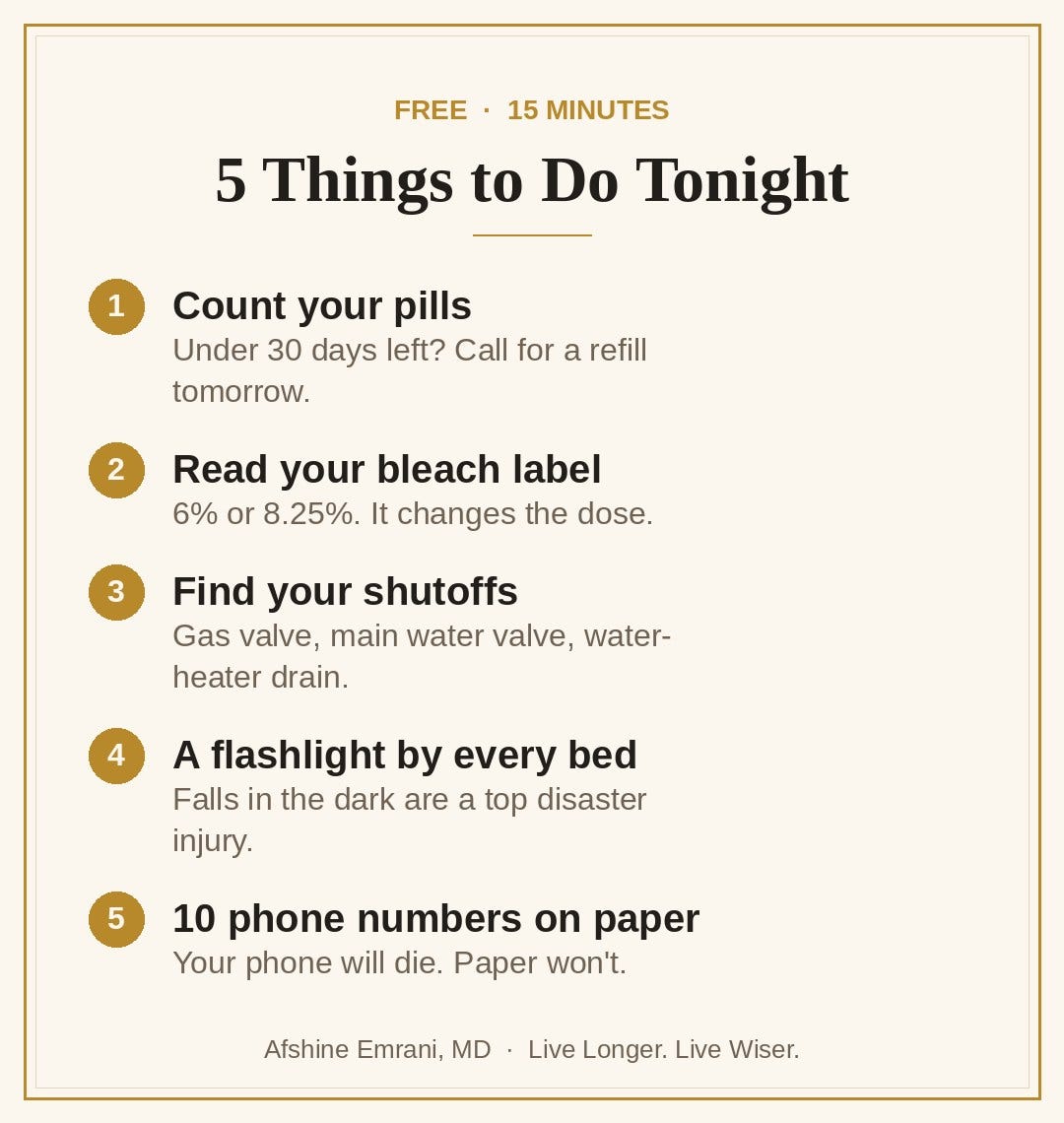
Do these 5 things tonight (free, 15 minutes)
-
Count your pills. Every daily prescription in the house. Anything under a 30-day supply gets a refill call tomorrow.
-
Read your bleach label. Find the percentage (6% or 8.25%). You’ll need it later, and it changes the dose.
-
Find your shutoffs. The gas meter valve, the main water valve, and the drain spigot at the bottom of your water heater. Know where they are before you need them in the dark.
-
Put a flashlight by every bed. Falls in a dark house are one of the most common injuries after a disaster.
-
Write 10 phone numbers on paper. Your phone will die. Your memory won’t have them.
That’s it. You’re already ahead of most households.
Phase 1: Water (the 360-gallon problem)
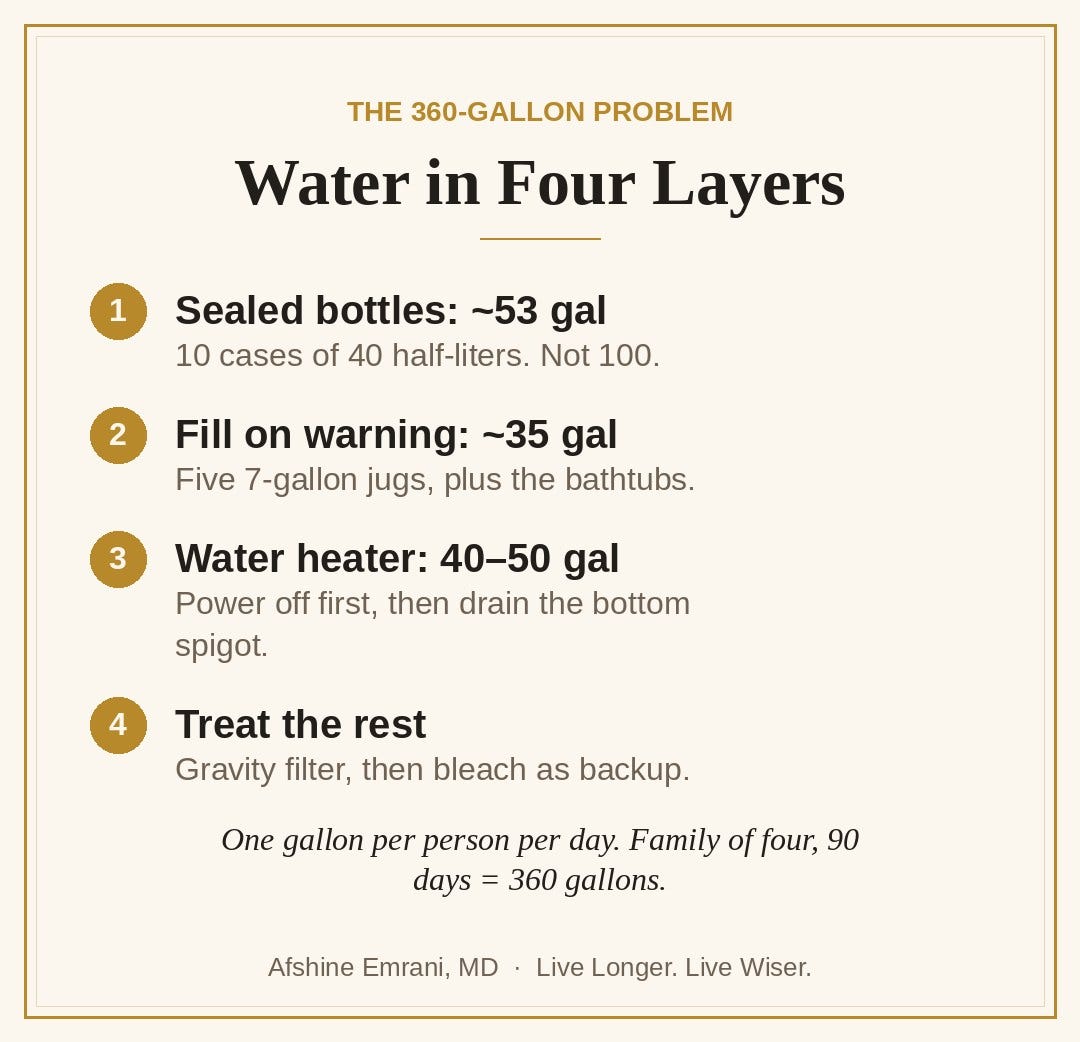
Plan on one gallon per person per day for drinking, cooking and basic hygiene. For a family of four over 90 days, that’s 360 gallons. Nobody can store that, so you build it in layers.
-
Layer 1: Sealed bottled water. Ten cases of 40 half-liter bottles is about 53 gallons. (Many lists claim 100. It isn’t. 400 bottles × 16.9 oz is about 53 gallons.) Bottles are also what you grab if you have to leave.
-
Layer 2: Fill on warning. Keep four or five empty 7-gallon BPA-free jugs. When a major storm or fire warning comes, fill them while the water pressure is still on, for another 28–35 gallons. Fill the bathtubs too (a bathtub water bladder keeps it clean enough to drink).
-
Layer 3: The 40–50 gallons hiding in your house. It’s in your water heater. Turn off the gas or flip the heater’s breaker first, close the cold-water inlet valve, open a hot tap upstairs to let air in, and drain from the bottom spigot. Let the sediment settle or filter it.
-
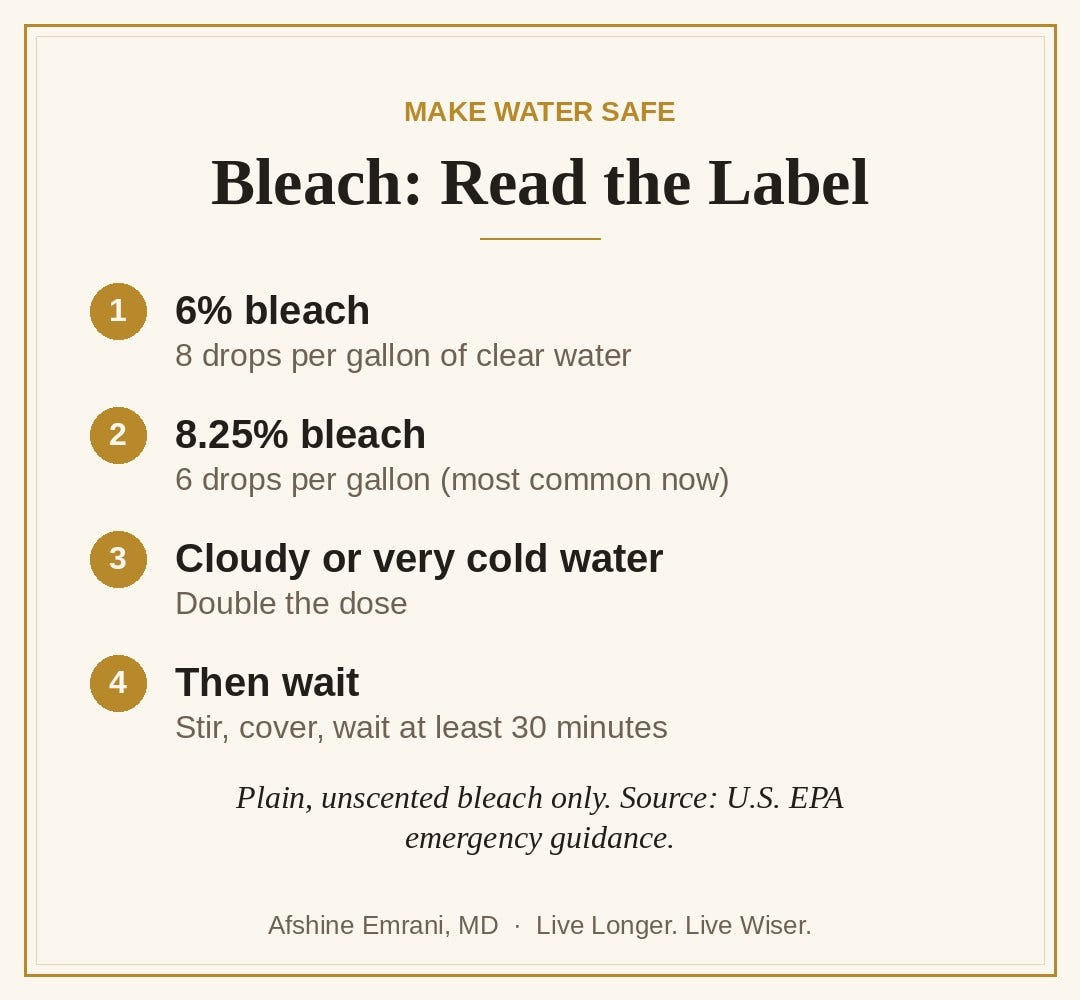
Layer 4: Treatment, for everything after week two. A non-electric gravity water filter makes rainwater or creek water drinkable without power. Back it up with plain, unscented bleach.
-
6% bleach: 8 drops per gallon of clear water
-
8.25% bleach (most common now): 6 drops per gallon
-
Cloudy or very cold water: double it. Stir and wait at least 30 minutes.
-
Pool water is for flushing and washing. Don’t drink it.
Phase 2: The 720,000-calorie pantry
Adults doing physical work without power (hauling water, cleaning up) burn around 2,000 calories a day. For four people over 90 days, that’s roughly 720,000 calories. It’s less overwhelming than it sounds, because three cheap staples cover more than half of it.
The core trio (~400,000 calories)
-
White rice, 150 lb. White, not brown. The oils in brown rice go rancid within months. Move it into 5-gallon food-grade buckets with gamma-seal lids so mice can’t get in.
-
Dried beans, 50 lb, plus two dozen cans. Rice and beans together give you complete protein. The cans are your zero-fuel meals.
-
Rolled oats, 50 lb. No cooking needed. Soak overnight in water or powdered milk with a spoon of honey.
Fats, protein, morale
-
Peanut butter (12 large jars), canned chicken, tuna, and some Spam
-
Cooking oil, 6 liters (about 8,000 calories per liter), kept in a cool, dark closet
-
Sugar, honey, powdered whole milk
-
Pasta, canned tomatoes, corn, green beans, fruit, multivitamins, salt, bouillon
-
Coffee or tea. A caffeine-withdrawal headache on Day 3 is completely avoidable.
The eating order (most people get this backwards)
-
Days 1–2: the refrigerator. Keep the door shut.
-
Days 2–4: the freezer, cooked before it spoils.
-
Days 4–14: your normal pantry.
-
Day 15 on: open the 90-day supply.
For babies: stock ready-to-feed formula, which needs no water, and diapers for 90 days. No honey before 12 months, because it can carry botulism spores.
Phase 3: Cooking without poisoning your family
Carbon monoxide has no smell and no color. In winter blackouts it kills whole families in their sleep.
-
Primary: a two-burner propane camp stove, using 1-lb cylinders or an adapter hose to a 20-lb grill tank.
-
Backup: charcoal in a dry, sealed bin and a cast-iron Dutch oven.
-
The rule: never run a stove, grill or generator inside the house, in the garage (even with the door open), or on a covered porch.
Put a battery-powered CO detector in every sleeping area. If everyone in the house gets a headache, nausea or confusion at the same time, get outside first and figure it out second.
The hay-box trick that saves most of your fuel. A 1-lb propane cylinder lasts about 90 minutes on high. Bring rice or soaked beans to a full rolling boil for 5–10 minutes, put the lid on tight, wrap the pot in towels or a sleeping bag, and set it in a cooler. The trapped heat finishes the cooking with no more gas. (Beans must reach a full boil first, especially red kidney beans, which are toxic undercooked.)
Phase 4: Light, sanitation, first aid
-
Two manual can openers. If your only opener plugs into the wall, a hundred cans of food are now steel bricks.
-
LED lanterns and headlamps, not candles. Candles start house fires in the dark.
-
Toilet: a 5-gallon bucket lined with a contractor bag and kitty litter. Use paper plates so you don’t spend drinking water on dishes. Keep baby wipes and hand sanitizer on hand.
-
First aid: a real kit, plus anti-diarrheal medicine, pain relievers, oral rehydration salts, and a thermometer.
-
The forgotten list: a spare pair of glasses, hearing-aid batteries, denture supplies, menstrual products, and pet food.
-
Storage: never in the attic, and never directly on bare concrete. Date every lid and rotate. Throw out any can that’s bulging, leaking or spurts when opened. Don’t taste it, and don’t try to boil it safe.
Phase 5: The medical plan nobody’s list includes
This is the part I’d go through with you if you were sitting across from me.
-
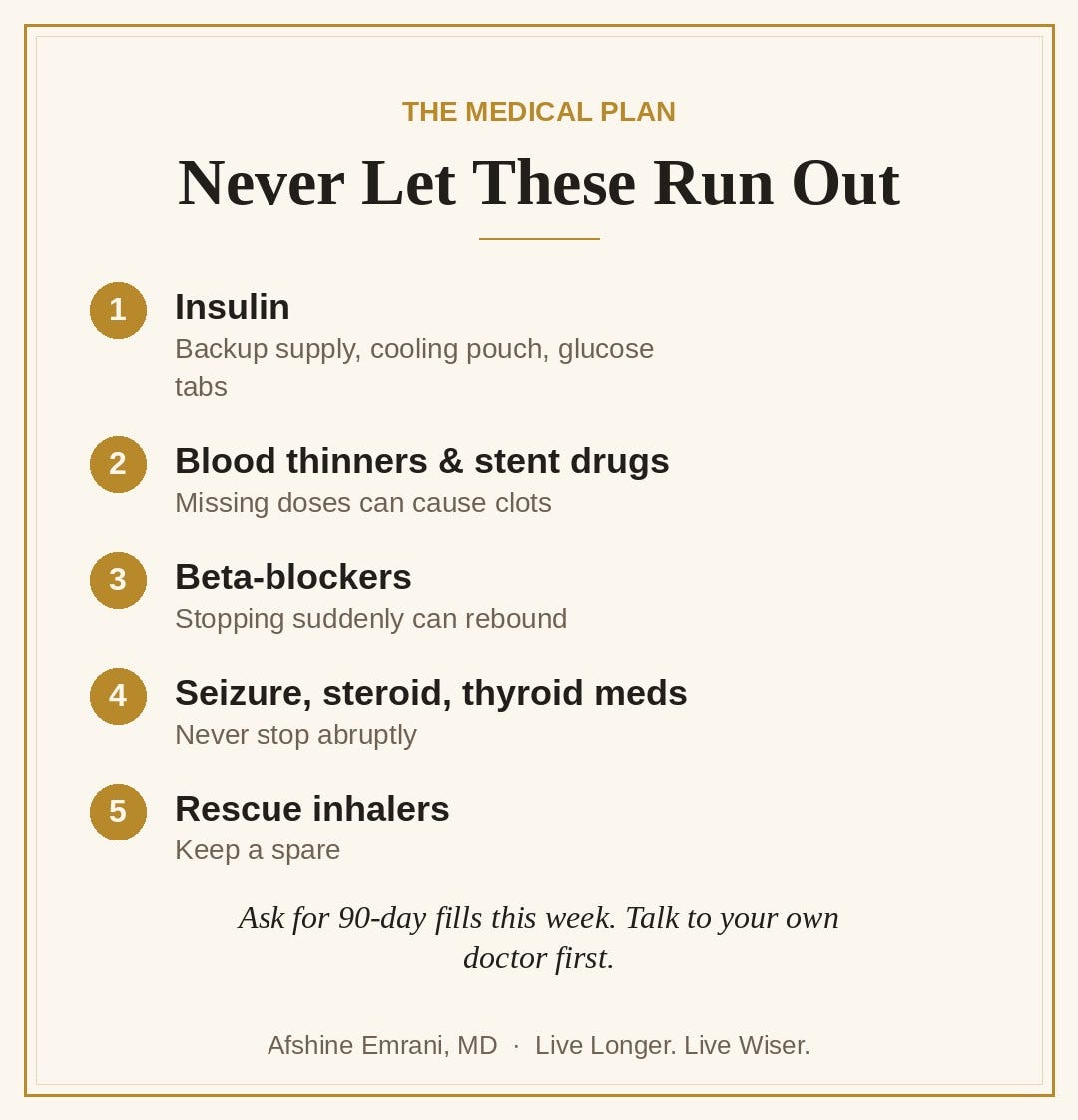
Get a 90-day supply of every daily medication. Many insurance plans already cover 90-day fills, so ask your doctor and pharmacy this week. In a long outage, pharmacies close and supply chains stall. Your medicine should be the first thing you stock, not the last.
-
Know your “never run out” list. Some medicines are dangerous to stop suddenly: insulin (keep a backup supply, an evaporative insulin cooling pouch and glucose tablets); blood thinners and the anti-clotting drugs taken after a heart stent; beta-blockers (stopping suddenly can cause a rebound racing heart and chest pain); seizure medications, daily steroids like prednisone, and thyroid medication; and rescue inhalers (keep a spare). If your supply is getting short, call your doctor before you start skipping doses.
-
Print a one-page medical summary. On paper, not just your phone: diagnoses, medications and doses, allergies, your doctors’ names and numbers. If you have a pacemaker or implanted device, keep the card with it. In a blackout, the ER may be working from paper too.
-
Your pantry is a salt bomb. Spam, canned soup, bouillon and canned beans are full of sodium. For anyone with high blood pressure, heart failure or kidney disease, that’s how a blackout turns into a hospital admission. Buy low-sodium versions and rinse canned beans and vegetables.
-
Plan for heat. Many outages come during heat waves. Older adults, young children, and people on diuretics or blood pressure medications handle heat poorly. Know your coolest room and your nearest cooling center. Drink steadily, unless your doctor has given you a fluid limit.
-
Back up anything that plugs into you. CPAP, oxygen concentrators, home dialysis, powered wheelchairs: get a backup battery or portable power station, and call your utility to register as a medical or life-support customer so they know you’re there.
-
Respect the exertion. Hauling water and lifting buckets is exactly the effort that sets off heart attacks and back injuries in people who mostly sit. Pace it and share the work. Chest pressure, sudden shortness of breath, a cold sweat, or pain spreading to the jaw or arm means call 911.
-
Learn hands-only CPR this month. It takes about 10 minutes. In a disaster the ambulance may be an hour away, and you’re the first responder.
-
Take care of everyone’s mind, not just their bodies. Northridge showed that fear by itself can be lethal to a vulnerable heart. Routine helps: wake at the same time, eat at the same time, get outside once a day, give kids a job. A prepared family is a calmer family, and calm is protective.
5 myths that will hurt you
-
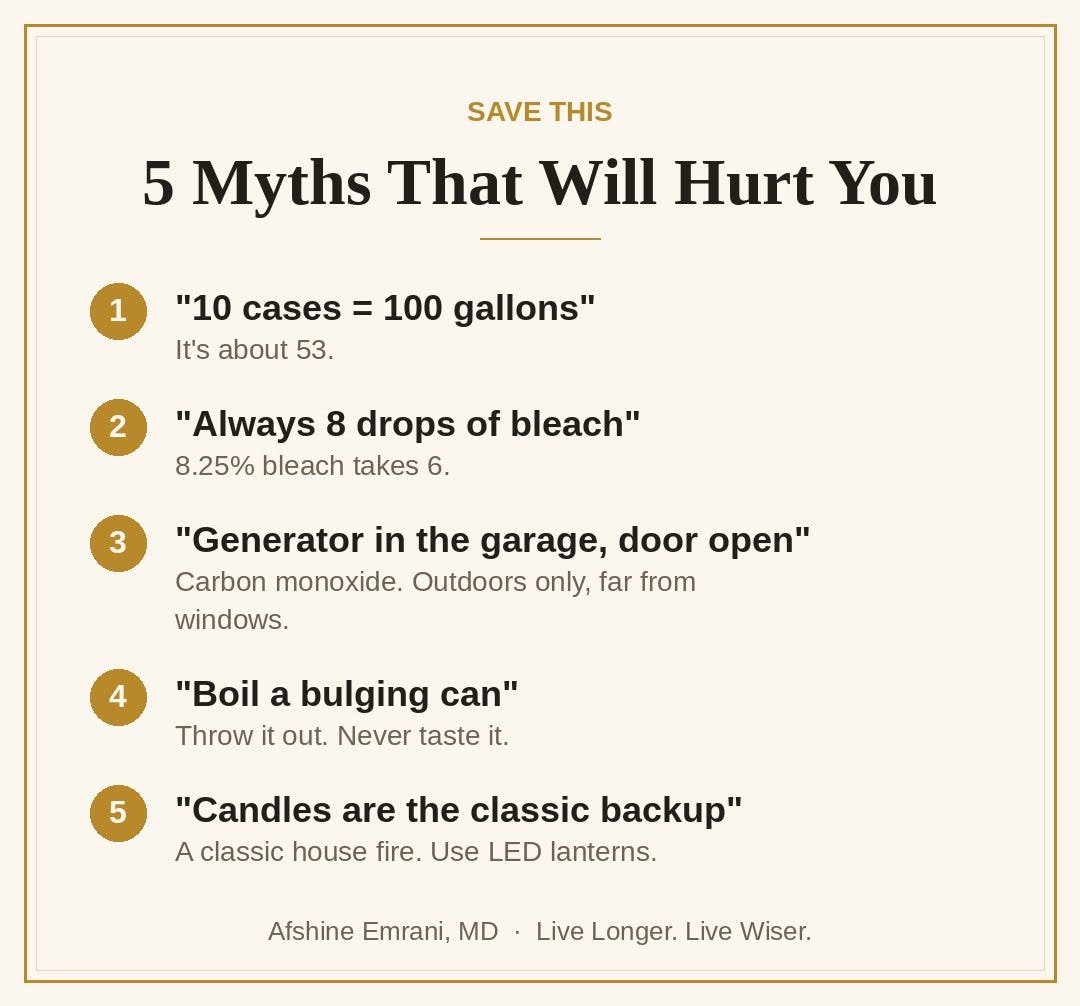
“Ten cases of water is 100 gallons.” It’s about 53.
-
“Eight drops of bleach, always.” If you have 8.25% bleach, it’s 6 drops.
-
“The generator’s fine in the garage with the door open.” It isn’t. Run it outdoors, well away from windows.
-
“Boil a bulging can and it’s safe.” No. Throw it out.
-
“Candles are the classic backup.” They’re a classic way to start a house fire.
How to buy it without panic: 4 paydays
-
Trip 1 (this week): Water + Day 1. Water filter, unscented bleach, water jugs, 2 can openers, LED lanterns, batteries, CO detectors, 90-day medication refills.
-
Trip 2: Core calories. White rice, food-grade buckets, dried and canned beans, oats.
-
Trip 3: Fats + protein. Peanut butter, canned chicken, tuna, oil (low-sodium where you can).
-
Trip 4: Cooking + extras. Camp stove, propane or charcoal, powdered milk, canned produce, paper goods, first aid kit.
Only have $200? Start here: a squeeze-style water filter (far cheaper than a countertop system), a jug of plain bleach, two cases of water, 50 lb white rice, 25 lb dried beans, 10 lb oats, two jars of peanut butter, a 6-pack of canned chicken, a manual can opener, batteries and one LED lantern. That’s roughly 150,000 calories, close to three weeks of food for a family of four, plus a way to make water safe. Then make the medication call. That one’s free.
The one-click gear list
Everything here is ordinary, inexpensive and easy to find on Amazon. Buy what fits your home.
-
Water: 7-gallon stackable jugs · Gravity filter · Squeeze filter (budget) · Bathtub bladder
-
Food storage: 5-gallon food-grade buckets · Gamma-seal lids
-
Cooking (outdoors only): Two-burner propane stove · 1-lb propane cylinders · Adapter hose to 20-lb tank · Cast-iron Dutch oven
-
Safety & light: Battery CO detector · Manual can opener · LED lanterns · Headlamps · Portable power station
-
Sanitation: Contractor bags
-
Medical: Family first aid kit · Insulin cooling pouch · Oral rehydration salts · Weekly pill organizer
Quick answers
How much water do I need for 90 days? One gallon per person per day: 360 gallons for a family of four. Store what you can and plan to filter and treat the rest.
How much bleach per gallon of water? 8 drops of 6% bleach, or 6 drops of 8.25% bleach, per gallon of clear water. Double it for cloudy water and wait 30 minutes.
Can I run a generator in the garage with the door open? No. Carbon monoxide builds up fast. Outdoors only, well away from doors and windows.
How much food does a family of four need for 90 days? About 720,000 calories. 150 lb rice, 50 lb beans and 50 lb oats cover more than half.
What’s the most overlooked part of an emergency plan? Your medications. Ask for 90-day fills this week.
The bottom line
Food and water keep you alive for 90 days. What usually gets people hurt is the stove in the garage, the prescription that ran out, and the panic. Plan for all of it.
Your turn: what’s the one item in your home you’d be in trouble without if the power went out tomorrow? Tell me in the comments. I read every one.
And send this to one person. Your parents, your sister, the friend with a new baby. This is the kind of article that’s useless the day you need it and priceless the day before.
New here? Subscribe free. Every week I send one practical, evidence-based plan like this one, from a practicing physician, with no hype. Join thousands of readers who want to live longer and live wiser.
Want honest, evidence-graded answers to 433 of the most-asked questions about living longer? That’s why I wrote Longevity Unmasked. → Get it on Amazon · longevityunmasked.com
This is general education, not personal medical advice. Talk with your own doctor about your medications and conditions before an emergency, not during one. Product links are general Amazon searches, not endorsements of a specific brand.
Blessings.
Afshine Ash Emrani, M.D., F.A.C.C.
Assistant Clinical Professor, UCLA David Geffen School of Medicine
Castle Connolly Top Doctor · LA Magazine Super Doctor · LA Style Top 100 Doctors in America
doctoremrani.com · Substack · Amazon Author Profile
Sources
-
Leor J, Poole WK, Kloner RA. Sudden cardiac death triggered by an earthquake. N Engl J Med. 1996;334:413–419.
-
U.S. EPA, Emergency Disinfection of Drinking Water (bleach dosing for 6% and 8.25%).
This article is general education, not medical advice, and does not create a doctor-patient relationship. Talk with your own doctor before starting, stopping or changing any medicine, supplement, hormone or peptide. Emergency? Call 911.