Writings
You Can Reverse Your Heart Disease
Originally published on Substack.
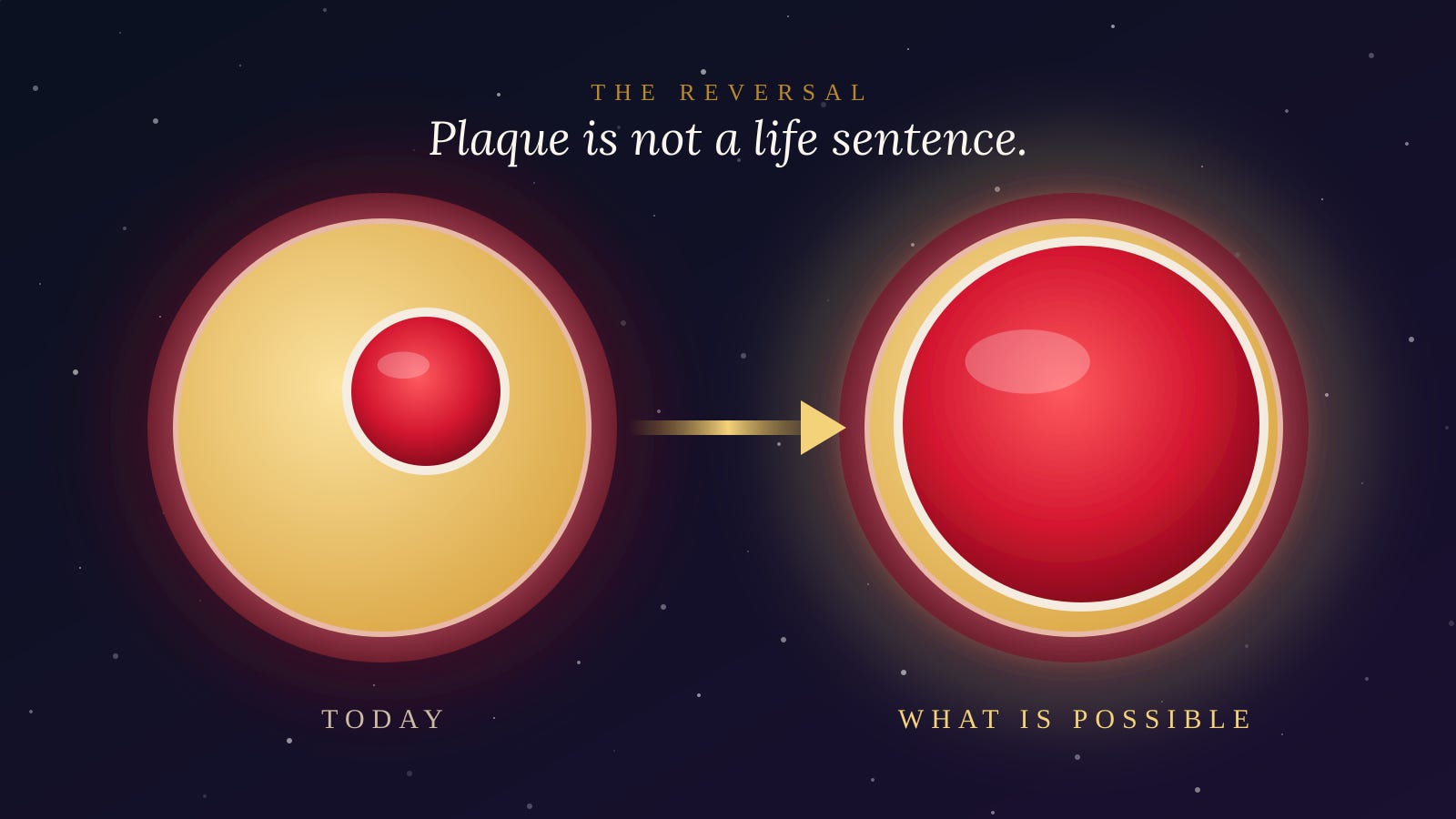
Plaque is not a life sentence.
Let me say the sentence most cardiologists still won’t say out loud:
You can reverse your heart disease.
Not slow it. Not “manage” it. Reverse it. You can clean up the plaque in your coronary arteries: shrink it, seal it, and make it dramatically less likely to kill you.
For decades we told patients a quiet lie. We said arteries only travel in one direction. The plaque builds, it narrows, it hardens. We can stent it, bypass it, slow it down, but we can never take it back.
I believed that as a young doctor. Most of us did. I don’t believe it anymore.
After nearly thirty years of caring for hearts, here is what I know: plaque is not rust. Plaque is alive. It is a living, inflamed tissue inside the wall of your artery, and like every living thing, it responds to its environment.
Starve it, and it shrinks. Cool it, and it goes quiet. Seal it, and it stops being dangerous.
This isn’t hope. It’s on the scans. We can now watch plaque shrink: on intravascular ultrasound, on AI-read CT angiograms, in trial after trial. Your arteries won’t look twenty again. But they can become cleaner, calmer and far safer than they are today.
The question is no longer whether heart disease can reverse. The question is whether anyone has ever told you that it can.
Consider this your notice.
The scary part: you almost certainly have plaque right now
Coronary plaque is not a disease of old age. It is a disease that announces itself in old age.
When researchers looked inside the coronary arteries of young organ donors, more than a third of people in their twenties already had early plaque. In a large US study, about half of white men had coronary calcium by their early-to-mid 50s; women tend to reach it a decade or more later.
So the real question is not “Do I have plaque?” It is “What is my plaque doing, and what am I doing about it?”
The blockage isn’t what kills you
Here is the part almost nobody is told.
Most heart attacks do not come from the tight, famous 90% blockage. They come from a soft, fatty, inflamed plaque that may narrow the artery only modestly, until the day its thin cap tears. Blood rushes in, a clot forms in minutes, and the artery closes.
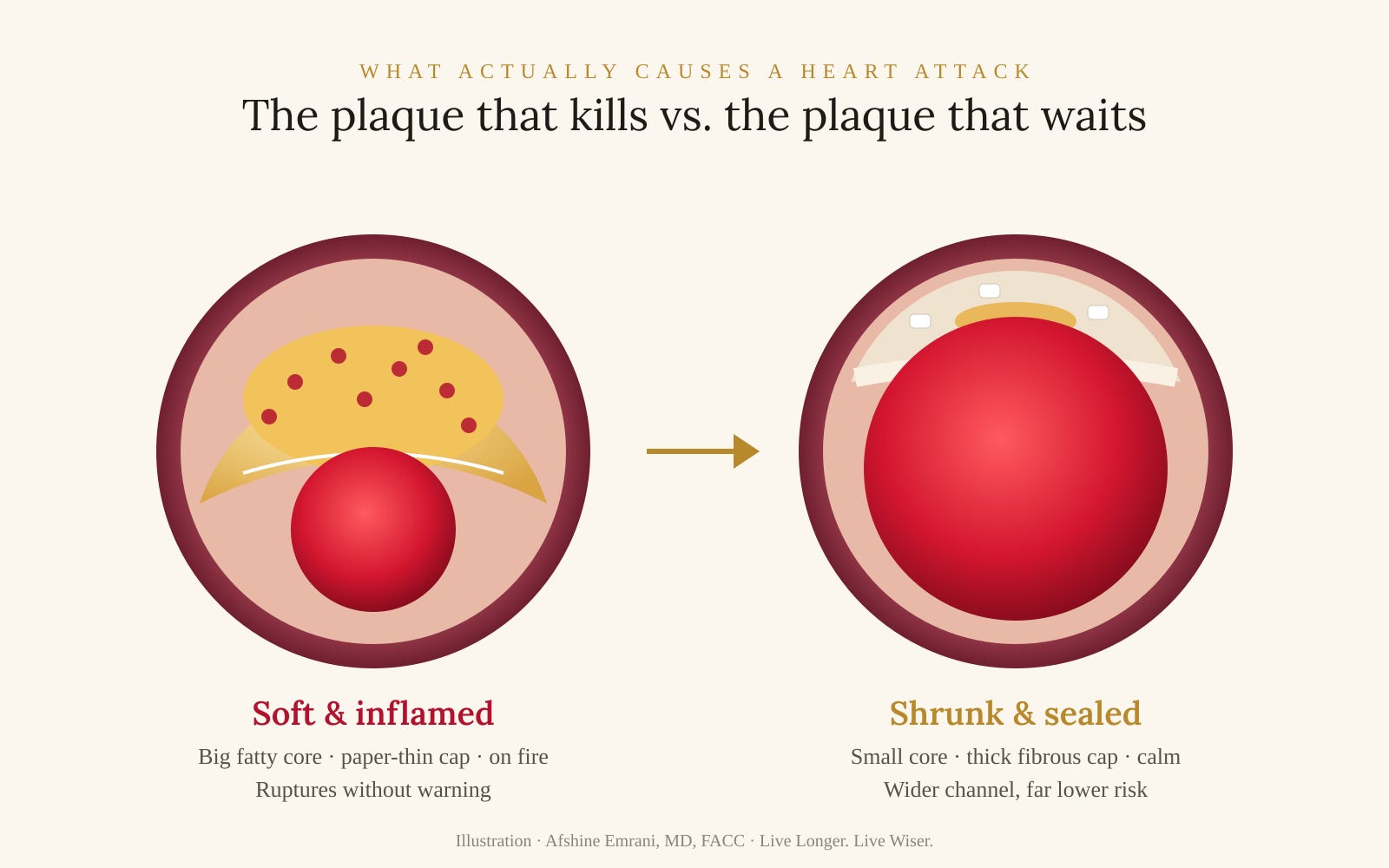
The plaque that kills vs. the plaque that waits.
That changes what “reversal” means. It means two things at once:
-
Shrink it: reduce the total volume of plaque.
-
Seal it: shrink the fatty core, thicken the fibrous cap, calm the inflammation, and turn a volcano into a stone.
And the payoff is real. A 2023 analysis of 23 imaging trials linked each 1% drop in plaque volume to about 19% lower odds of major cardiac events. One percent. That is how sensitive your future is to the inside of your arteries.
How to clean up your plaque: the Emrani Reversal Framework
I think of reversal as four levers. Most people pull one, usually a statin, and wonder why nothing changes. The magic is in pulling all four at the same time.
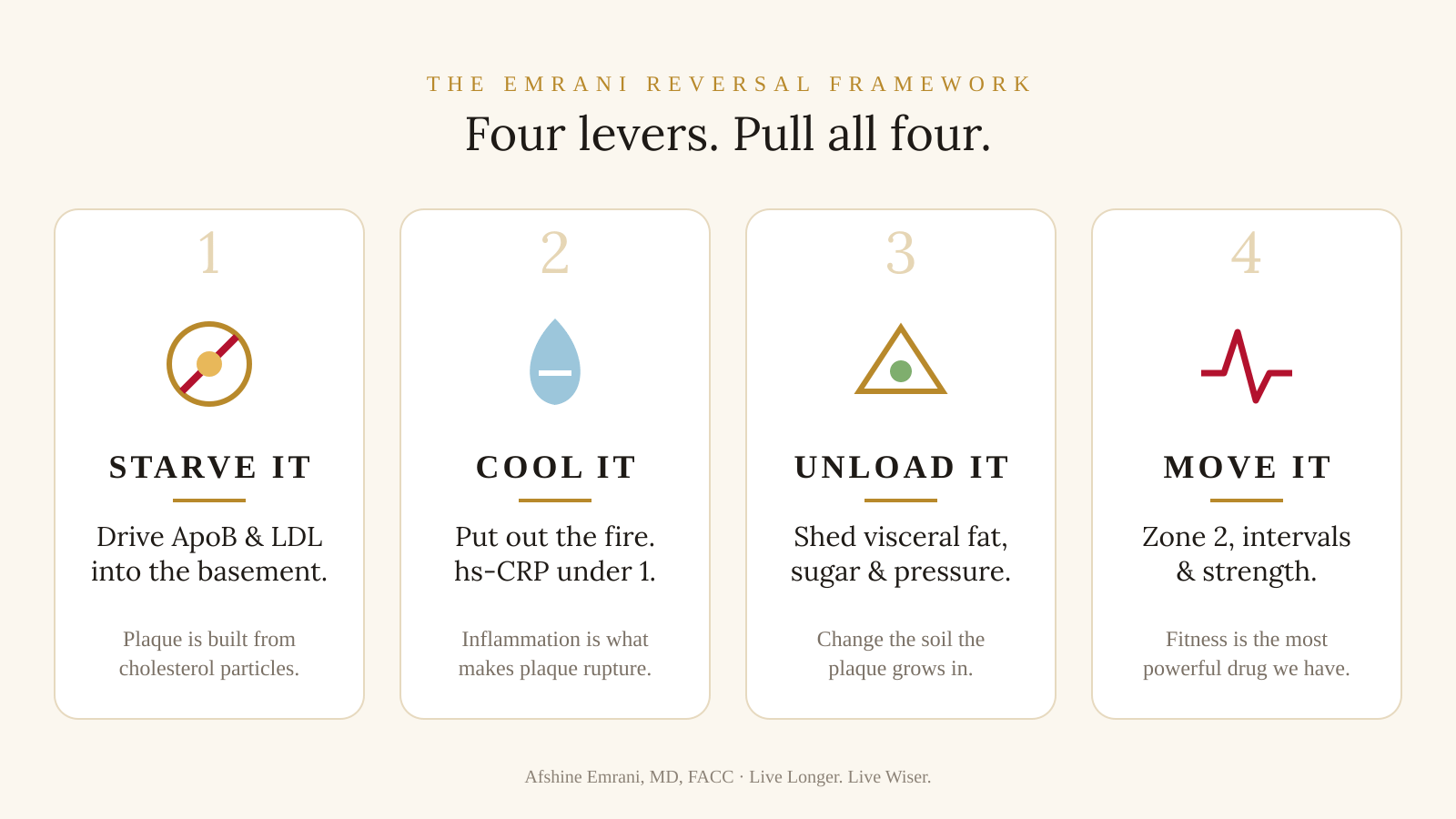
Four levers. Pull all four.
Lever 1: STARVE IT. Drive ApoB and LDL into the basement
Every coronary plaque begins the same way: cholesterol-carrying particles (measured as ApoB, and approximated by LDL) slip into the artery wall and get stuck. No particles, no plaque. It is that simple.
The imaging trials tell a consistent story: modest lowering slows plaque; aggressive lowering reverses it. In the ASTEROID trial, driving LDL to around 60 mg/dL produced measurable regression. In GLAGOV, the PCSK9 group reached an LDL around 36, and nearly two-thirds saw plaque shrink.
My message to every patient: stop being afraid of low LDL. You were born with an LDL of roughly 30 to 50. We now have years of data on people living with LDL in the 20s and 30s without a safety signal. Your arteries are not asking for moderation. They are asking for the basement.
Your tools: statins, ezetimibe, bempedoic acid, PCSK9 inhibitors (injectable and now oral), inclisiran, in whatever combination gets you to target.
Lever 2: COOL IT. Put out the fire
Cholesterol is the fuel. Inflammation is the match.
Inflammation is what turns a quiet plaque into one that ruptures. Measure it with a simple, cheap blood test: high-sensitivity CRP. My goal is under 1 mg/L.
The evidence is growing. Low-dose colchicine, a drug older than aspirin, cut major cardiac events by about 31% in people with stable coronary disease in the LoDoCo2 trial, and imaging shows it shrinks the dangerous, low-density plaque. Purified EPA (icosapent ethyl) reduced events by 25% in REDUCE-IT, though questions about its mineral-oil placebo keep me honest about the size of that effect.
Your tools: don’t smoke or vape, treat sleep apnea, fix your gums (yes, really), sleep seven to eight hours, and ask whether colchicine makes sense for you if CRP stays high.
Lever 3: UNLOAD IT. Change the soil the plaque grows in
Plaque doesn’t grow in a vacuum. It grows in a body. Visceral belly fat, insulin resistance, high blood pressure, fatty liver, and the one almost no one talks about: epicardial fat, the fat wrapped directly around the heart that bathes your coronary arteries in inflammatory signals.
Change the soil, and you change what grows.
We have known since Dean Ornish’s work in the 1990s that an intensive lifestyle program can produce regression. Diets like DASH appear to shrink the soft, vulnerable plaque even when total plaque doesn’t budge much.
Your tools: 30 to 40 grams of fiber a day, mostly plants, extra-virgin olive oil, fish twice a week, beans and lentils, very little ultra-processed food or refined sugar, and limited saturated fat. Alcohol is not heart medicine. Home blood pressure under 120/80.
Lever 4: MOVE IT. The most underprescribed drug in medicine
If I could put cardiorespiratory fitness in a pill, it would be the best-selling drug on earth. In a large 2018 study, people with elite fitness had the lowest mortality of all, with no upper limit of benefit. Six-month interval-training programs have shown real reductions in plaque volume. In people who already have coronary disease, regular exercise roughly halves the odds of a future event.
Your prescription: 150 to 300 minutes a week of zone 2 (you can talk, but you’d rather not sing), one interval session a week (try four minutes hard, three minutes easy, four times), and strength training twice a week, because muscle is a metabolic organ.
My bet: PCSK9 + GLP-1, the combination I believe can clean out your arteries
Now let me tell you what I actually believe.
If I saw soft plaque on my own CT scan tomorrow, I would not just reach for a statin and hope. I would ask for two keys at once: a PCSK9 inhibitor to remove the fuel, and a GLP-1 medicine to heal the soil.
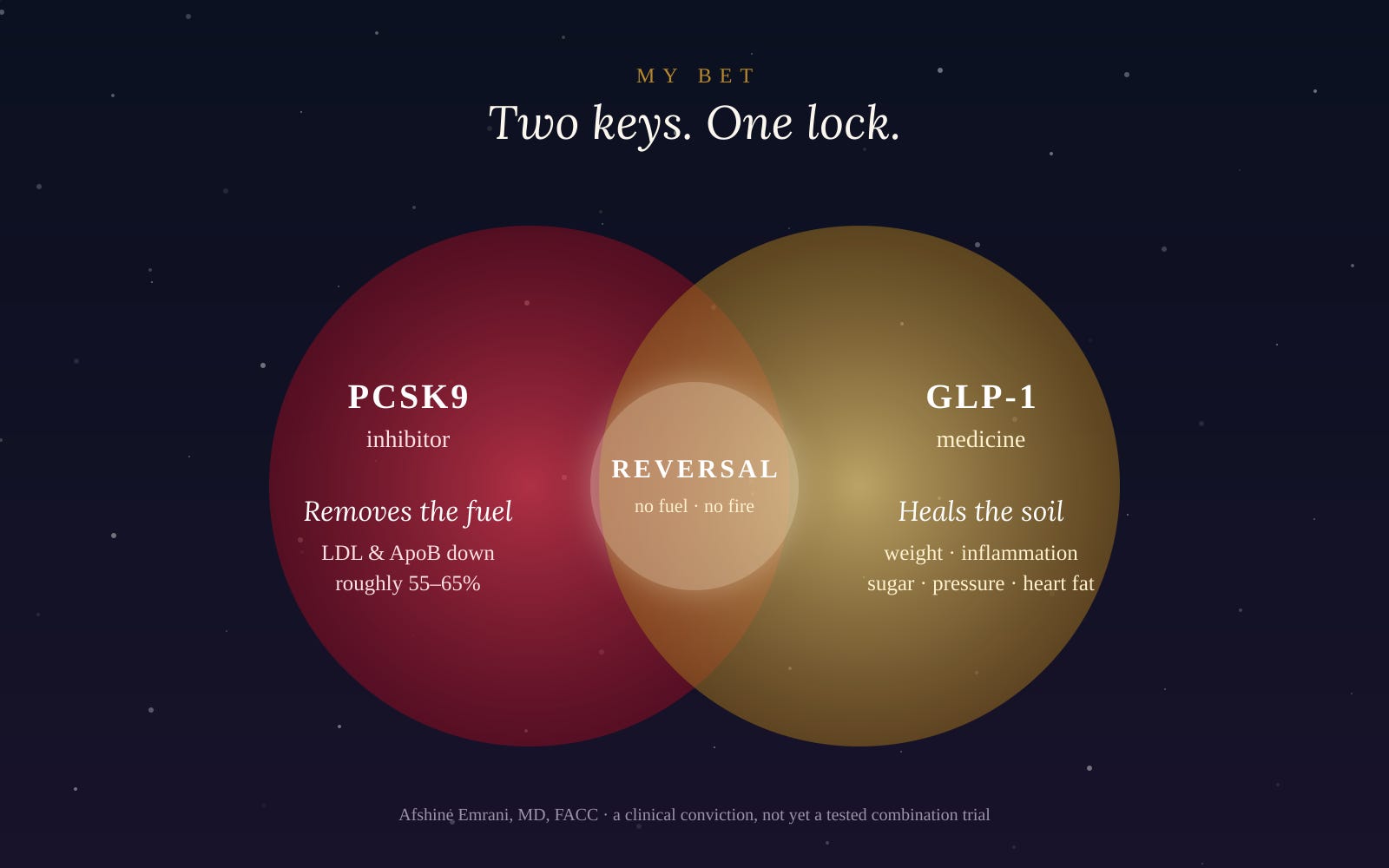
Two keys. One lock.
Key one: the PCSK9 inhibitor removes the fuel
Your liver pulls LDL out of the blood using receptors on its surface. A protein called PCSK9 destroys those receptors. Block PCSK9, and the liver keeps more of its receptors and vacuums LDL out of the bloodstream. On top of a statin, LDL typically falls by another 55 to 65%.
What happens to the plaque is extraordinary:
-
PACMAN-AMI: in heart attack survivors already on high-intensity statins, adding alirocumab produced significantly more plaque regression at one year. About 85% of patients regressed versus 66% on statin alone. The fatty cores shrank. The protective caps thickened. The volcanoes were turning into stones.
-
FOURIER: evolocumab reduced major cardiac events by 15% in people with established heart disease.
-
VESALIUS-CV (2025): the game-changer. In over 12,000 high-risk people who had never had a heart attack or stroke, evolocumab cut first major cardiac events by 25%, first heart attacks by 36%, and death from any cause by 20%. Earlier is better.
And as of July 2026, the needle excuse is gone: the FDA approved enlicitide (Lipfendra), the first oral PCSK9 inhibitor, a once-daily pill that lowered LDL by 56 to 59% versus placebo in its pivotal trials.
Key two: the GLP-1 medicine heals the soil
We started calling GLP-1 drugs “weight-loss shots.” That name is far too small.
In the SELECT trial, semaglutide reduced heart attacks, strokes, and cardiovascular death by 20% in people with heart disease and excess weight, without diabetes. GLP-1 medicines lower blood pressure, blood sugar, CRP, liver fat, and the dangerous epicardial fat around the heart. They pull on Levers 2 and 3 at the same time. Dedicated plaque-imaging trials of semaglutide are now underway, and I am watching them closely.
Why together?
Because they work on completely different parts of the problem.
The PCSK9 inhibitor takes away the bricks. The GLP-1 medicine takes away the fire, the inflammation, and the metabolic chaos that keep laying those bricks down. One drains the swamp; the other changes the climate.
There is an early hint that the effects add up: in VESALIUS-CV, evolocumab’s benefit held whether or not people were already taking a GLP-1 or SGLT2 medicine.
My honest caveat. No trial has yet tested this exact combination head-to-head for plaque regression. My conviction rests on biology, on separate large outcome trials for each drug, and on what I see in my own patients. I would love to see the definitive trial. Until then, for the right patient, I would rather act on strong evidence than wait for perfect evidence.
Who I think it’s for: people with plaque on a CT scan or a calcium score above zero, whose LDL or ApoB isn’t at target on a statin, and who carry excess visceral fat, insulin resistance, or a stubbornly high CRP.
What to watch: GLP-1 medicines can cause nausea and can cost you muscle along with fat, so eat 1.2 to 1.6 grams of protein per kilogram of body weight and lift weights. PCSK9 inhibitors are generally very well tolerated. Insurance coverage is the real fight; persist, appeal, and ask your doctor to document your plaque and your numbers.
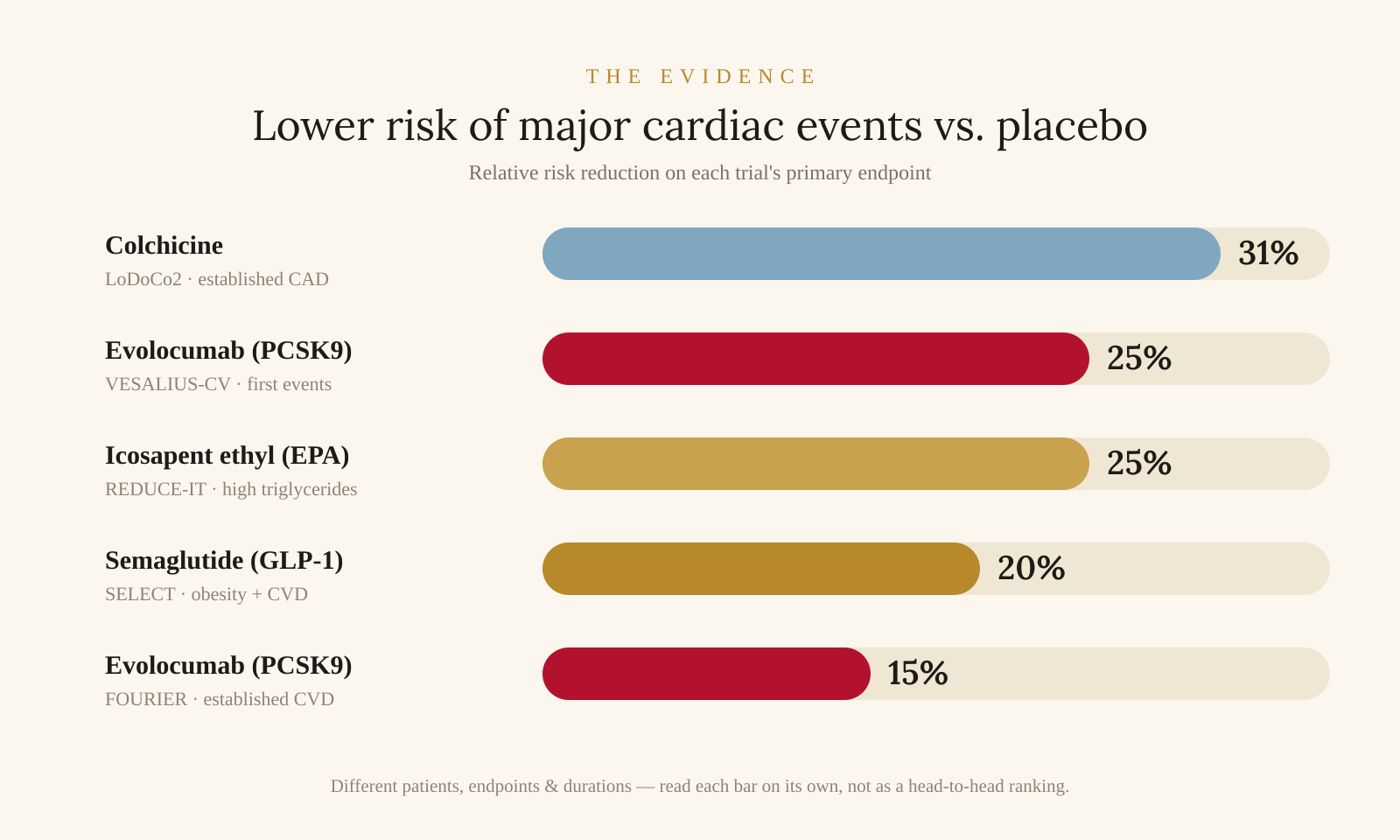
Different patients, different endpoints. Read each bar on its own.
The 90-day reversal playbook
Inspiration without action is just entertainment. Here’s exactly what to do.
This week: know your numbers
-
Ask for: ApoB, a full lipid panel, Lp(a) (once in your life), hs-CRP, HbA1c, and fasting insulin.
-
Check your blood pressure at home for seven days, morning and evening.
-
Measure your waist. It should be less than half your height.
This month: get a picture of your arteries
-
Get a coronary calcium score. If it’s above zero, or your risk is high, ask about a coronary CT angiogram with AI plaque analysis. It measures the soft plaque a calcium score can’t see.
-
Repeat the CT in 12 to 24 months. That is how you see your reversal.
-
Don’t panic if your calcium score rises on treatment. As soft plaque heals, it often calcifies. Sometimes a higher score is a scar of victory.
Days 1 to 90: pull all four levers
-
Starve: start or intensify lipid therapy until you hit target. If you can’t get there on a statin, ask about a PCSK9 inhibitor.
-
Cool: stop smoking, fix sleep, recheck CRP.
-
Unload: fiber up, ultra-processed down. If you carry visceral fat or insulin resistance, ask about a GLP-1 medicine.
-
Move: zone 2 most days, one interval session, two strength sessions every week.
Day 90: recheck and adjust. Labs again. Numbers don’t lie, and they don’t flatter.
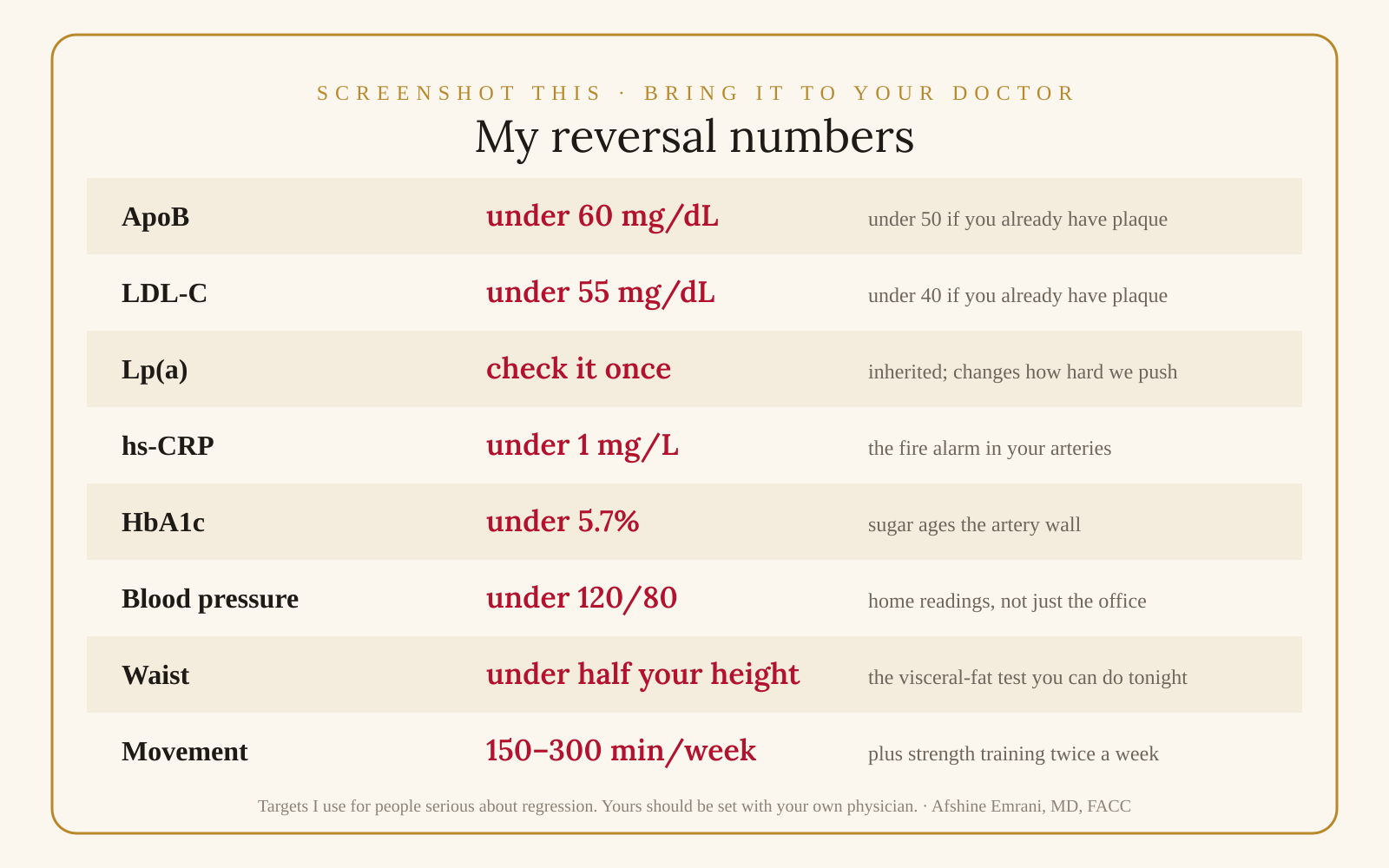
Screenshot this. Bring it to your doctor.
Five questions to bring to your next appointment
-
What is my ApoB, and what is my target?
-
Have I ever had my Lp(a) checked?
-
Should I have a calcium score or a coronary CT angiogram?
-
If I’m not at goal on a statin, am I a candidate for a PCSK9 inhibitor, injectable or oral?
-
Given my weight, sugar, and inflammation, would a GLP-1 medicine help my arteries, not just my scale?
Want the full playbook?
This article is one chapter of a much bigger story. In Longevity Unmasked: A Cardiologist Reveals What Works, What’s Hype, and How to Live (Almost) Forever, I answer 433 of the questions my patients ask me most. Every answer is graded for the strength of its evidence, so you know exactly what’s proven, what’s promising and what’s pure hype.
👉 Get Longevity Unmasked on Amazon
👉 Explore LongevityUnmasked.com: ask the book’s questions, see the evidence grades, and get updates as new science lands.
The heart was never meant to rust
I have sat with thousands of patients on the day they learned they had heart disease. I have seen the fear in their eyes, the sense that a door has closed.
I want you to hear this from a cardiologist: the door is open.
The heart is not a pipe slowly corroding in the dark. It is more like a garden. Neglect it, and weeds take over. Tend it, with the right medicines, the right food, movement, rest, and a little courage, and it grows back toward life.
The sages teach that it is never too late to return. Your arteries, it turns out, agree.
Blessings,
Ash
P.S. If this changed how you think about your arteries, forward it to one person you love who has been told they have plaque. Then grab Longevity Unmasked. It’s the book I wish every patient read before their first cardiology visit.
Afshine “Ash” Emrani, MD, FACC · Assistant Clinical Professor, UCLA David Geffen School of Medicine · Live Longer. Live Wiser.
This article is for education, not personal medical advice. Every medication discussed here has risks, benefits, and costs that should be weighed with your own physician.
Key studies: ASTEROID (JAMA 2006) · GLAGOV (JAMA 2016) · PACMAN-AMI (JAMA 2022) · FOURIER (NEJM 2017) · VESALIUS-CV (NEJM 2025) · SELECT (NEJM 2023) · LoDoCo2 (NEJM 2020) · REDUCE-IT (NEJM 2019) · MESA (Circulation 2006) · CORALreef Lipids and HeFH (enlicitide; FDA approval July 2026)
This article is general education, not medical advice, and does not create a doctor-patient relationship. Talk with your own doctor before starting, stopping or changing any medicine, supplement, hormone or peptide. Emergency? Call 911.