Writings
Zero Isn’t Safe. 137 Isn’t a Death Sentence.
Originally published on Substack.
I’m a cardiologist, and I’ve been practicing for nearly thirty years. This week, one TV segment sent a lot of people looking for a heart scan.
On Good Morning America, ABC’s Gio Benitez shared that his coronary artery calcium score is 137.
The questions came fast: “Should I get one?” “Mine was zero, so I’m fine, right?” “Is 137 bad?”
Here’s the honest answer. The calcium scan is a great test. But we know a lot more about it than three minutes of morning television can tell you. Some of what we now know will reassure you. Some of it should change what you do next.
Let’s go through it.
First, what the scan actually measures
A coronary calcium scan is a quick, low-dose CT of the chest. No IV, no dye, about ten minutes. It finds calcium inside the walls of your heart arteries, which is a fingerprint of plaque that has been there long enough to harden.
The result is a single number (the Agatston score):
-
0: no calcified plaque found
-
1–99: mild
-
100–399: moderate
-
400+: extensive
That number is powerful. It’s also incomplete. Here’s why.
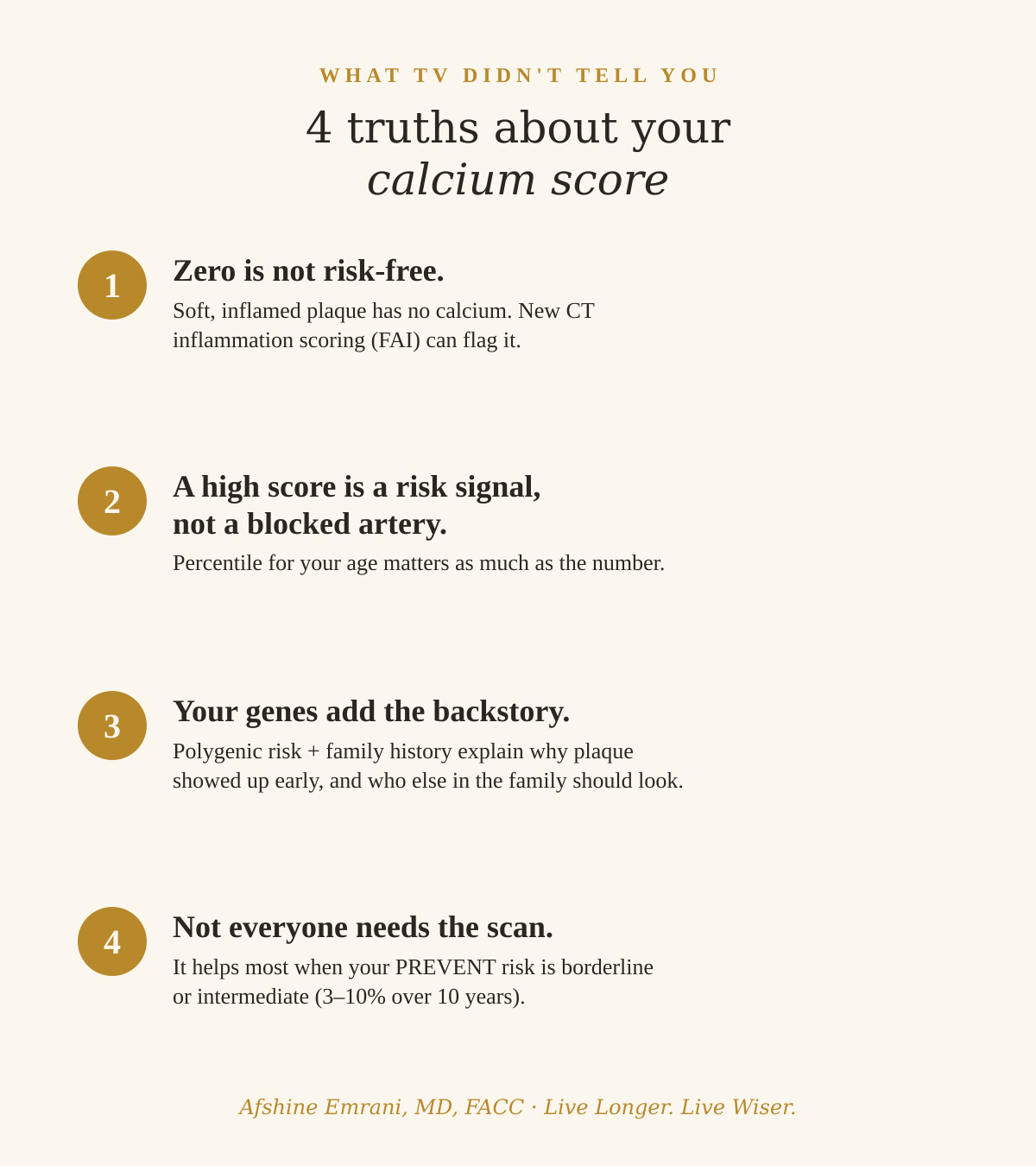
Truth #1: A score of zero is not a free pass
A zero is genuinely good news. People with a zero have a low rate of heart attacks over the next decade.
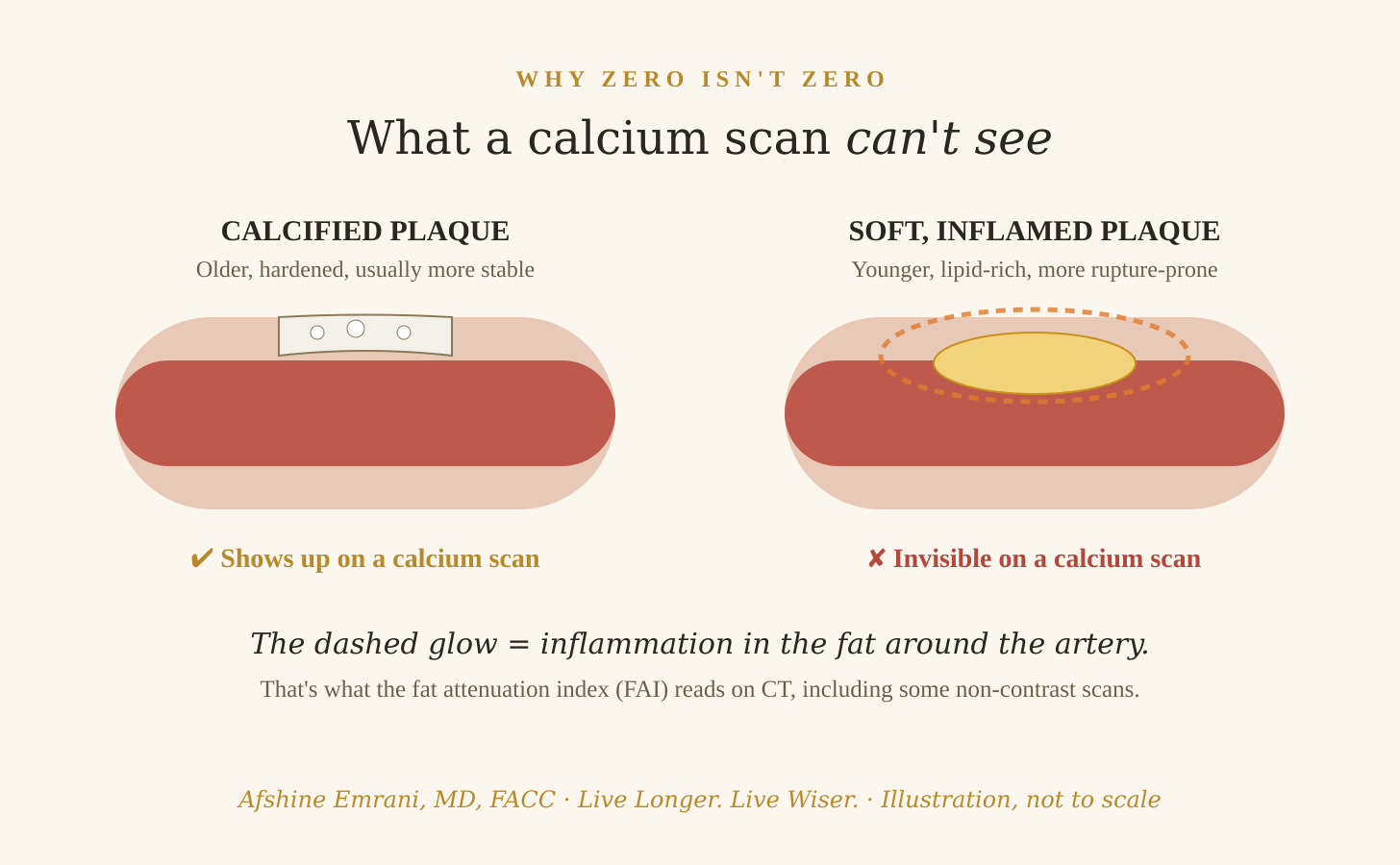
But a calcium scan can only see plaque that has calcified. It’s blind to younger, non-calcified, fatty plaque that hasn’t hardened yet. And that plaque is often the kind that ruptures and causes a heart attack.
This is where the science has moved fast.
Researchers at Oxford developed a way to read inflammation in the fat around the heart arteries on CT. It’s called the fat attenuation index (FAI). When an artery is inflamed, the fat hugging it changes texture, and the scan can pick that up. Think of it as a noninvasive biopsy of your arteries.
In the large ORFAN study (more than 19,000 patients), an FAI-based inflammation score predicted cardiac death on top of the calcium score, and the link was strongest in people whose calcium score was zero. New work presented this year showed it can be measured even on some non-contrast scans, the same kind used for calcium scoring.
Honest caveat: FAI scoring is new, comes from a commercial software platform, isn’t available everywhere, and usually isn’t covered by insurance. It’s not a test everyone needs. But it does mean this: a zero is a snapshot of calcium, not a guarantee.
What to do with a zero:
-
Keep treating your numbers: LDL/ApoB, blood pressure, blood sugar, weight, smoking.
-
If you have a strong family history, high Lp(a), diabetes, or an inflammatory disease, ask your cardiologist whether a zero is enough reassurance for you.
-
Repeat the scan in a few years if your risk profile warrants it.
Truth #2: A high score is a risk signal, not a diagnosis of blocked arteries
Back to Gio’s 137.
On TV, that number sounded like a verdict. It’s not. A calcium score does not tell you whether any artery is narrowed. It tells you how much calcified plaque exists, which predicts future risk. Plenty of people with a score of 137 have no significant blockage at all.
What matters just as much as the number is the percentile: how your score compares with people of your age and sex.
For a man around 40, a score of 137 sits well above the 90th percentile. A JAMA Cardiology study published last month followed nearly 13,000 adults aged 30 to 45 (mean age 41) for a median of about 22.6 years. Those with scores above the 90th percentile had roughly 1.9 times the risk of dying from any cause compared with those at zero, and higher heart-related mortality as well.
So it’s a real signal. It deserves action. It does not mean someone is a heart attack waiting to happen, and it does not by itself mean they need a stent.
One more nuance: a score is a measurement, and measurements can be off. Motion, scanner technique, or calcium in a nearby valve can be miscounted as artery calcium. An unexpectedly high score in a young, low-risk person should be reviewed by a cardiologist, not just read off a printout.
What to do with an elevated score:
-
Get a full risk workup: LDL, ApoB, Lp(a), blood pressure, A1c, kidney function.
-
Treat early. At this age, every year of lower LDL is compounding interest.
-
Ask whether a CT angiogram or stress test is warranted. That depends on symptoms and the overall picture, not the number alone.
Truth #3: Your genes tell the backstory
When a 40-year-old has more plaque than 9 out of 10 peers, the next question is why?
Family history is the first clue. But we now have something sharper: polygenic risk scores, which add up the small effects of hundreds of thousands of genetic variants linked to coronary disease.
A 2025 study in Nature Medicine built a coronary risk model that embeds multiple polygenic scores alongside clinical data. It improved on standard clinical risk scores and held up when tested in the diverse NIH All of Us cohort.
Why this matters for someone with early plaque:
-
It can help explain why plaque showed up early, and how hard to push treatment.
-
It flags whether siblings and children should be screened sooner.
-
Your genes don’t change, so one test gives you lifetime information.
Honest caveat: Once you already see plaque on a scan, that plaque is the strongest evidence you have. A genetic score adds context, not permission to treat less. Polygenic testing is not yet routine in guidelines, and results vary by ancestry. Discuss it with a physician who knows how to interpret it.
Truth #4: Not everyone should rush out and get the scan
This is the part the segment skipped, and it matters most.
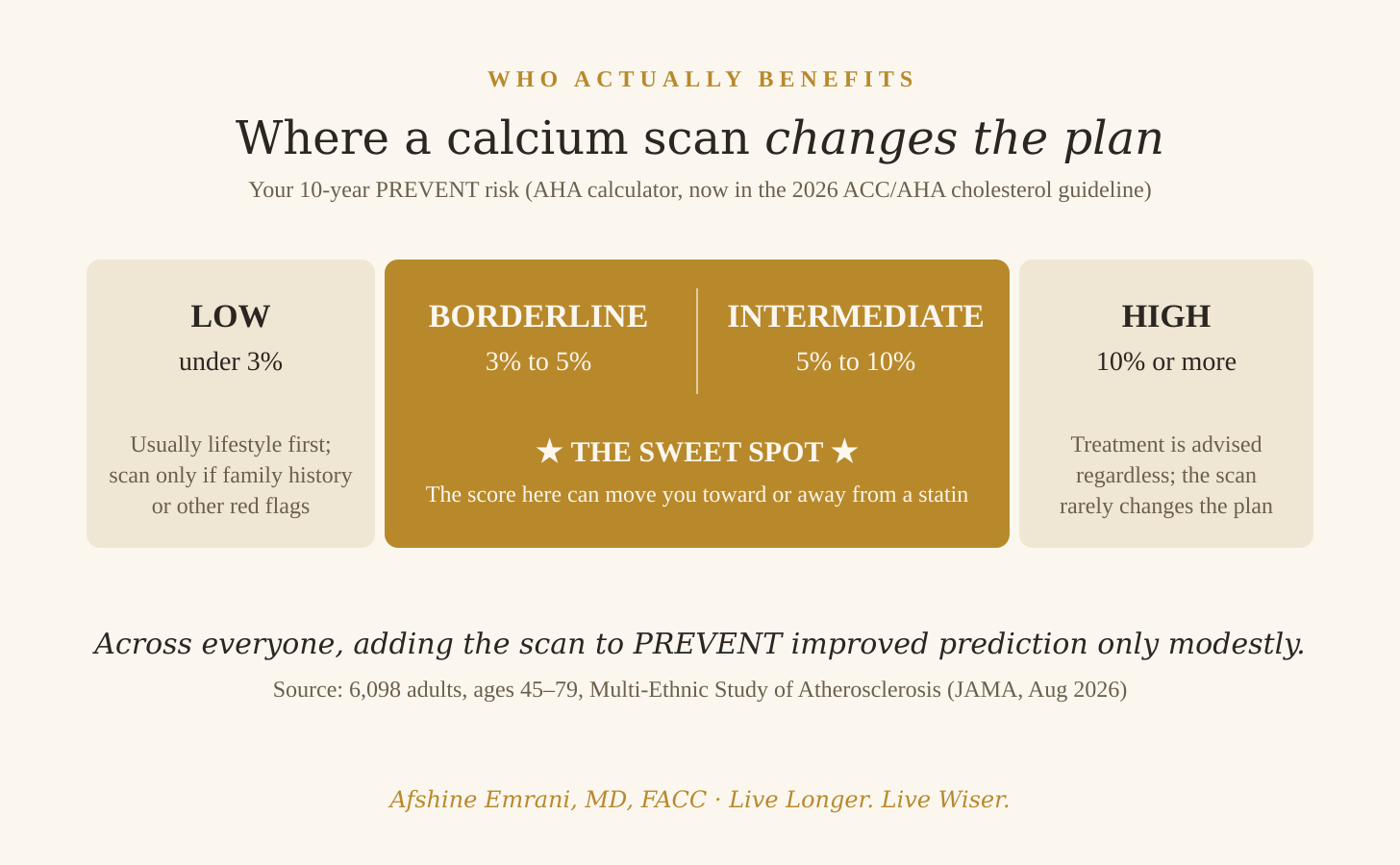
In 2026, the ACC/AHA cholesterol guideline adopted the AHA’s PREVENT calculator: a free risk score built from your age, sex, blood pressure, cholesterol, blood sugar, kidney function, and smoking. It sorts your 10-year risk into four tiers: low (under 3%), borderline (3% to under 5%), intermediate (5% to under 10%), and high (10% or more).
In August, a major JAMA study asked a simple question: does adding a calcium scan to PREVENT improve prediction? Researchers followed 6,098 adults aged 45 to 79 for about a decade.
The answer: across everyone, only modestly. But in people in the borderline and intermediate tiers, the scan was genuinely useful. It helped sort out who was heading toward heart disease and who wasn’t.
In plain terms:
-
High risk? You should probably be on treatment already. A scan rarely changes the plan.
-
Very low risk, no family history? A scan is unlikely to change much either.
-
In the middle, or on the fence about a statin? That’s the sweet spot. The scan can tip the decision either way.
The danger of a viral TV moment is that many people who don’t need the test get it, and some of them end up anxious, over-tested, or falsely reassured.
The bottom line
The calcium scan is one of the best tools we have. But it’s one number in a much bigger story.
Here’s my protocol:
-
Know your PREVENT score first. Ask your doctor, or calculate it with your latest labs.
-
Get a calcium scan if you’re borderline or intermediate, or if you have a strong family history.
-
A zero is good news, not a guarantee. Keep treating your risk factors.
-
A high score is a call to action, not a catastrophe. Look at the percentile, get a full workup, and treat early.
-
For early or unexplained plaque, dig deeper: Lp(a), ApoB, and consider genetic risk testing.
Gio, if you’re reading this: 137 at your age is a gift of early warning. Most people find out the hard way. You found out with decades left to change the story.
That’s not bad news. That’s a head start.
Blessings,
Afshine “Ash” Emrani, MD, FACC
Assistant Clinical Professor, UCLA David Geffen School of Medicine
Free for readers
Want my plain-English guide to plaque, “Your Arteries Are Not a Death Sentence”? Reply to this email or comment “PLAQUE” and I’ll send it to you.
Go deeper
My book Longevity Unmasked answers 433 of the most common longevity questions, each graded by the strength of the evidence, including the heart scans, labs, and genetic tests worth your money (and the ones that aren’t): longevityunmasked.com
If this helped, forward it to someone who just booked a calcium scan. And subscribe so you never miss what the headlines leave out.
This article is for education only and is not medical advice. Talk with your own physician about whether a calcium scan, inflammation scoring, or genetic testing is right for you.
References
-
Choi S, Blaha MJ, et al. Advanced subclinical atherosclerosis in young individuals and risk of mortality over 30 years. JAMA Cardiology. Published online Oct 23, 2026. doi:10.1001/jamacardio.2026.4819
-
Shah NS, et al. Predictive utility of coronary artery calcium score added to the PREVENT atherosclerotic cardiovascular disease equations. JAMA. Published online Aug 26, 2026. doi:10.1001/jama.2026.13233
-
Chen SF, Torkamani A, et al. Meta-prediction of coronary artery disease risk. Nature Medicine. 2025. PMID: 40240837
-
Chan K, Antoniades C, et al. Coronary inflammation quantified on contrast and non-contrast cardiac CT identifies high-risk individuals independently from coronary calcification. ESC Congress 2026 (ORFAN study).
-
Chan K, et al. Inflammatory risk and cardiovascular events in patients without obstructive coronary artery disease: the ORFAN study. Lancet. 2024.