Writings
You’re on a GLP! What Vitamins Should You Take?
Originally published on Substack.
A post went viral this week listing five supplements everyone on a GLP-1 should take. Psyllium. A multivitamin. Omega-3s “for inflammation.” Vitamin D. Protein powder.
Thirty thousand people read it. The replies were more interesting than the post. Someone pointed out that psyllium on a GLP-1 would make you miserably full. Someone else noted that GLP-1s already lower inflammation. A third person begged the author to say he wasn’t endorsing these drugs at all.
I’m a cardiologist. I have prescribed semaglutide and tirzepatide to hundreds of patients, and I have watched what happens to their bodies over months and years — not just on the scale, but on the DEXA scan, the bloodwork, and the bathroom floor at 3 a.m. with a leg cramp.
So let me do what the viral post didn’t. Let me tell you what actually changes in your body on these drugs, which supplements address those changes, which ones are a waste of money, and which one on that list could send you to the emergency room.
First, what a GLP-1 actually does to you
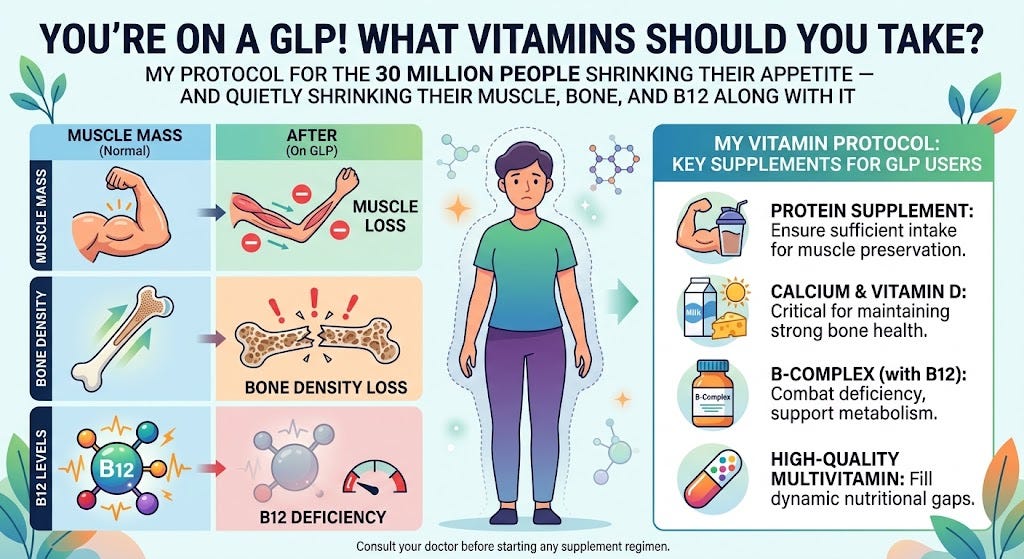
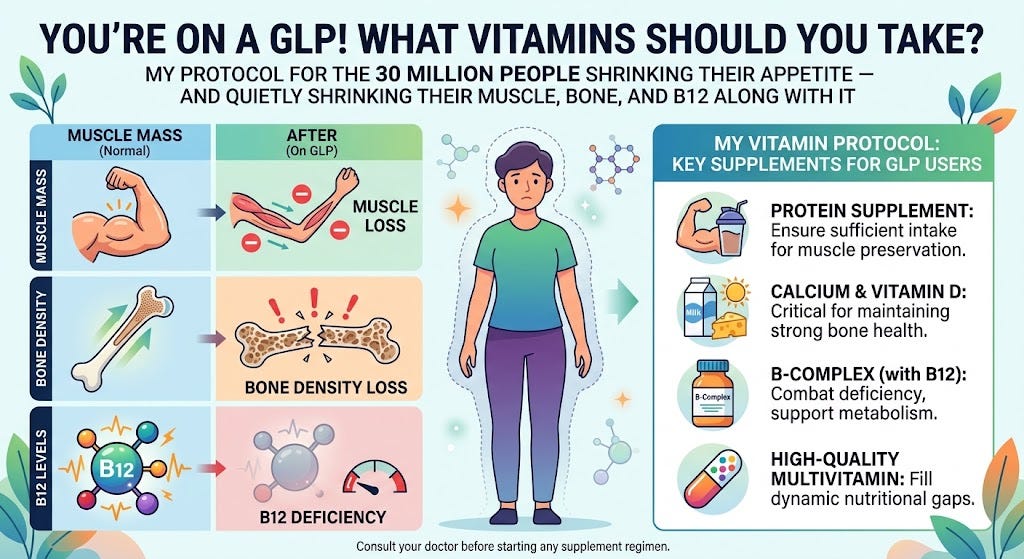
These medications don’t just suppress appetite. They slow the emptying of your stomach, sometimes dramatically. They cut your total food intake by a third or more. And they trigger weight loss fast enough that your body doesn’t only burn fat — it burns muscle and bone with it.
That is the entire supplement story in three sentences:
-
You’re eating less, so you’re absorbing less of everything — protein, B12, iron, magnesium, zinc, vitamin D.
-
Your stomach empties slowly, so anything that expands, sits, or binds can turn from helpful into harmful.
-
You’re losing lean mass, and depending on the study, a quarter to nearly half of the weight lost can be muscle if you do nothing to stop it. Your bones follow.
A supplement that doesn’t address one of those three problems is noise. A supplement that makes one of them worse is dangerous. Let’s sort the list.
What I would actually take on a GLP-1
1. Protein — and I mean a number, not a scoop
The viral post said “protein powder for muscle retention.” Correct instinct, useless instruction. Protein isn’t a supplement; it’s the single most important nutrient decision you will make on this medication, and most patients get it badly wrong because they are simply not hungry.
The target is 1.2 to 1.6 grams per kilogram of ideal body weight per day, spread across the day in 25–35 gram servings. For a woman whose ideal weight is 60 kg, that’s roughly 75–95 grams. For a man at 80 kg, 100–130 grams. On a GLP-1, eating that much from food alone is nearly impossible for most people, which is where whey isolate earns its place — not as a magic powder, but as the only practical way to hit the number when a full plate makes you nauseated.
Eat protein first at every meal. If you get full, get full on the chicken, not the rice.
2. Creatine monohydrate — the one the viral list forgot
This is the supplement I was most surprised to see missing. Creatine is the most studied performance supplement in history, and during a caloric deficit it does something GLP-1 patients desperately need: it helps preserve lean muscle and offsets the fatigue and brain fog that come with rapid weight loss.
3 to 5 grams daily, any time, every day. No loading phase. It is cheap, safe, and I take it myself. The one honest caveat: creatine pulls water into muscle, so on a drug that already dehydrates you, you must drink more. Which brings us to —
3. Water and electrolytes — not optional
Nobody puts hydration on a supplement list because it’s free. It’s still the most common reason my GLP-1 patients feel terrible in the first two months. Reduced thirst, reduced food (which is where much of your water normally comes from), and slowed motility add up to headaches, dizziness, constipation, and the “I just feel off” that patients can’t name.
Aim for two to three liters a day, and on training days or hot days, add a low-sugar electrolyte. This isn’t glamorous. It’s the foundation everything else sits on.
4. Magnesium glycinate — the supplement patients thank me for most
Up to three-quarters of Americans are already low in magnesium. Now eat 35% less food. On a GLP-1, magnesium addresses three problems at once: the constipation from slowed motility, the muscle cramps from electrolyte loss, and the sleep disruption that comes with a changing body.
300 to 500 mg at night, glycinate form — not oxide. Oxide is poorly absorbed and mostly a laxative. Glycinate is gentle, calming, and actually raises your levels. If you’re constipated, magnesium citrate can be swapped in temporarily, but glycinate is the daily driver.
5. Vitamin D3 with K2 — and the bone story nobody mentions
The viral post said vitamin D “for mood and energy.” Here is the better reason: rapid weight loss costs you bone density, and GLP-1 weight loss is rapid. Vitamin D controls how much calcium you absorb. K2 controls where that calcium goes — into bone rather than into the walls of your coronary arteries, which as a cardiologist is a distinction I care about deeply.
2,000 to 5,000 IU of D3 with 100 to 200 mcg of K2, taken with your largest meal because both are fat-soluble. Test your 25-hydroxy vitamin D level and aim for 50–80. And note the system: vitamin D needs magnesium to activate. Starting D without magnesium is the single most common reason people feel worse on it. If you’re on warfarin, do not add K2 without talking to your physician.
6. Vitamin B12 — the deficiency that shows up late
B12 comes almost entirely from animal protein — the exact category of food GLP-1 patients eat less of. If you’re also on metformin, which impairs B12 absorption, or if you’re over 60, the risk compounds. B12 deficiency doesn’t announce itself. It arrives as fatigue, numbness, tingling, and forgetfulness that patients blame on the diet or on age.
Get your B12 checked, and if it’s low or low-normal, take 500 to 1,000 mcg of methylcobalamin daily. This is the one supplement where I’d rather you test first, because the symptoms overlap with several conditions that aren’t fixed by a vitamin.
What I’d take conditionally — with the honest caveats the viral post skipped
Omega-3s — yes, but not for the reason you were told
The replies were right. GLP-1s reduce inflammation on their own; hs-CRP typically drops substantially. “Omega-3 for inflammation” on a GLP-1 is redundant.
But I still take omega-3s, and I’d still recommend them here, for a different reason: you’re eating less fatty fish than ever, and your omega-3 index — the measure of these fats in your cell membranes — is probably far below the 8% target I want to see for cardiovascular protection. 1,000 to 2,000 mg of combined EPA and DHA, third-party tested (NSF or USP), taken with a fatty meal. If the capsule smells strongly fishy, it’s rancid. Throw it out.
Psyllium husk — the one that could hurt you
This is where the viral post went from lazy to potentially dangerous. Psyllium expands. It absorbs many times its weight in water and swells in your stomach. On a medication that has already slowed your stomach to a crawl, a full tablespoon of psyllium is a recipe for pain, bloating, nausea, and in the worst cases, a trip to the emergency room with a bowel obstruction.
I love psyllium in my non-GLP-1 patients. It lowers LDL and steadies blood sugar. But on a GLP-1, the rules change: start with one teaspoon, not one tablespoon, in a full glass of water, and only if you’re not already nauseated or full. If you’re constipated, magnesium and water come first. And take it at least two hours away from your other medications, because it binds them.
CoQ10 — only if you’re on a statin
Many of my GLP-1 patients are also on a statin, and statins deplete CoQ10, the molecule your heart uses to make energy. If that’s you, 100 to 300 mg of ubiquinol in the morning with food. If you’re not on a statin, this one is optional.
Glycine — for sleep, if magnesium isn’t enough
5 grams in water at bedtime. It speeds sleep onset and pairs beautifully with magnesium glycinate. Not essential, but patients who add it rarely give it up.
What I would not bother with
A generic multivitamin. This is the “I don’t know what you’re deficient in so here’s everything” answer. Most contain magnesium oxide, synthetic folic acid, and doses too low to correct any real deficiency. If you insist on one, fine — but it doesn’t replace the targeted list above, and it shouldn’t make you feel like you’ve covered yourself.
Betaine HCl and digestive enzymes. Someone in the replies suggested these “for better digestion.” Your problem on a GLP-1 isn’t insufficient stomach acid; it’s a stomach that empties slowly by design. Adding acid to a stomach that holds food for hours can worsen reflux, which GLP-1 patients already get. Skip it.
Fat burners, thermogenics, high-dose caffeine. You’re already in a deficit. Stacking stimulants on top of a suppressed appetite and dehydration is how people end up in my office with palpitations.
Stimulant laxatives as a daily fix. They work once. Then they don’t. Fix the constipation with water, magnesium, movement, and a gentle fiber — not senna every night.
The two things no supplement can replace
Resistance training. Two to three sessions a week. This is not a suggestion; it is the only intervention that reliably tells your body which tissue to keep. Protein and creatine give your muscles the materials. Lifting gives them the reason.
Slower is better. The faster you lose, the higher the fraction that is muscle and bone. If you’re losing more than 1% of your body weight per week, talk to your doctor about your dose. The goal is the body you’ll live in for thirty years, not the number in three months.
What to measure
Don’t fly blind. Before starting and every three to six months:
-
25-hydroxy vitamin D — target 50–80
-
Vitamin B12 (with methylmalonic acid if borderline)
-
Ferritin and iron studies — rapid weight loss and reduced red meat quietly drain iron, especially in women
-
RBC magnesium — more accurate than serum
-
Zinc — low zinc blunts taste and immunity, and both matter when you’re already eating less
-
A DEXA scan if you can — body composition, not weight, is the number that matters
-
Omega-3 index — target above 8%
-
Lipid panel with ApoB, hs-CRP, fasting insulin, HbA1c — to see the metabolic benefit you’re actually getting
The honest bottom line
The viral post wasn’t malicious. It was generic — a list you could give to anyone, for any reason. But GLP-1 patients are not anyone. Their stomachs are slow, their plates are small, and their muscle and bone are on the clock.
So here’s the list I’d actually give you: Protein to a number. Creatine. Water. Magnesium glycinate. D3 with K2. B12 if you’re low. Then omega-3s for your heart, not your inflammation. Psyllium carefully or not at all. CoQ10 if you’re on a statin.
And lift something heavy three times a week.
These drugs are among the most powerful tools I’ve seen in twenty-five years of cardiology. They will change your life. Whether they change it for the better in the long run depends on what you do while the scale goes down.
I’m a physician, but I’m not your physician. Take this list to yours.
Blessings.
Afshine Ash Emrani, M.D., F.A.C.C.
Assistant Clinical Professor, UCLA
David Geffen School of Medicine
Join Our new website
Castle-Connolly Nationwide Top Doctor (Since 2008)
Los Angeles Magazine Super Doctor (Since 2010)
LA Style Magazine Top 100 Doctors in America (2024)
Subscribe to mynewsletter: substack.com/@afshineemrani
Explore my books: Amazon Author Profile