
Writings
What Actually Makes Blood Pressure Look “Stubborn”
Originally published on Substack.
On November 12, a European Medicines Agency committee recommended approval of baxdrostat (brand name Baxfendy), a new pill for blood pressure that stays high despite at least two medicines. The FDA approved it in the US in May. It is a real advance.
Here is what the headlines skip. In a Spanish registry, more than 8,000 people met the office definition of “resistant.” Over a third of them had a 24-hour average below the hypertension line once their pressure was measured around the clock.
The 2-minute check to try tonight
Sit with your back supported, feet flat, legs uncrossed. Rest your arm on a table at heart level. Then take the reading.
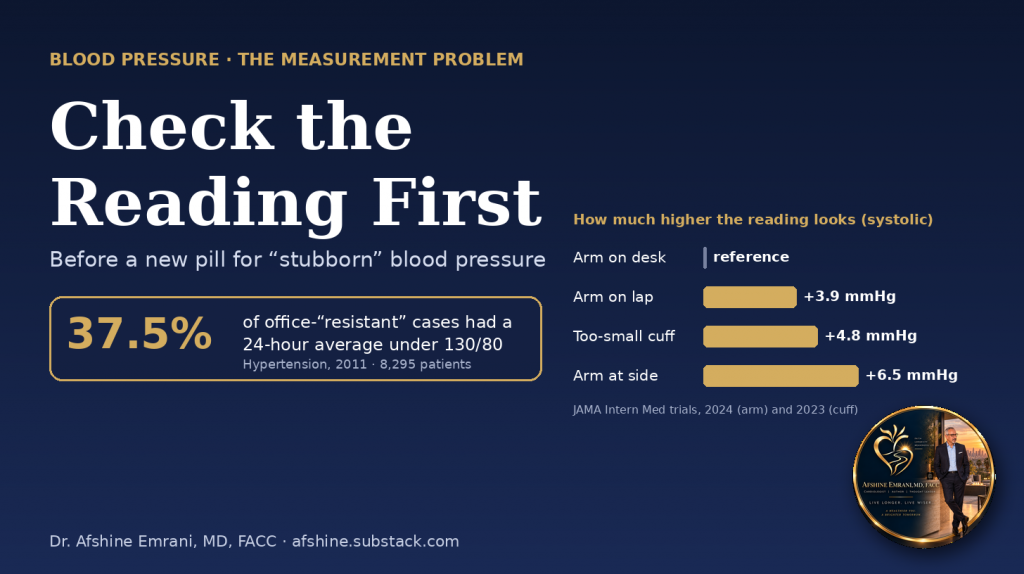
In a 2024 crossover trial in JAMA Internal Medicine (133 adults), an arm resting on the lap read 3.9 points higher systolic than an arm on a desk. An arm hanging at the side read 6.5 points higher.
What “stubborn” often turns out to be
Resistant hypertension means pressure above goal despite three or more medicines. A Spanish team’s 2011 study in Hypertension drew on a registry of 68,045 patients who wore 24-hour monitors. Of those, 8,295 met the office definition: at least 140/90 on three or more drugs, one a diuretic.
In 37.5% of them, the 24-hour average was below 130/80. Doctors call this white-coat resistance. The study could not confirm that people took their pills, so true resistance may be rarer still.
Why the reading lies
Arm position is one error. Cuff size is another. In a 2023 randomized crossover trial in JAMA Internal Medicine (195 adults), a regular cuff on a large arm overestimated systolic pressure by 4.8 points. On a small arm, it underestimated by 3.6.
Errors can stack. If they simply added up, an arm hanging at the side (6.5) plus a cuff that is too small (4.8) could push a reading up by about 11 points. That is enough to change how a reading is interpreted.
What the new drug actually does
In the BaxHTN trial (796 people, New England Journal of Medicine), the 2 mg dose lowered seated systolic pressure 9.8 points more than placebo at 12 weeks. In Bax24 (218 people with resistant hypertension, The Lancet), at 12 weeks, 24-hour systolic pressure fell 14.0 points more than placebo.
That is a meaningful effect, for people whose pressure is truly high. It works by stopping the body from making aldosterone, a salt-retaining hormone. Its main risk is a high potassium level, so blood tests are part of using it. The 2025 US blood pressure guideline now recommends testing every adult with resistant hypertension for primary aldosteronism, even when their potassium is normal.
The clinic view
A pattern cardiologists see often: the office number and the home log tell different stories. The 2025 guideline says to confirm the diagnosis with home or ambulatory readings. The home log is cheap.
What this means for you
-
Log for 7 days. Two readings, one minute apart, morning and evening. That is 28 readings.
-
Prepare. No caffeine, food, exercise or smoking for 30 minutes. Empty your bladder. Sit quietly for 5 minutes. No phone, no talking.
-
Time it. Take the morning reading before your morning medicines.
-
Check the cuff. Upper arm, bare skin, sized to your arm. Bring your monitor and cuff to your next visit so the office can check it.
-
Ask two questions. Was my diagnosis confirmed outside the office? If I am still high on three medicines, have I been screened for primary aldosteronism?
Never start or stop a medicine on your own. Decide it with your doctor.
The deeper point
New drugs make headlines. Measurement never does. But a better number is the cheapest upgrade in blood pressure care, and it helps guard against both mistakes: the pill you don’t need and the one you miss.
Have your home and office readings ever disagreed? By how much?
This is education, not medical advice.
Blessings, Ash
Sources
-
AstraZeneca. Baxfendy recommended for approval in the EU (RNS 2385D), Nov 16, 2026: release
-
FDA approval: ACC, FDA Update: Agency Approves Baxdrostat to Treat Adults With HTN, May 2026: ACC
-
de la Sierra A, et al. Clinical features of 8,295 patients with resistant hypertension classified on the basis of ambulatory blood pressure monitoring. Hypertension, 2011: PubMed
-
Liu H, et al. Arm position and blood pressure readings (randomized crossover trial). JAMA Internal Medicine, 2024: Healio summary
-
Ishigami J, et al. Effects of cuff size on the accuracy of blood pressure readings: the Cuff(SZ) randomized crossover trial. JAMA Internal Medicine, 2023;183(10):1061-1068: AFP summary
-
AMA and AHA. How to measure blood pressure at home: PDF
-
Jones DW, et al. 2025 AHA/ACC/multisociety Guideline for the Prevention, Detection, Evaluation and Management of High Blood Pressure in Adults. J Am Coll Cardiol, 2025. doi:10.1016/j.jacc.2025.05.007
Want the evidence on 433 longevity questions, graded? Get my book LONGEVITY UNMASKED on Amazon: https://www.amazon.com/dp/B0HNZ3MG41 · Explore it free at https://longevityunmasked.com
If this was useful, subscribe and forward it to one person who needs it.