Writings
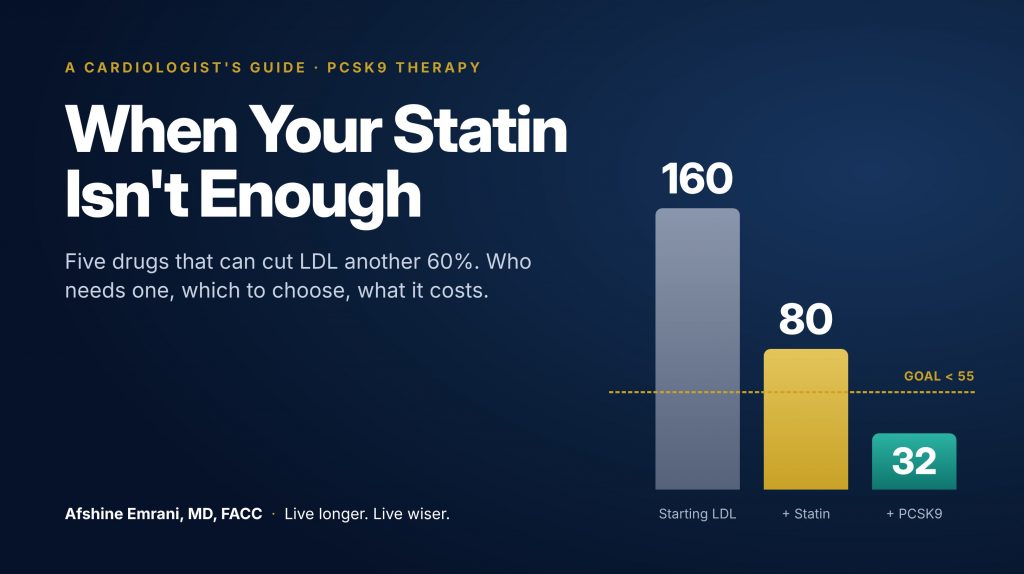
When Your Statin Isn’t Enough
Originally published on Substack.
I hear some version of this every week: “I take my statin every night. My LDL is still 112. Am I protected?” Often it comes from someone who runs four days a week and just scored over 400 on a coronary calcium scan. The statin is doing its job. It just isn’t enough.
That conversation is happening in cardiology offices everywhere, because the rules for lowering cholesterol changed more in the past year than in the previous ten. Here is what you need to know.
The 60-second summary
-
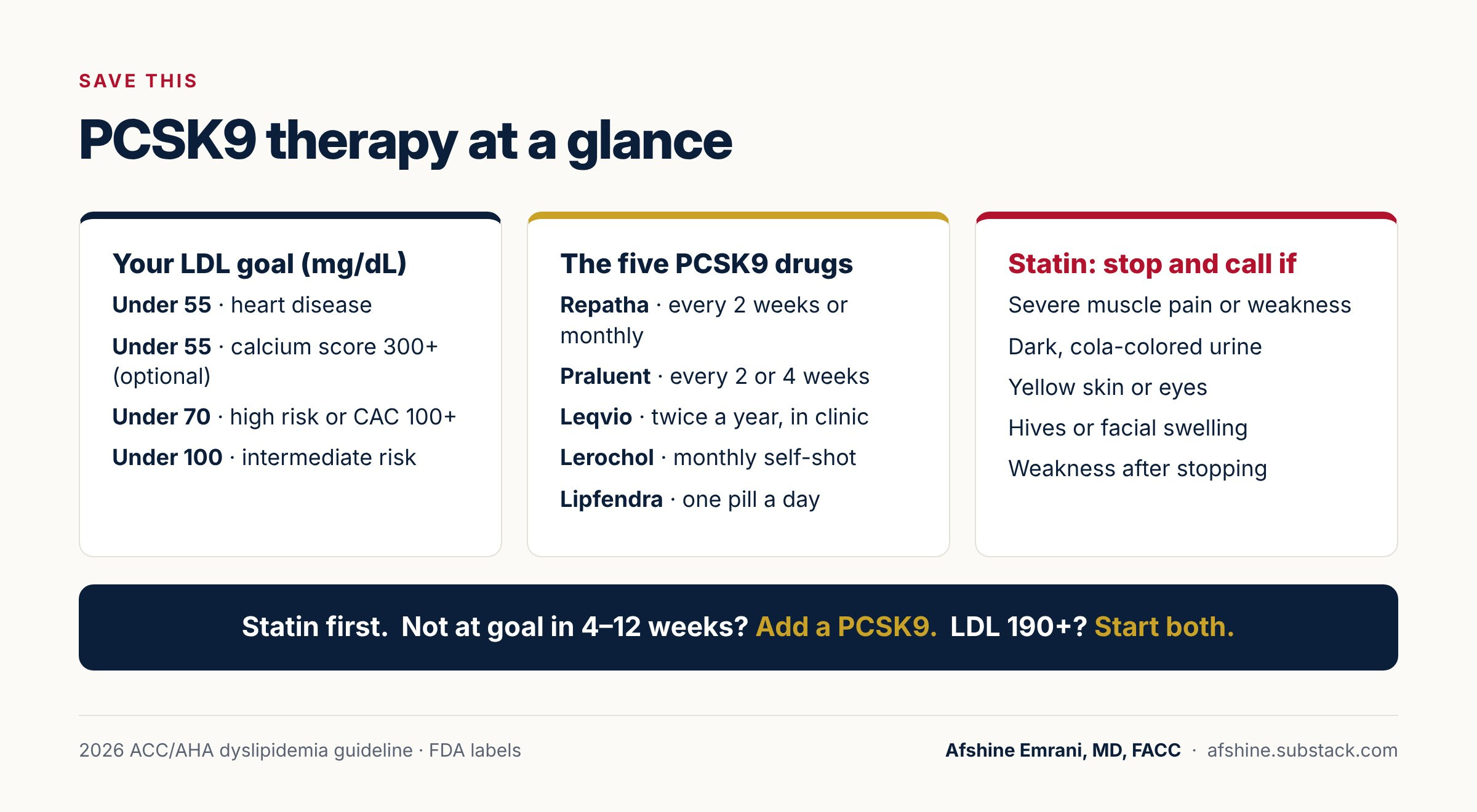
Lower targets. The 2026 ACC/AHA guideline sets LDL under 100 mg/dL for intermediate risk, under 70 for high risk, and under 55 for most people with heart disease.
-
Five PCSK9 drugs, including the first daily pill, approved in July 2026.
-
Proven outcomes. In VESALIUS-CV, evolocumab cut first heart attacks, strokes and coronary deaths by 25% in people who had never had one.
-
Lower prices. Cash programs now start around $239 a month.
-
Statins still come first for most people. A PCSK9 is the next step when they fall short.
Know two numbers: your LDL and your coronary calcium score.
How PCSK9 drugs work
Your liver clears LDL from the blood using receptors on its surface. PCSK9 is a protein that destroys those receptors. Block it, and the liver keeps pulling LDL out of circulation.
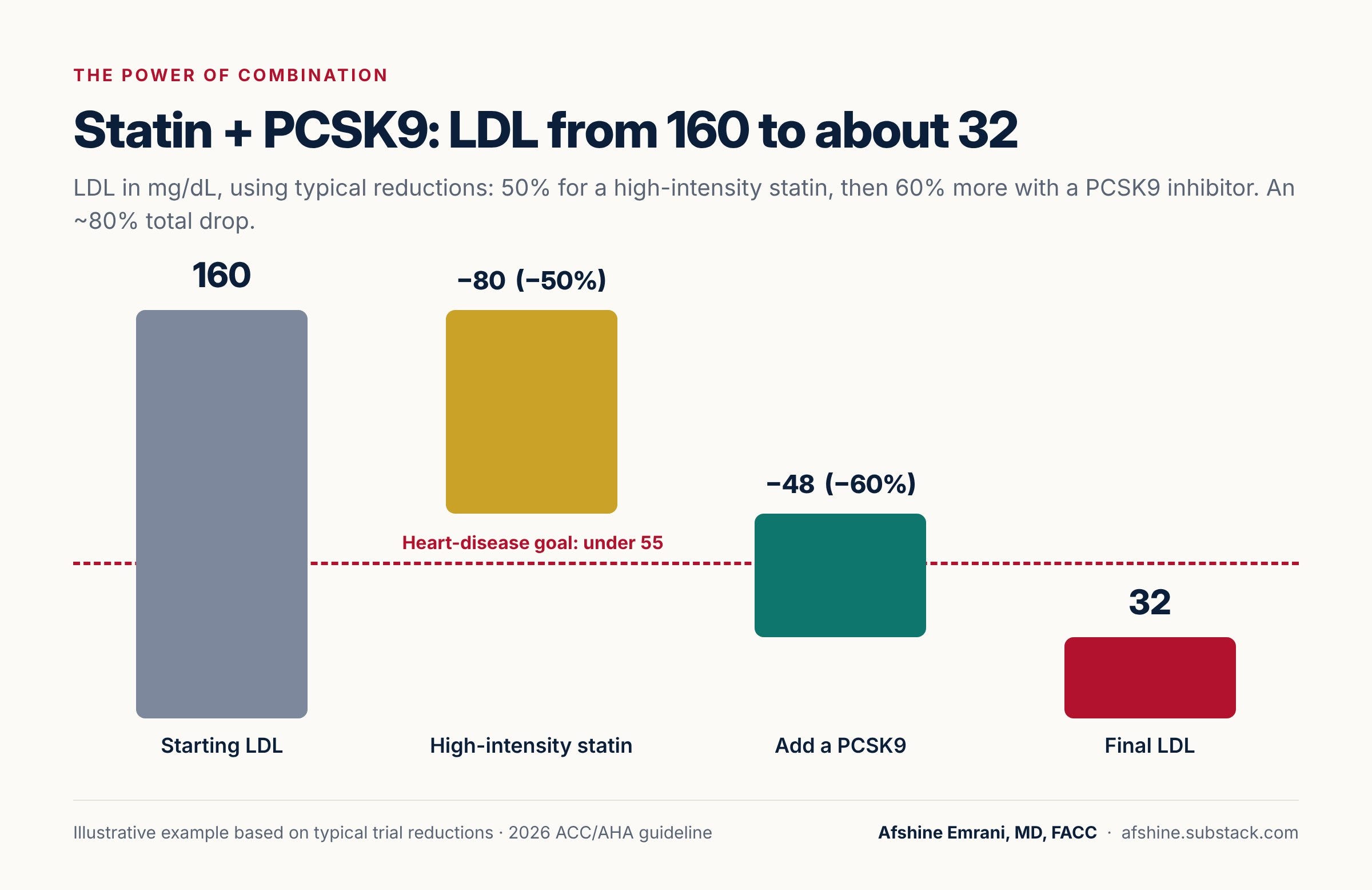
Statins prompt the liver to make more receptors, so the two stack. A statin lowers LDL 30–50%; a PCSK9 inhibitor lowers it another 50–60%. Nature ran the experiment first: people born with an inactive PCSK9 gene have lifelong low LDL and far less heart disease, with no apparent harm.
The five PCSK9 drugs
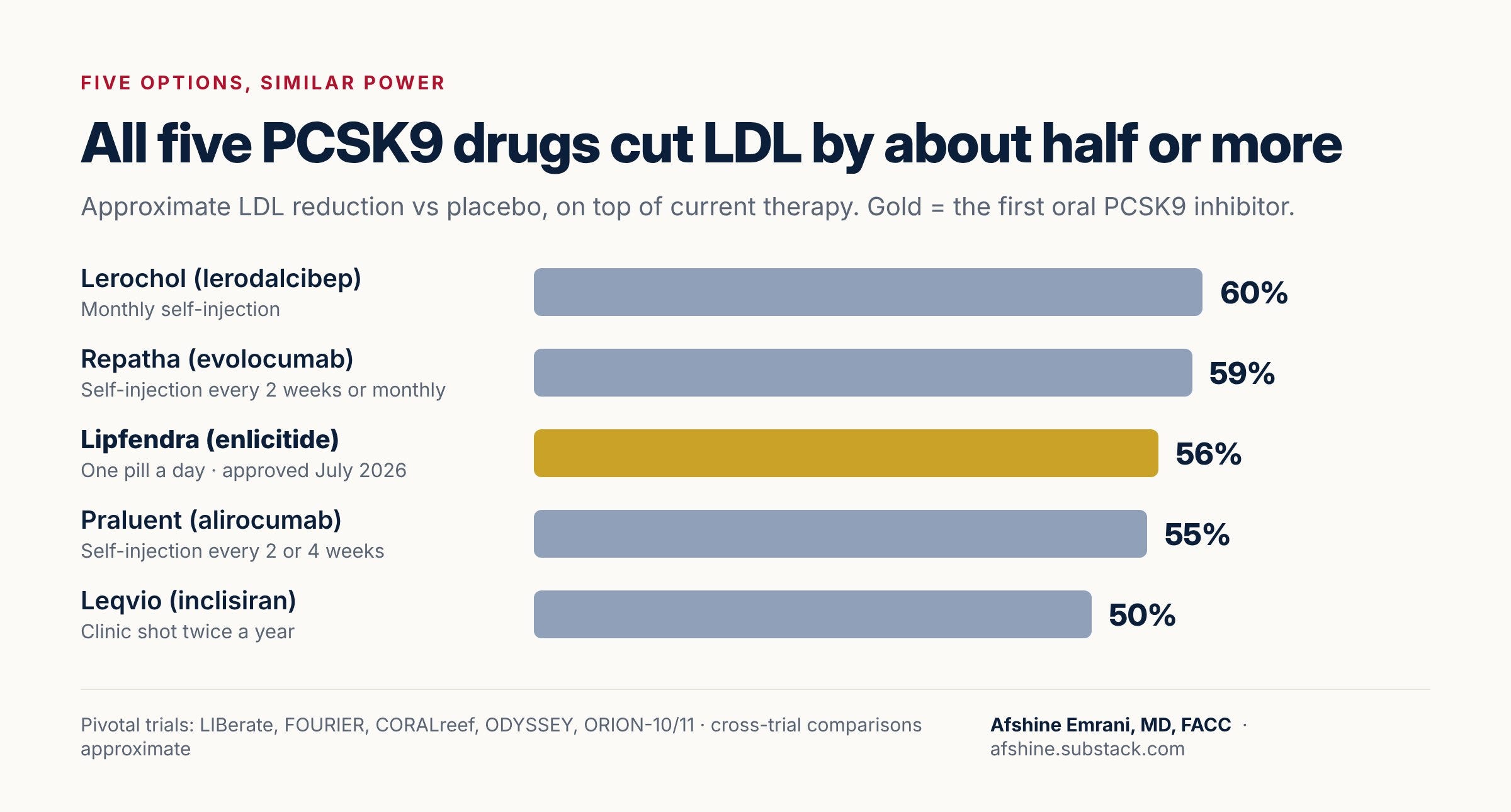
All five are FDA-approved. They differ less in power than in how you take them and how much outcome proof stands behind them.
-
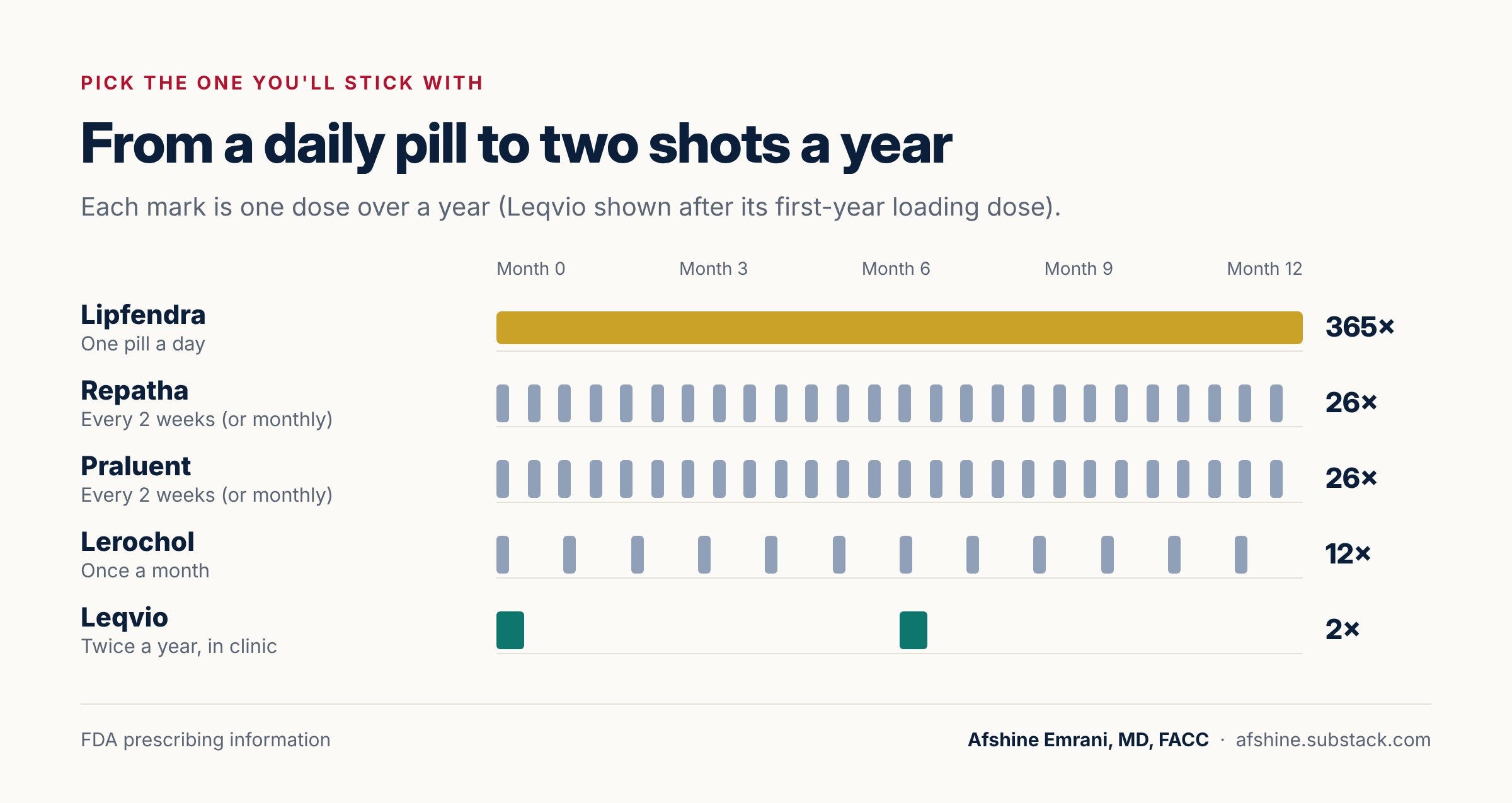
Repatha (evolocumab): the deepest evidence, and the only one proven to prevent a first heart attack or stroke. Self-injection every 2 weeks or monthly.
-
Praluent (alirocumab): an equivalent antibody, with strong data right after a heart attack. Every 2 or 4 weeks.
-
Leqvio (inclisiran): two clinic shots a year after loading. Its outcome trial, ORION-4, reports in early 2027.
-
Lipfendra (enlicitide): the first PCSK9 pill, for the needle-averse. Outcome trial under way.
-
Lerochol (lerodalcibep): monthly self-injection that keeps at room temperature for up to three months. Outcome data pending.
The benefit: fewer heart attacks and strokes
PCSK9 antibodies have prevented heart attacks and strokes in three landmark trials covering more than 58,000 patients.
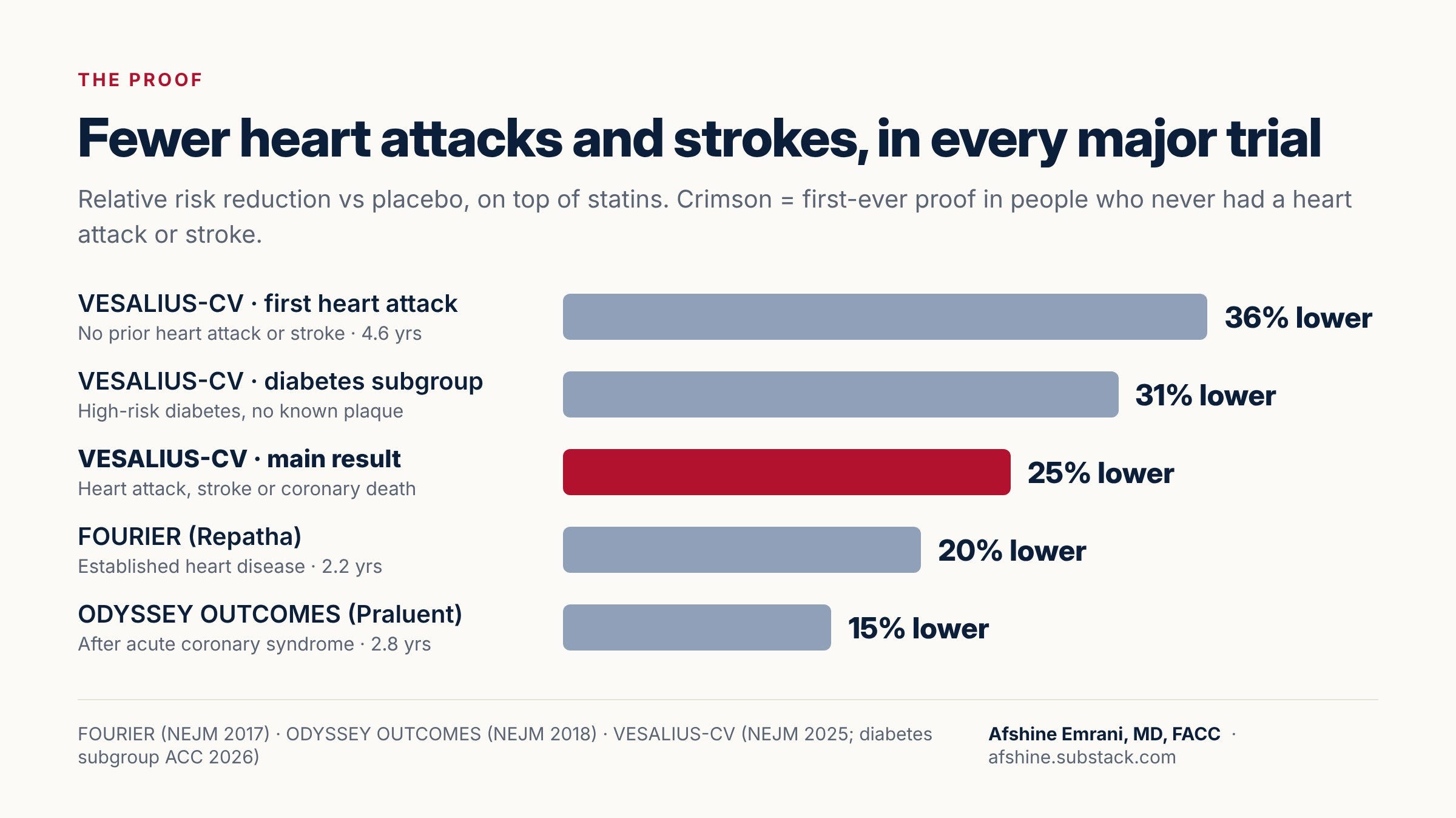
VESALIUS-CV is the one to know. It enrolled 12,257 high-risk people who had never had a heart attack or stroke, all already on standard therapy with LDL of at least 90 mg/dL. Over a median 4.6 years, evolocumab drove median LDL to about 45 mg/dL and cut heart attack, stroke or coronary death from 8.0% to 6.2%. Heart attacks alone fell 36%. The lesson: lower is better, and earlier is better.
Relative risk makes headlines. Absolute risk makes decisions:
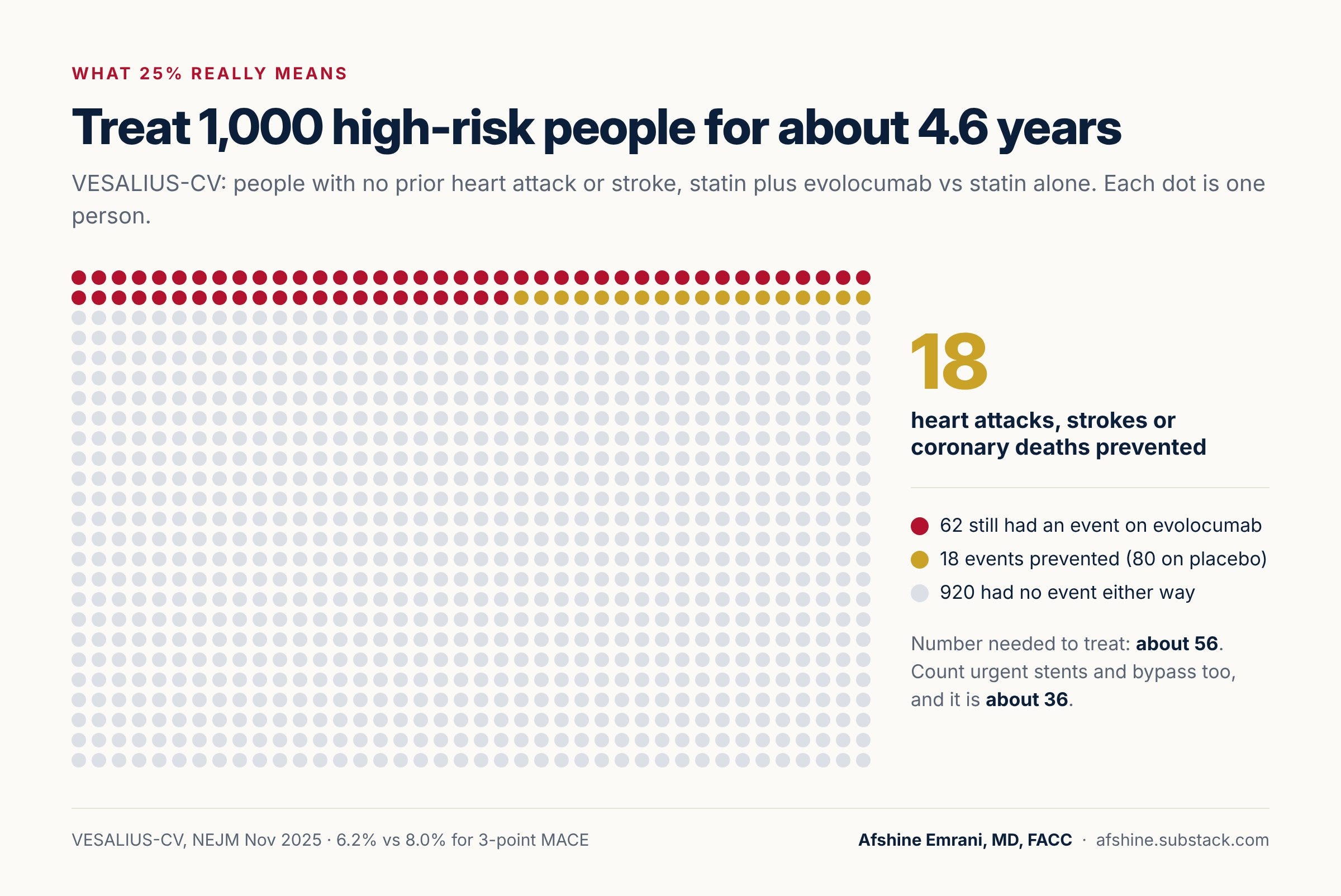
The higher your starting risk, the fewer people need treatment to prevent one event. That is why the payoff is greatest with known plaque, a high calcium score, or long-standing diabetes.
The risks
PCSK9 inhibitors have one of the cleanest safety records in cardiology. In VESALIUS-CV, safety events matched placebo.
-
Injection-site reactions and occasional cold-like symptoms with the injectables.
-
With the pill, diarrhea and dizziness were somewhat more common than placebo in one trial.
-
Not shown: diabetes, muscle or liver damage, or memory problems (tested directly in the EBBINGHAUS study).
-
Caveats: Leqvio, Lerochol and Lipfendra don’t yet have outcome data; these drugs are stopped before pregnancy; and the benefit ends when you stop the drug.
The costs
PCSK9 drugs launched in 2015 at about $14,500 a year. Today, U.S. list or cash prices look like this:
-
Generic statin: $4–30 a month. Still the best value in medicine.
-
Repatha via AmgenNow (cash, direct): about $239 a month, no insurance needed.
-
Lipfendra (pill): about $315 a month list.
-
Praluent: about $490–580 a month list.
-
Repatha through insurance: about $573 a month list; copay cards can cut commercial costs sharply.
-
Leqvio: about $3,250 a dose, usually billed to the medical benefit.
Insured patients rarely pay list price. Lerochol pricing is not yet widely published.
Getting insurance to say yes
Most denials are paperwork denials. Give your doctor’s office:
-
Your diagnosis in writing: heart disease, familial hypercholesterolemia, or a calcium score report
-
Two recent LDL results on treatment, above goal
-
Every statin tried: name, dose, how long, and what happened
-
Ezetimibe tried, or why not
-
The guideline LDL goal and the trial that supports it
If denied: request a peer-to-peer review, appeal with the missing documents, ask which PCSK9 your plan prefers, consider Leqvio (a different approval pathway), or use a cash program. Copay cards generally can’t be used with Medicare.
When to add a PCSK9 to your statin
When your statin hasn’t brought you to goal within 4 to 12 weeks and you’re far from target, or your risk is very high. The 2026 guideline gives this its strongest (Class I) recommendation for people with heart disease.
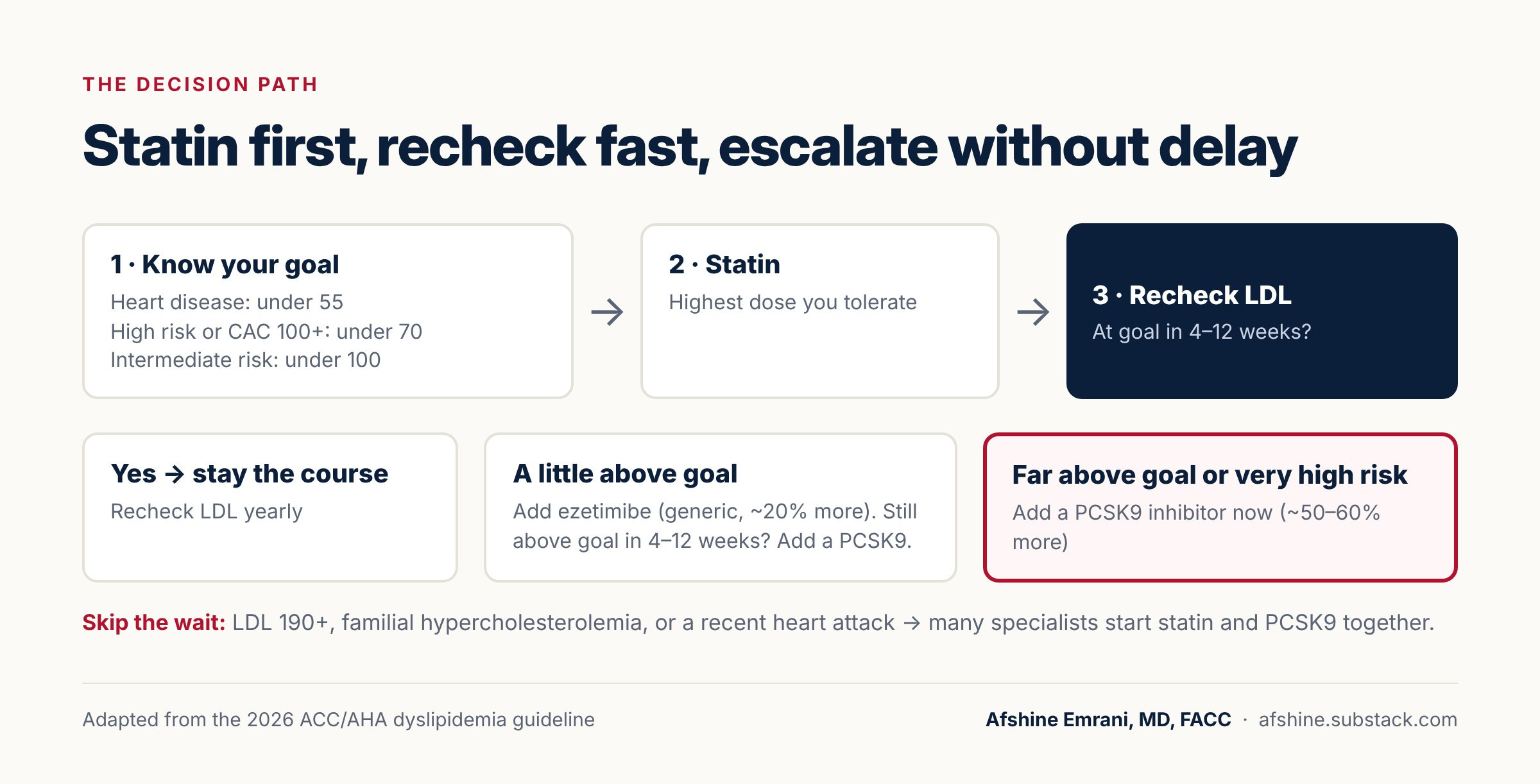
Most likely to need the combination:
-
Established heart disease with LDL above 55 mg/dL
-
A coronary calcium score of 300 or more
-
High-risk diabetes (31% fewer first events in VESALIUS-CV)
-
LDL of 190 or higher, or familial hypercholesterolemia
-
High Lp(a): PCSK9 antibodies lower it about 25%
Rule of thumb: if you need to drop more than about 25% further, ezetimibe alone won’t get you there.
When to skip the statin entirely
Rarely, but without apology for the right person. A statin you can’t take protects no one. Go straight to a PCSK9 if you have:
-
True statin intolerance: symptoms on at least two statins, including low or every-other-day doses.
-
A serious statin reaction: muscle breakdown, autoimmune muscle disease, or liver injury.
-
A dangerous drug interaction, such as with cyclosporine or certain HIV or antifungal drugs.
-
Active liver disease.
-
An informed decision to decline statins. A PCSK9 alone beats nothing.
Start both together if your LDL is 190 or higher, you have familial hypercholesterolemia, or you’ve just had a heart attack. One honest caveat: most outcome data come from patients who were also on a statin.
Statin symptoms: when to call
Stop the statin and call your doctor today for:
-
Severe muscle pain or weakness, or trouble rising from a chair
-
Dark, cola-colored urine
-
Yellow skin or eyes, or pain under the right ribs
-
Weakness that persists weeks after stopping
-
Hives or facial swelling
Worth a conversation, not a panic:
-
Mild aches. In the SAMSON trial, about 90% of symptoms also appeared on placebo. Try another statin, a lower dose, or every other day, and check thyroid and vitamin D.
-
A small rise in blood sugar, mainly in people already near diabetes. The heart benefit outweighs it.
-
Memory complaints. Large studies show no lasting cognitive harm.
PCSK9 plus GLP-1: the power pairing
-
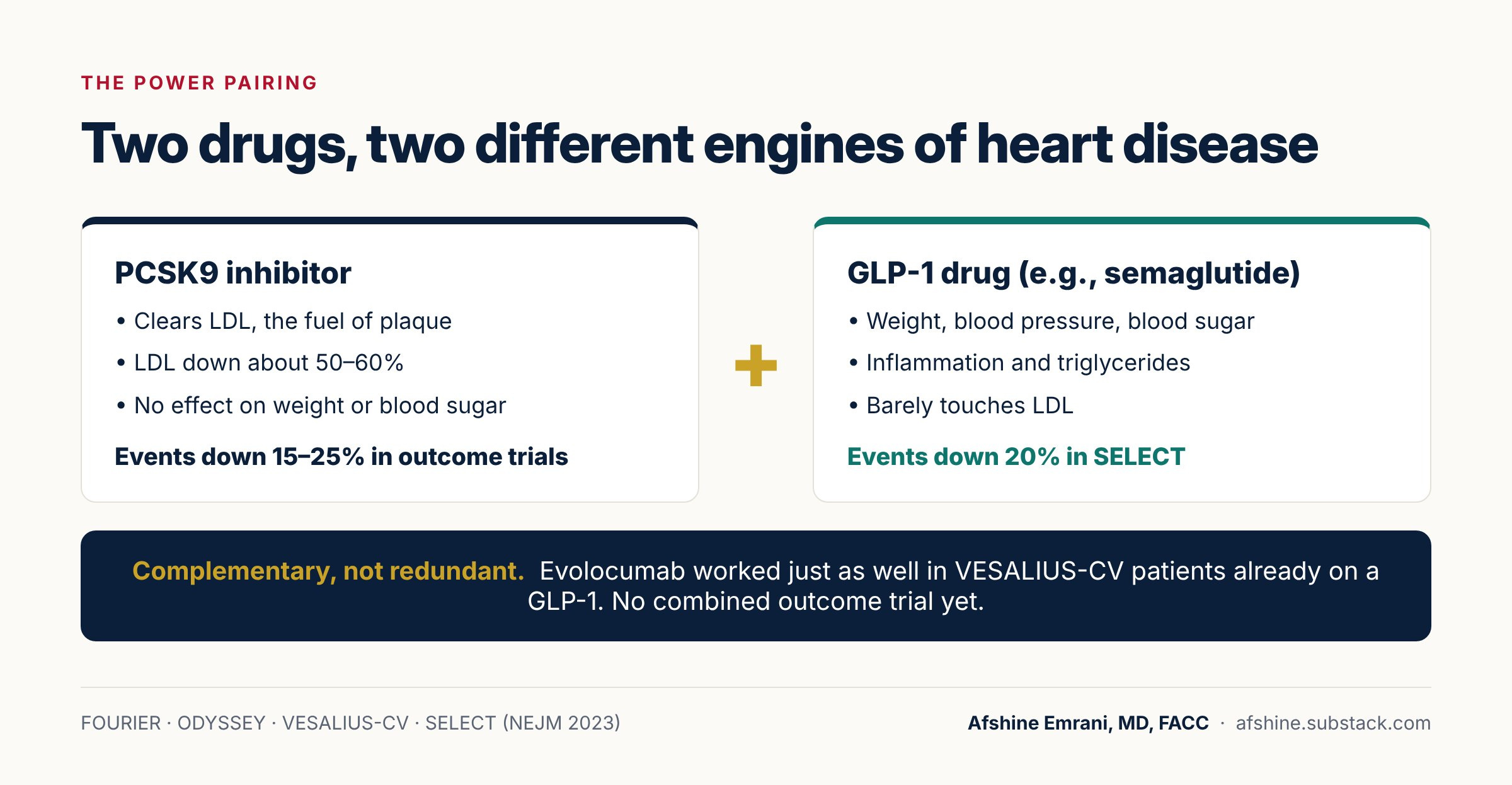
GLP-1s barely lower LDL, and PCSK9s do nothing for weight or blood sugar. Neither replaces the other.
-
In VESALIUS-CV, evolocumab worked just as well in people already taking a GLP-1 or SGLT2 drug.
-
In SELECT, semaglutide cut major cardiac events by 20% in people with heart disease and excess weight.
No trial has tested the combination head-on, so call it complementary, not proven synergy. It makes the most sense for people with heart disease or a high calcium score who also carry extra weight, diabetes, high blood pressure or fatty liver.
Three patients, three plans
Illustrative composites, not real patients.
1. Fit at 54, calcium score 410. LDL 112 on atorvastatin 40 mg. Goal: under 70, ideally under 55. Plan: maximize the statin, add a PCSK9 now, check Lp(a). A normal stress test does not rule out the plaque a calcium scan finds.
2. Age 61, diabetic, “can’t take statins.” Twelve years of diabetes with kidney involvement; three statins failed; LDL 148. Plan: rule out low thyroid and try a low or every-other-day dose, then a PCSK9 alone. Add a GLP-1 for weight, blood sugar and kidney protection.
3. Age 48, LDL 210, father’s heart attack at 50. Likely familial hypercholesterolemia. Plan: high-intensity statin plus ezetimibe now; add a PCSK9 if not at goal in 6–8 weeks. Screen siblings and children: half of first-degree relatives inherit it.
Your action list
Know these numbers: LDL · Lp(a), once in your life · ApoB if triglycerides are high · coronary calcium score · HbA1c and blood pressure.
Ask your cardiologist:
-
What is my LDL goal, and am I at it?
-
Would a calcium score change my treatment?
-
Is my Lp(a) high?
-
If my statin isn’t enough, ezetimibe or a PCSK9?
-
Which PCSK9 fits my life?
-
Would a GLP-1 add protection?
What’s coming in 2027
-
ORION-4 (~15,000 patients): first outcome data for twice-yearly Leqvio. Results expected early 2027.
-
PREVAIL: outcome results for obicetrapib, a new CETP-inhibitor pill already approved in Europe, expected Q1 2027.
-
OCEAN(a)-Outcomes: tests whether cutting Lp(a) by over 95% with olpasiran prevents events.
-
Lp(a)HORIZON: pelacarsen lowered Lp(a) dramatically but did not reduce events. Full results presented at AHA on November 7 confirmed it.
That last result is a reminder: lowering a number is not the same as preventing a heart attack. PCSK9 antibodies have proven both. Lp(a) testing still matters, because a high level tells you to treat LDL more aggressively.
The bottom line
Statins remain the foundation. For anyone who can’t reach goal on a statin, or can’t take one, PCSK9 inhibitors are now proven, safe, varied and affordable. In nearly thirty years of practice, I’ve watched heart attacks move from fate to choice. Act before the first symptom.
If this helped, share it with someone who takes a statin, and subscribe for more evidence-based guides like this one.
Live longer. Live wiser.
Blessings.
Afshine Ash Emrani, M.D., F.A.C.C.
Assistant Clinical Professor, UCLA David Geffen School of Medicine
Castle Connolly Top Doctor since 2008 · LA Magazine Super Doctor since 2010 · LA Style Top 100 Doctors in America 2024
doctoremrani.com · Longevity Unmasked
This article is education, not medical advice. Prices are U.S. list or cash prices as of November 2026 and change often. Never start, stop or change a medication without your own physician.
Key sources: 2026 ACC/AHA Dyslipidemia Guideline; VESALIUS-CV (NEJM 2025); FOURIER (NEJM 2017); ODYSSEY OUTCOMES (NEJM 2018); CORALreef (Lipfendra); LIBerate (Lerochol); ORION-4 design paper; SELECT (NEJM 2023); SAMSON (NEJM 2020); EBBINGHAUS (NEJM 2017); Lp(a)HORIZON (AHA 2026).